
Several years ago, scientists implanted four microelectrodes into the brain of a paralyzed man, and he regained the sense of touch through an electronic arm that was controlled by his thoughts. The implant was connected to the region where the neurons that control hand movements and touch are located, known as the Somatosensory Cortex.

A couple of years later, a pair of Pakistani engineers developed an artificial hand that worked through sensors being implanted where the brain sends electric currents or signals to fingers, commanding them to move. The user was able to control the hand by thought as well. However, no brain implant was necessary this time.

That same year, the world’s first mind-controlled robotic arm that worked without any implant at all was developed by other researchers. Their device used a noninvasive brain-computer interface to enable a person to move the prosthesis remotely by thinking about it.

This year, an international group of researchers reported the success of a mind-controlled arm that can experience sensations of touch and pressure. The years-long study – involving three Swedish patients who have been living with the device and using it in everyday life – proves the safety of the life-changing prosthesis.
Max Ortiz Catalan, the lead researcher on the study, said:
Right now, patients in Sweden are participating in the clinical validation of this new prosthetic technology for arm amputation. We expect this system to become available outside Sweden within a couple of years.
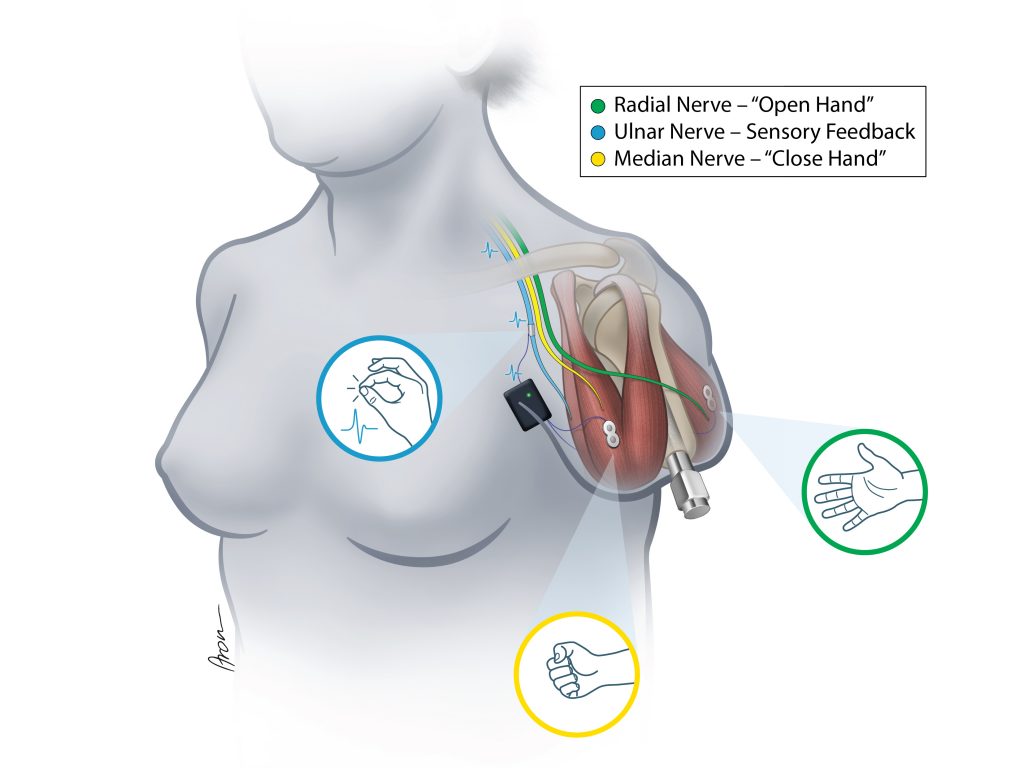
This is a new concept for artificial limbs is one of the world’s most integrated interfaces between humans and machines. It is called a neuromusculoskeletal prosthesis. It connects directly to the user’s nerves, muscles, and skeleton.
Catalan said:
Our study shows that a prosthetic hand attached to the bone and controlled by electrodes implanted in nerves and muscles can operate much more precisely than conventional prosthetic hands. We further improved the use of the prosthesis by integrating tactile sensory feedback that the patients use to mediate how hard to grab or squeeze an object. Over time, the ability of the patients to discern smaller changes in the intensity of sensations has improved.
The user can control the device in a realistic way, and the feeling is so lifelike and natural that no training is required. The nerve interface that transmits signals from the prosthesis to the brain is so detailed that the user can perceive individual fingers in real-time.
One of the study participants said:
The prosthesis has changed my life a lot. The traditional socket prosthesis I had before was a tool I wore. The new prosthesis does not feel like something I wear but as part of me. I use it all day, so for me, it’s so natural, it’s not something I really think about.

A 6- to 8-hour surgical procedure to connect nerves directly to the prosthesis is required. The prosthesis is anchored to the bone for stability, and electrodes are implanted into the muscles and nerves.
Catalan says they are currently working on similar technology for leg prosthesis. They have made considerable progress already and plan to implant it in a first patient later this year.


