
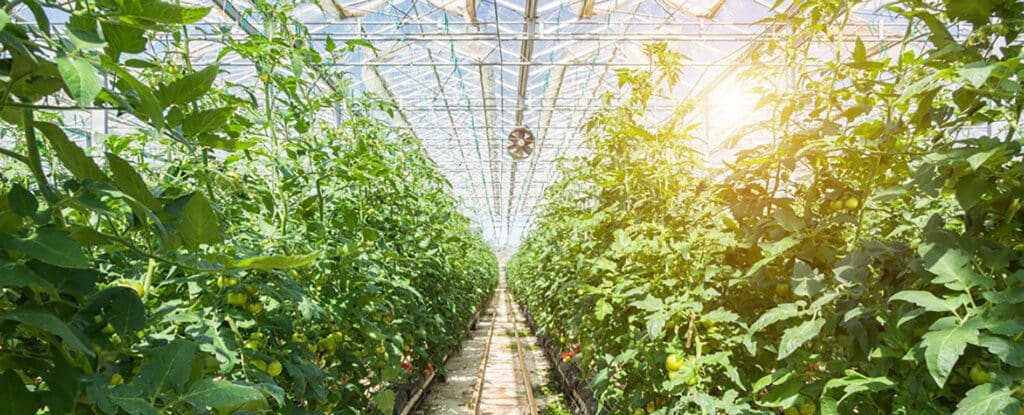
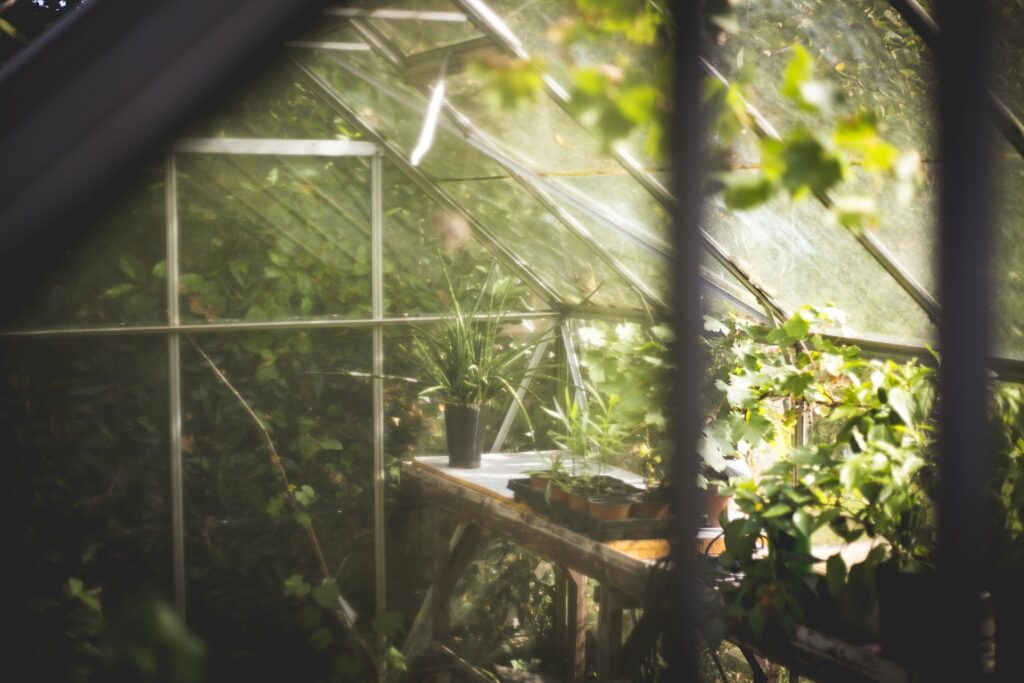
Greenhouse farming is an efficient method of food production. However, the needed electricity associated with greenhouse lighting sums up around 30% of its operating costs. In a study published on March 17, 2021, in Cell Reports Physical Science, NCSU researchers fitted greenhouses with semi-transparent solar cells. They found that it can generate electricity without affecting the plants’ health and growth, suggesting we could build energy-neutral greenhouses without hurting crops.
To determine whether the solar cells harm plants, the NCSU team tested groups of red leaf lettuce under different glass types and light wavelengths, keeping all other variables the same – such as CO2 concentration, temperature, and water supplies, and fertilizer.
The results showed that the lettuce grown under solar cells exhibited no significant difference in any crucial measurement, including size, weight, antioxidants, and CO2 absorption. The solar panels also helped regulate the greenhouse’s temperature.
Heike Sederoff, a plant biologist from North Carolina State University (NCSU), said:
We were a little surprised – there was no real reduction in plant growth or health. It means the idea of integrating transparent solar cells into greenhouses can be done.
The type of solar panels used in this research is semi-transparent organic solar cells (ST-OSCs) rather than the silicon-based type used in massive solar energy farms. ST-OSCs promise flexibility and can be adjusted to absorb different light wavelengths as needed, such as the wavelengths that plants don’t use for photosynthesis.
In the study, one lettuce control group was exposed to the entire spectrum of white light. In contrast, three other groups were grown under different light filters, simulating various ST-OSC absorption types and with blue light to red light-regulated in each filter.

Brendan O’Connor, a mechanical and aerospace engineer from NCSU, explained:
Not only did we find no meaningful difference between the control group and the experimental groups, but we also didn’t find any significant difference between the different filters.
The discovery is promising in terms of plant health and growth and for the future applications of ST-OSCs. Greenhouses have several benefits but require more energy than other farming methods. The solution to that could be transparent and semi-transparent solar cells.
For now, ST-OSCs don’t have the same sunlight-to-electricity conversion rates as conventional photovoltaic cells. However, they are continuously improving this, and eventually, they could be installed in many different scenarios, including home windows.
The NCSU team’s next step towards solar-powered greenhouses is to conduct further tests with crops like tomatoes and plants (other than lettuce).
O’Connor said:
Based on the number of people who have contacted me about solar-powered greenhouses when we’ve published previous work in this space, there is a lot of interest from many growers. I think that interest is only going to grow. We’ve seen enough proof-of-concept prototypes to know this technology is feasible in principle; we just need to see a company take the leap and begin producing to scale.
Earlier this year, we saw design student Eliza Hague from the University of Westminster produce a low-cost paper-like material from bamboo pulp to make sustainable inflatable greenhouses. The bamboo paper would be pre-assembled and transported flat to the site, then inflated and coated in shellac for weather-proofing.


