
Alaska Airlines Imagine Tomorrow is a competition designed to challenge 9th through 12th graders to seek new ways to support the transition to sustainability. Students are required to research complex topics related to sustainability, then innovate technologies, designs, or plans to mobilize behavior. Meanwhile, they naturally forge connections in their communities by working on their idea and inspire positive change. There are no limitations to what can be done – any solutions are limited only by imagination.
From last year’s competition, which took place at Washington State University in Pullman, 98 teams from across the Pacific Northwest presented their projects after months of preparation. When all was said and done, the scores were tallied and the winners were announced the same day. And the first-place prize in the Itron Food, Energy and Water Challenge was awarded to a team of four students from Ellensburg High School for their experiment with Styrofoam (polystyrene) eating larvae! Each student received $300 for their merit.
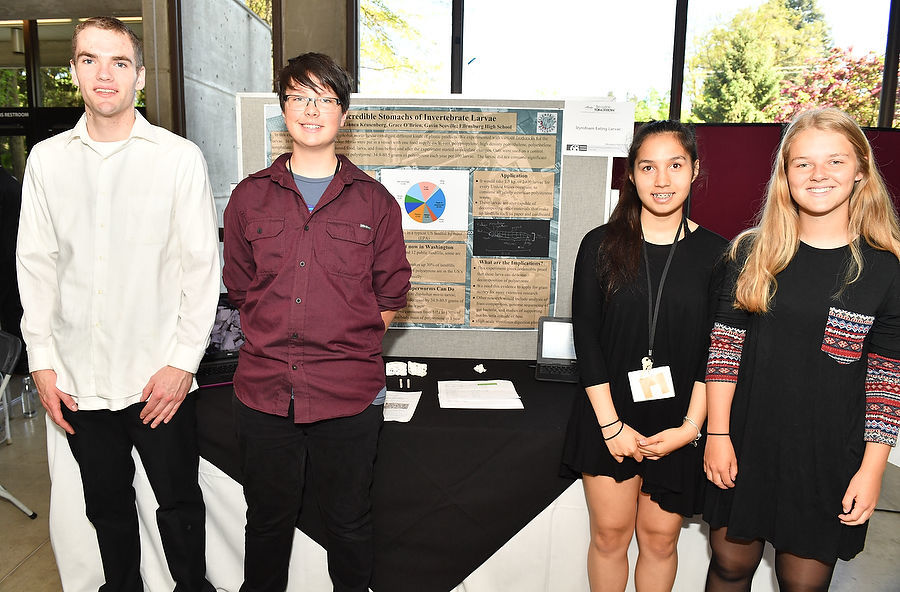
“What helped us was we had a legitimate experiment where we had as many controlled variables as possible and everything was like lab procedure,” said Gavin Scoville, one of the students from the winning team. “We had a well put together poster and we talked precisely.”
The teammates are all members of the Environmental Club at EHS. One day they learned about a Stanford study about how mealworms could eat small amounts of styrofoam and became inspired to do some research about it too. They were encouraged by their teacher Jeff Hashimoto to do it and enter the competition with their findings.

Scoville said that the first thing they did was go to the pet store to buy mealworms and Superworms to test on the polystyrene or Styrofoam. They set up one-liter Mason jars and massed the styrofoam and massed the worms and monitored as the styrofoam disappeared. “Superworms ate a lot faster and they were twice as efficient,” Scoville said.


