
The brain-machine interface (BMI) is an incredible technology in development with a wide range of applications. It can do everything from creating a sixth sense to controlling hearing aids and allowing people to move and control objects with their minds. Each of the different possible applications gets focused on individually. The technology is still in its infancy but has proven to work on several accounts.
One such application area focuses on using a BMI to enable people with physical disabilities such as spinal injuries to more easily interact with their environment by controlling a wheelchair, interacting with a computer, or operating small robots. The BMI used was a large bulky system called an electroencephalograph (EEG) – a cap that covers the entire head and can measure EEG signals. It worked but it’s so big that it doesn’t necessarily make it easier to interact with the environment… at least not comfortably.

Taking things to the next level, a team of researchers from the Georgia Institute of Technology, the University of Kent, and Wichita State University collaborated to make the device more discreet and usable in everyday situations by miniaturizing the technology. Together, they were able to develop a portable EEG system that can be attached unobtrusively at the base of the neck.
The system is comprised of flexible, wireless sensors that come as a patch that can be attached to the skin, along with other electrodes held in place by a headband. The flexible patch processes the EEG data and then sends the data wirelessly to a computer via Bluetooth. It can transmit data from their thoughts to distances of up to 15 meters.
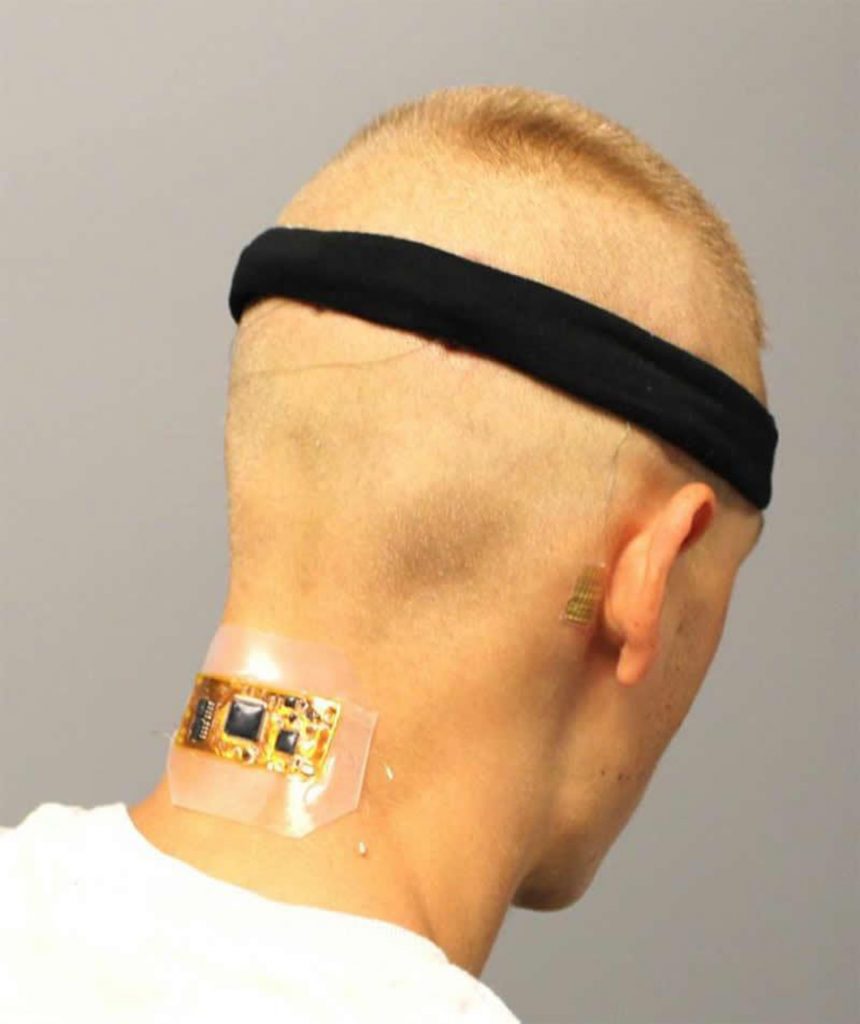
Woon-Hong Yeo, an assistant professor at Georgia Tech’s School of Mechanical Engineering and Department of Biomedical Engineering said in a statement:
This work reports fundamental strategies to design an ergonomic, portable EEG system for a broad range of assistive devices, smart home systems, and neuro-gaming interfaces. The primary innovation is in the development of a fully integrated package of high-resolution EEG monitoring systems and circuits within a miniaturized skin-conformal system.
To test the system out, the team had six able-bodied participants try it out. The tests demonstrated that they could use it to control an electric vehicle and a small robotic vehicle with just their thoughts. The research has been published in the journal Nature Machine Intelligence.
At the moment, they are further improving the electrodes. Then, the next phase of testing with the revised system will be with people with motor impairments. This device is truly wonderful as it could be a way for people with disabilities to interact with computers and machines in a more comfortable and practical manner. “This miniaturized, wearable soft device is fully integrated and designed to be comfortable for long-term use,” Yeo said.


