
Imagine a world where go-karts, the speedy little vehicles adored by kids and adults alike, are not only fun but also eco-friendly. Thanks to the brilliant minds of students across the U.S., this vision is becoming a reality. With hydrogen, the most abundant element in the universe, winning the race for clean energy, young innovators are putting the pedal to the metal to create hydrogen-powered go-karts. Let’s delve into how these projects are shaping the future and the potential for hydrogen technology.

The Spark of Innovation: Davidson College’s Hydrogen Go-Kart
At Davidson College, a liberal arts institution known for its broad curriculum rather than technical engineering, a trio of physics majors dared to dream big. Mallory Justis, Branner D’Amato, and Pat Kielb took on the challenge of building a hydrogen-powered go-kart. Their adventure began with the idea of integrating a hydrogen fuel cell to charge the kart’s batteries.
An Ambitious Project
Armed with $5,000 and a donated go-kart body, the team embarked on their project. Their goal was straightforward—to create an electric go-kart powered not by a wall outlet but by a hydrogen fuel cell. Yet, things didn’t go exactly as planned. The fuel cell they acquired only provided a tiny current, meaning it would take weeks just to fully charge the batteries.
Despite this setback, their ingenuity shone through. They created two versions of the go-kart: a miniature RC kart and a full-sized one equipped with a safe charging system. Their efforts culminated in an exciting display at the Verna Miller Case Symposium, proving that even at a liberal arts college, engineering projects can thrive and inspire.
Young Talent Shines: Centralia High School’s Hydrogen Kart
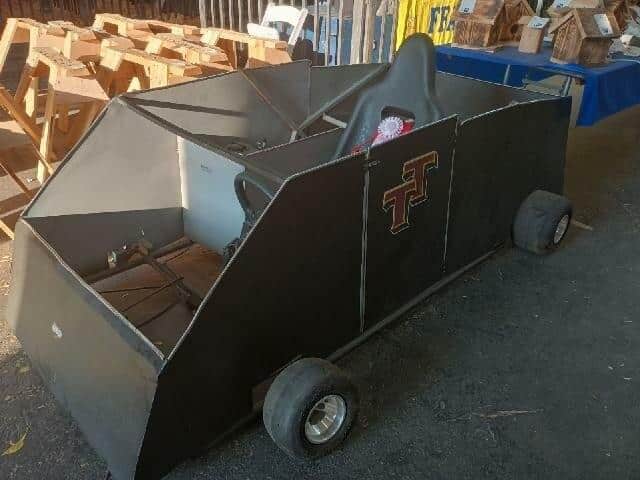
Pedro Picazo, a high school junior from Centralia, Washington, is another name making waves in the hydrogen-powered kart community. Sparked by fascination when he first saw his cousin’s hydrogen fuel cell-powered Toyota Mira, Pedro’s journey into hydrogen technology began in earnest.
Engineering against Odds
Supported by his science teacher and driven by a passion for renewable energy, Pedro Picazo embarked on a challenging project: converting a traditional combustion engine to operate on hydrogen. His success in this endeavor was not only a personal victory but also garnered recognition at local fairs for his impressive innovative creation.
Pedro’s hydrogen-powered go-kart transcends the scope of a mere school assignment. It highlights the promising potential for future zero-emission vehicles. Currently, Pedro is focused on a more ambitious goal—constructing a street-legal hydrogen vehicle. Additionally, he is actively collaborating with local authorities to set up a hydrogen fueling station in Centralia, steadily turning his vision into reality.

Advanced Technology: LiquidPiston’s X-Engine
While student projects bring theoretical concepts to life, companies like LiquidPiston are advancing hydrogen technology to new heights. LiquidPiston has engineered a hydrogen-powered go-kart utilizing their state-of-the-art rotary engine, the X-Engine.
Revolutionary Rotary Engines
Traditional engines are typically heavy, but the X-Engine by LiquidPiston is uniquely lightweight at just 2 kilograms. Unlike standard engines that ignite hydrogen at a single point, the X-Engine ignites it at three distinct points. This design enhances efficiency and performance. Additionally, the go-kart features regenerative braking, which recharges the battery each time the driver decelerates.
Although initial tests revealed slower-than-anticipated speeds, the potential applications of LiquidPiston’s technology extend far beyond go-karts. In both aviation and automotive industries, their hydrogen-powered rotary engines herald a future where vehicles are lighter, faster, and emission-free.

Future for Hydrogen-Powered Go-Karts
So, what does the future hold for hydrogen-powered go-karts and the broader applications of this technology? Here are a few possibilities:
Educational Tools
Hydrogen-powered go-karts present an exceptional opportunity for education. They offer practical lessons in renewable energy, engineering, and sustainability. These projects can ignite interest in STEM fields—Science, Technology, Engineering, and Mathematics. Engaging with this technology inspires students, fostering the next wave of innovators.
Zero-Emission Transportation
As demonstrated by LiquidPiston and the forward-thinking projects of Pedro Picazo, hydrogen engines have the potential to transform the transportation industry. These engines could lead to the development of street-legal hydrogen vehicles that emit only water vapor. This innovation would significantly reduce air pollution and decrease our dependence on fossil fuels.
Renewable Energy Integration
Integrating hydrogen technology with renewable energy sources, such as solar or wind, could create a fully sustainable energy solution. Hydrogen produced through these renewable methods can power engines without generating any carbon emissions. This approach offers a practical pathway toward a future with significantly reduced environmental impact.
Students from Davidson College and Centralia High School, along with companies like LiquidPiston, lead the charge with hydrogen-powered go-karts.

A Bright, Green Future
Students from Davidson College and Centralia High School, along with innovative companies like LiquidPiston, are leading the charge toward sustainable transportation. Their work with hydrogen-powered go-karts underscores the practicality and advantages of using hydrogen as an alternative fuel source.
These hydrogen-powered go-karts are more than just advanced projects; they symbolize the beginning of a new age in transportation. Innovation often originates in small, passionate settings in college labs or high school workshops. The next generation of problem solvers and visionaries ignites the drive for a cleaner planet.
So, when you see a go-kart speeding by, consider this: it could be a glimpse into the future of transportation powered by hydrogen—the most abundant element in the universe.


