
The world’s first hydrogen-powered passenger trains are here.
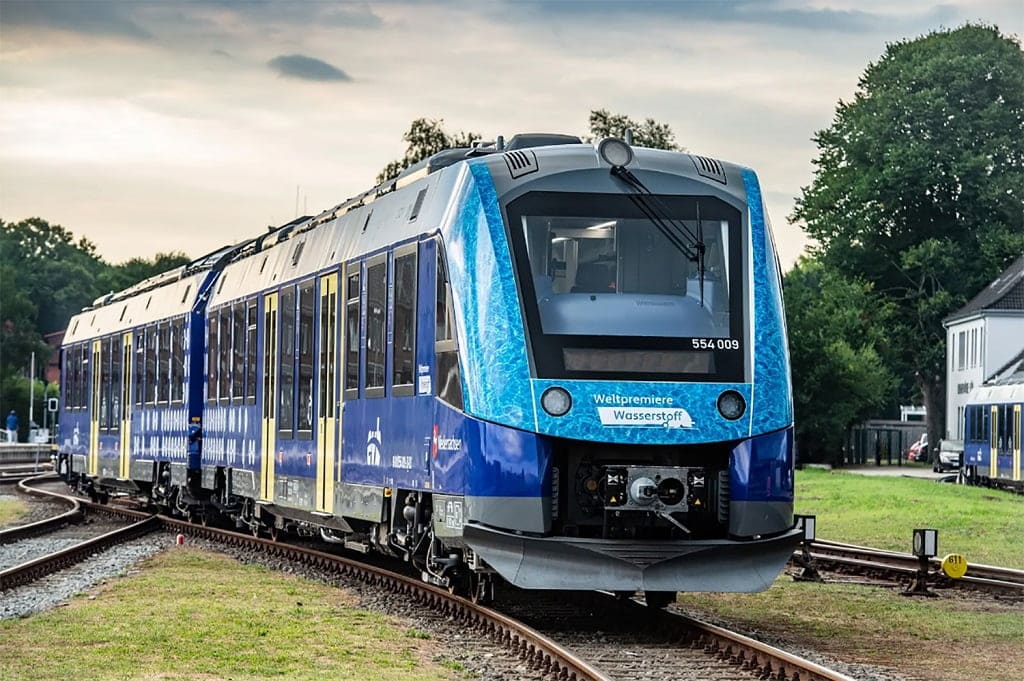
Four years after launching a two-year operational trial run in Germany, several Coradia iLint hydrogen fuel-cell trains have started carrying passengers on a 100% hydrogen track in Lower Saxony.
The passenger service trial began in September 2018 and lasted almost two years. It involved successfully running two pre-series Coradia iLint hydrogen fuel-cell trains over an existing route run by Eisenbahnen und Verkehrsbetriebe Elbe-Weser (EVB).
The project is officially in public service and has expanded to 14 hydrogen-powered passenger trains produced by Alstom engineers in the traction systems plant in Tarbes, France, and the regional trains facility in Salzgitter, Germany. The Lower Saxony Ministry of Transport purchased the trains and are now under the ownership of the state-run Landesnahverkehrsgesellschaft Niedersachsen mbH (LNVG) railway authority. LNVG started searching for alternatives to diesel trains a decade ago and has committed to only acquiring non-diesel (battery electric or hydrogen fuel cell) trains moving forward.

Carmen Schwalb, Chief Executive Officer of the rail operator LNVG, commented last year:
“After 18 months in passenger service, we are very pleased with the performance of the Alstom Coradia iLint fuel cell hydrogen trains. The technology is now tried and true, ticking all boxes: sustainability, economic viability, and customer satisfaction.”
Each train is expected to run on only one tank of hydrogen for a full day’s service over the route between Buxtehude, Bremervörde, Bremerhaven, and Cuxhaven emitting only steam and condensed water.
The trains have a range of 620 miles (1,000 kilometers) on a single tank of hydrogen. According to reports, the (EVB) network’s regular travel speed is 50 to 74.5 mph (80 to 120 km/h), but the trains can reach a maximum speed of 87 mph (140 km/h).
In addition, each hydrogen passenger train will receive a daily top-up at the Bremervörde Linde hydrogen filling station, which has six hydrogen compressors, 64 high-pressure (500-bar) storage tanks, and two fuel pumps. Using “electrolysis and regeneratively generated electricity,” hydrogen will be produced locally in the future.

According to EVB, five of the Coradia iLints are currently in use. The remaining units are expected to join the fleet by the end of 2022, replacing the network’s 15 diesel trains and saving approximately 1.6 million liters of diesel and 4,400 tonnes of CO2 annually.
“Emission-free mobility is one of the most important goals for ensuring a sustainable future, and Alstom has a clear ambition to become the world leader in alternative propulsion systems for rail,” says Henri Poupart-Lafarge, CEO and Chairman of the Board of Alstom. “The world’s first hydrogen train, the Coradia iLint, demonstrates our clear commitment to green mobility combined with state-of-the-art technology. We are very proud to bring this technology into series operation as part of a world premiere, together with our great partners.”
The German government supported the project financially, which provided funding for the development of the Coradia iLint via the National Innovation Programme for Hydrogen and Fuel Cell Technology (NIP).
Stephan Weil, the Minister-President of Lower Saxony, said:
“This project is setting a global example, it is an outstanding example for a successful transformation that is Made in Lower Saxony. As a renewable energy state, we mark another milestone on the road to climate neutrality in our transport sector.”
Besides Lower Saxony, Alstom has contracts to provide 27 Coradia iLint hydrogen fuel-cell trains to the Frankfurt metropolitan area, six Coradia Stream hydrogen trains for the Lombardy region in Italy, and twelve Coradia Polyvant hydrogen trains for various areas of France. The company has also conducted operational trials in the Netherlands, Poland, Austria, and Sweden.
Sustainable train operations are popping up around the world. Earlier this year, Australian mining company Fortescue Metals Group announced its commitment to making its operations eco-friendly by 2030. On March 1, the company announced its first project: the world’s first electric “Infinity Train” that charges itself using gravity and can transport tons of iron ore without ever needing to be charged.


