
Scientists have been creating fascinating solar cell ideas that don’t require the sun in recent years. From anti-solar panels that generate electricity in the dark of night to indoor organic solar cells and flexible perovskite photovoltaics optimized to convert ambient indoor light to electricity, sunlight won’t be necessary soon. The latest concept to add to the list is a device that harnesses the darkness of shadows to generate electricity.
A team of researchers from NUS Physics and NUS Materials Science and Engineering created a shadow-effect generator (SEG) – a device that uses the contrast in illumination between shadowed and lit areas to generate electricity. Like the organic solar cells, their invention is an approach that enables clean energy production under indoor lighting conditions to power electronics.
Study leader Tan Swee Ching, an Assistant Professor at NUS Materials Science and Engineering, explained:
Shadows are omnipresent, and we often take them for granted. In conventional photovoltaic or optoelectronic applications where a steady source of light is used to power devices, shadows are undesirable since it degrades the performance of devices. In this work, we capitalized on the illumination contrast caused by shadows as an indirect power source. The contrast in illumination induces a voltage difference between the shadow and illuminated sections, resulting in an electric current. This novel concept of harvesting energy in the presence of shadows is unprecedented.
Smartphones, smart e-watches, and other mobile electronic devices need an efficient and continuous power supply. Since they’re worn and used indoors and outdoors, typical solar panels aren’t suitable. The wearable power source has to be something that harnesses ambient light and no light as well. That’s why the NUS team’s new approach to scavenger energy from shadows and illumination associated with low-light intensities is so exciting. It can maximize the efficiency of clean energy harvesting.
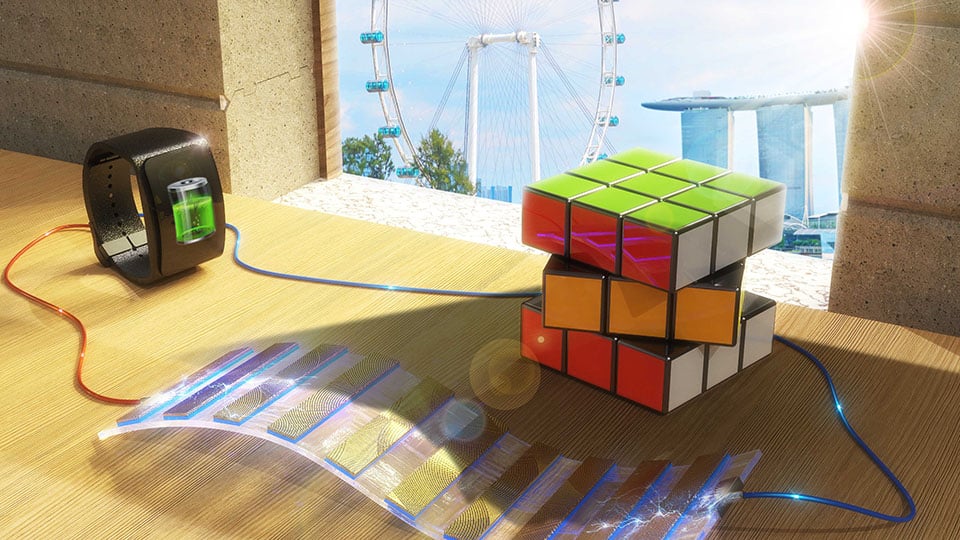
The SEG is low-cost and easy to fabricate. It consists of a set of SEG cells arranged on a transparent and flexible plastic film. Each cell is a thin gold film deposited on a silicon wafer.
The device performs two functions:
- It converts illumination contrast from partial shadows castings into electricity, and
- it serves as a self-powered proximity sensor to monitor passing objects.
The team tested the SEG’s performance as a self-powered sensor and in its ability to generate electricity. They ran laboratory experiments on a four-cell SEG and found it to be twice as effective as commercial silicon solar cells under the effect of shifting shadows. The harvested energy was enough to power a 1.2V digital watch.
Co-leader Andrew Wee, a Professor at NUS Physics, said:
When the whole SEG cell is under illumination or in shadow, the amount of electricity generated is meager or none at all. When a part of the SEG cell is illuminated, a significant electrical output is detected. We also found that the optimum surface area for electricity generation is when half of the SEG cell is illuminated and the other half in shadow, as this gives enough area for charge generation and collection respectively.
The SEG also worked as a self-powered sensor for monitoring moving objects. When an intermittent shadow fell upon the device as an object passed, the device began recording the thing’s presence and movement.
The NUS team’s next phase of research will be to experiment with other materials to reduce the device’s cost.


