
Predictable pay cycles rarely match the chaos of real-world expenses. Income shifts and early bill arrivals often disrupt standard plans. Climbing interest rates break traditional budgets that rely on perfect stability.
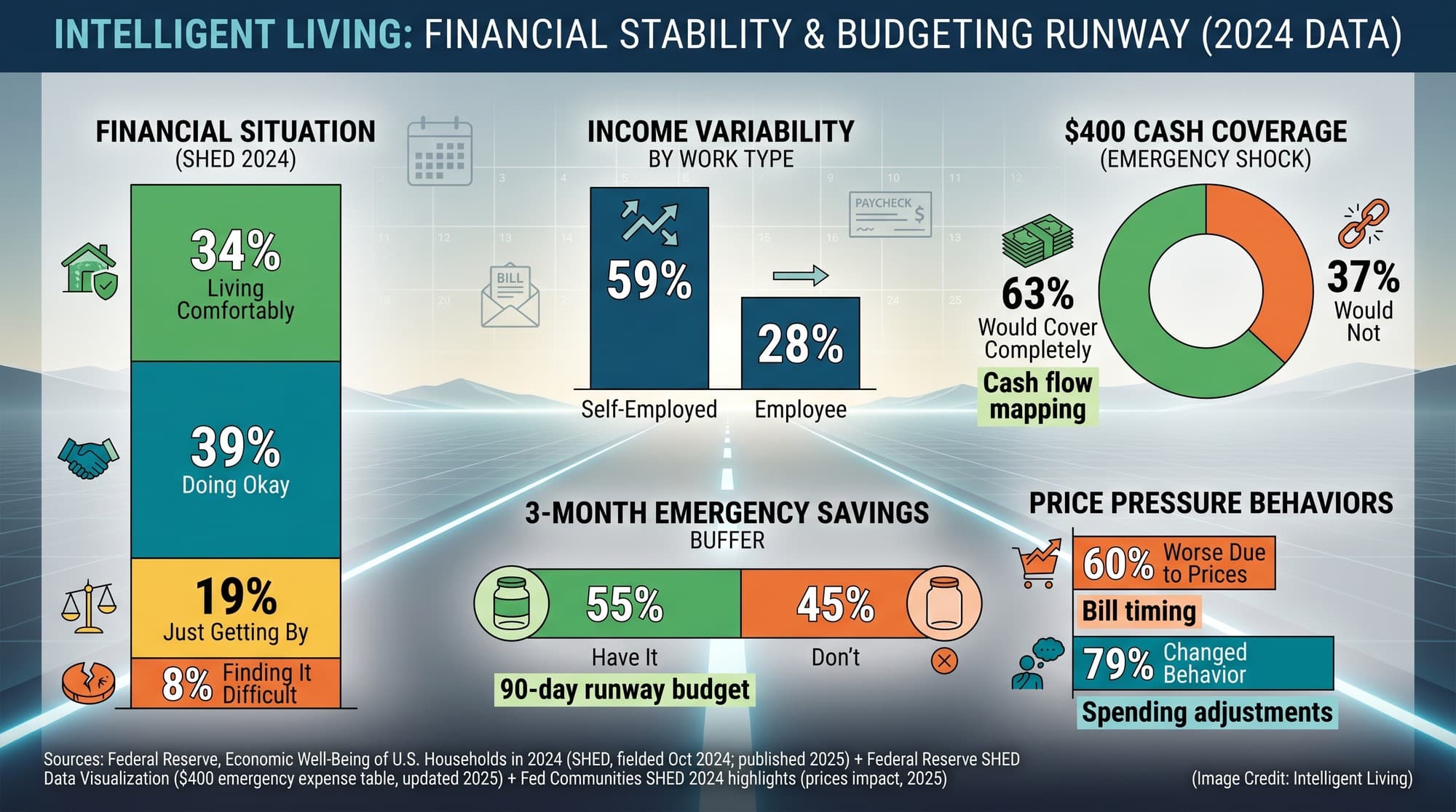
Rising living costs are primary sources of stress, and current data on household economic well-being highlights how timing gaps turn standard months into financial emergencies.
Establishing a 90-day view stress-tests your plan against realistic scenarios while fostering long-term household economic security through proactive app hygiene. This proactive method allows for income volatility smoothing, ensuring that essential obligations stay funded even when earnings fluctuate or costs spike unexpectedly. Add a quarterly open finance permission audit, and the system reduces not only cash flow strain but also digital risk exposure.
Building a 90-day view stress-tests your plan against realistic scenarios while trimming digital risk exposure through proactive app hygiene.

90-Day Runway Budget Quick Facts: Cash Flow, Bill Timing, Scenario Planning, and Permission Cleanup
These quick facts are the working parts of a 90-day runway budget. These core principles focus on cash flow budgeting that matches the unpredictability of real life, particularly during income shifts or surprise expenses.
- A 90-day runway budget focuses on timing and coverage, not daily transaction tracking.
- Income variability is common, which makes three-month cash flow mapping more realistic than strict monthly budgeting.
- A bill calendar reveals fee-risk weeks when due dates collide with low cash balances.
- Scenario sliders help answer questions like what happens if income drops next month or how a rate change affects minimum payments.
- Emergency funds act as shock absorbers for job loss or surprise expenses.
- Connected app permissions can be audited and trimmed so old links do not quietly pile up.
- Using a visual bill tracking tool makes it easier to spot the weeks that need a plan before they turn into fees.
Treat this list like a checklist for stability rather than a list of rules. The rest of the article shows how to put each piece in place without turning everyday life into a constant expense-tracking project.
The Runway Budget Mindset: Timing, Coverage, and the 90-Day Horizon
Timing Gaps Obscure Real-World Financial Stability
Standard monthly budgets assume scheduled income arrivals and perfect stability, though the reality of household cash flow rarely matches these expectations.
The Federal Reserve continues to track how income fluctuations and expenses shape financial stress for many Americans.
When rent is due on the first but paychecks arrive on the fifth and twentieth, the problem is timing. A household can earn enough overall and still get hit with overdraft fees because money leaves before it arrives.
Income Variability Turns “Perfect Plans” into Guesswork
Fixed budgets built on peak earnings quickly become unsustainable regardless of discipline. Strategic planning reveals that the primary challenge is cash flow misalignment rather than personal overspending.
Stress Makes Micromanagement Harder to Sustain
Cognitive load and financial stress significantly impact decision-making during economic uncertainty. Research often describes how saving for financial shocks is difficult because stress narrows attention and makes follow-through harder, which is one reason complicated tracking routines often collapse when life gets messy.
The runway approach changes the target. Instead of chasing perfect categorization, it answers one question that matters in the real world: how long can essentials be covered under different conditions?
What a 90-Day Runway Budget is and What it is Not
What it Measures: Essential Coverage Over the Next Quarter
A 90-day runway budget serves as a three-month projection of essential coverage. This forward-looking view ensures that your most critical living costs remain funded across the next quarter regardless of short-term income volatility.
Critical coverage items include:
- Housing (Rent or Mortgage)
- Essential Utilities
- Food and Household Supplies
- Work-Related Transportation
- Insurance Premiums
- Minimum Debt Payments
Keeping these specific costs safe acts as your ultimate safety net. It stops service cuts and credit drops even when your monthly income feels like a roller coaster.
What it Skips on Purpose: Daily Expense Micromanagement
It is not a strict spending diary. It does not require logging every coffee or subscription in real time. Instead, it focuses on high-consequence obligations first. High-consequence obligations create significant real-world stress if payments are missed or delayed.
How the Runway Stays Simple: A Clear Essentials-First Layout
Applying an essentials-first budget strategy reinforces two ideas that translate perfectly to a runway: protect high-consequence bills first, and map payments against the timing of income. That same principle anchors a runway plan. Essentials come first. Flex categories adjust later.
Think of the runway as a dashboard. One section shows fixed bills. Another shows flexible spending. A third shows buffers and reserves. When income drops or bills spike, the dashboard shows how long coverage lasts before adjustments are needed.
A retail worker facing reduced shifts does not need a new spreadsheet. That worker needs a clear answer on whether rent and utilities are safe for the next three months, and the runway provides it.
Cash Flow Mapping: Build Your 90-Day Runway in 60 Minutes
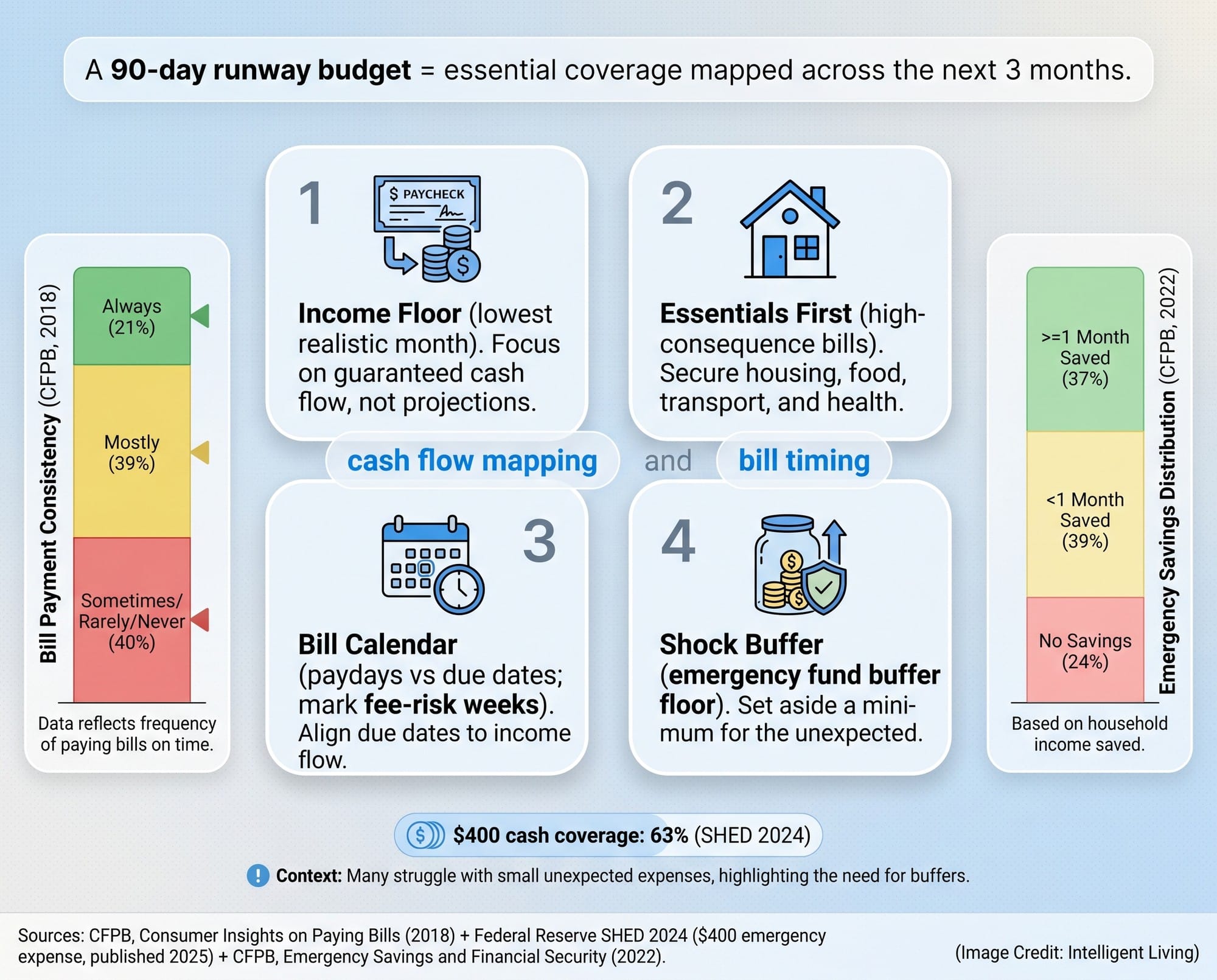
Step 1: Establishing Your Minimum Income Floor for Resilience
Analyzing your lowest historical earnings from the past year provides the most conservative baseline for resilient planning. Replacing peak-income assumptions with a predictable minimum floor transforms false confidence into genuine financial resilience.
Adopting an irregular-income smoothing routine supports the same approach by focusing on predictable minimums rather than peak earnings.
If income is salaried but variable due to overtime or commissions, exclude bonuses. Build from guaranteed pay.
Maintaining a gig-work tax reserve can keep the runway from being quietly drained by quarterly deadlines.
Add one more small reality check here: if income is seasonal, the floor month should come from the slow season, not the month that feels easiest.
Step 2: Prioritizing Essential High-Consequence Obligations
Priority bills represent the core expenses that keep your household safe and functional. Listing these obligations first is the only way to build a runway that actually holds up.
Your primary bill list should include:
- Mortgage or Rent Payments
- Electricity, Water, and Gas
- Health and Auto Insurance
- Life-Saving Prescription Costs
- Commuting and Fuel Expenses
- Minimum Monthly Debt Obligations
Focusing on these priorities ensures that your core stability remains intact before any flexible spending occurs.
Essential obligations like rent, utilities, and insurance represent your high-consequence bills. Missing them triggers fees, service disruptions, or credit damage.
A bill’s firewall is simply a habit of protecting these obligations first so daily spending does not crowd them out. That protection is the core of the runway.
To keep the list realistic, treat child care, medical copays, and work-required commuting as essentials when they are truly non-optional.
Step 3: Create a Bill Calendar
Plot paydays and bill due dates on a calendar. Visual mapping often reveals fee-risk weeks where large payments cluster ahead of scheduled income deposits.
Detailed research explains that shifting bill due dates to better line up with income flow can help manage cash timing more effectively. When possible, request due date adjustments so major bills land shortly after paydays.
Picture a household where car insurance renews on the 28th but pay arrives on the 30th. A two-day gap can trigger overdrafts even if the monthly total is positive.
Moving that due date resolves the timing stress without changing your total spending. This simple adjustment protects your cash flow from unnecessary bank fees.
The calendar should also include quarterly and annual charges, since quarterly and annual charges are the specific expenses most likely to ambush a month that otherwise looks fine.
Step 4: Add a Shock Buffer
Building a shock buffer through liquid savings provides a critical layer of defense against unplanned expenses. Standard guidance defines building an emergency fund as setting aside cash for unplanned expenses or financial emergencies.
A modest buffer totaling one to two weeks of essential expenses significantly stabilizes your three-month runway. Over time, that buffer can grow toward one to three months of essentials.
Developing specific money automation habits can turn emergency savings into a default, not a monthly debate.
A worker whose refrigerator fails mid-summer experiences inconvenience, not crisis, when a buffer exists. The runway absorbs the shock.
A practical detail that helps: set a clear “buffer floor” where the runway plan triggers an immediate pause on optional spending until that floor is rebuilt.

Stress Testing Cash Flow: Bill Shock Planning and Timing Calendars
The Shock-Proof Calendar: Stop Fee-Risk Weeks Before they Hit
How to Spot Fee-Risk Weeks Before they Become Fees
A shock-proof calendar blends income timing, due dates, and buffer thresholds into one visual map.
Begin by marking all high-consequence bills in bold. Next, mark paydays. Then identify weeks where outgoing payments exceed incoming cash. Those are fee-risk weeks, even if the month looks “fine” on paper.
Three Fixes that Reduce Timing Stress Fast
When your bill calendar identifies a high-risk week, you can deploy specific tactics to protect your cash balance. These adjustments ensure that your essential coverage remains uninterrupted.
Proven timing fixes include:
- Adjusting due dates to align with pay cycles
- Splitting payments into smaller, manageable portions
- Reducing flexible spending during peak bill weeks
These proactive steps prevent cash gaps from turning into expensive overdraft fees or credit marks.
Mapping out seasonal bills and recurring expenses helps catch annual renewals and once-a-year charges before they stack up in the wrong week.
A family might notice three streaming renewals and an annual software fee landing in the same window, and the relief comes from spreading the timing, not from stripping life down to nothing. One small change in payment dates can keep the runway steady.
Interactive What-if Forecasting: Stress-Testing Your Plan
Scenario planning transforms anxiety into data. Instead of imagining worst-case outcomes, adjust three variables and observe the effect on the runway.
Slider 1: Income Drop
Reduce projected income by 10 to 30 percent for one month. Does the runway remain above zero? If not, identify which expenses would pause first.
A warehouse employee facing reduced overtime can simulate fewer hours and see exactly how many weeks of coverage remain, which makes it easier to choose the first adjustment instead of guessing.
Slider 2: Bill Shock
Testing an increase in a major bill, such as a utility spike during extreme weather or an unexpected medical expense, helps you identify how much buffer you need to absorb sudden cost increases.
Interactive forecasting allows you to adjust your assumptions and see the projected outcome update in real time. Even without software, a simple worksheet can mimic the same idea by changing one number at a time and watching the runway move.
One common pattern is a bill shock that arrives right after a holiday or a school expense season, and the runway only works when those timing clusters are visible.
Slider 3: Rate Pressure
Rising interest rates often increase minimum payment obligations, making it necessary to simulate higher borrowing costs in your forecast. The FRED series on the commercial bank credit card rate shows the direction of borrowing costs over time.
If rates rise, minimum payments often rise too. Simulate a higher interest rate and project the added monthly cost. This clarifies whether accelerating debt repayment strengthens the runway.
Choosing a proven debt repayment method can help decide whether the runway benefits more from quick momentum or lower interest costs.
Maintaining a plain plan for managing high debt levels can keep the runway from being swallowed by scattered minimum payments.
A household that models a two-percentage-point increase often discovers that small extra payments now reduce vulnerability later, because they buy down future interest before it compounds.

Permission Hygiene: The 15-Minute Quarterly Connected Apps Audit
Open Finance Basics: A Guide to Financial Data Permissions
Cash flow stability is just one pillar of financial resilience, as digital risk oversight and data security are equally critical.
Understanding open finance data sharing frames the process as consumer authorization rather than silent data collection.
Why Stale Links Expand Risk Over Time
Permission hygiene is a short habit: list what is connected, keep what is necessary, and revoke what is stale. The idea matches the security concept called the least privilege principle, which means giving systems only the access needed to do the job, nothing extra.
In the United States, the concept of consumer control over data sharing sits at the center of ongoing rulemaking around personal financial data rights, even as timelines and enforcement details continue to evolve.
A Fast Audit Routine that Fits a Busy Week
Start with a simple list: which budgeting apps, tax tools, payment services, and shopping apps are connected to a bank or credit account. Keep the links that are actively used and remove the ones that have gone stale, because old permissions can hang around long after the last login.
In common account-linking pipelines, disconnecting a linked financial account typically stops future access through that connector, which reduces what can be pulled going forward.
Distinguishing Between Disconnection and Permanent Deletion
Distinguishing between disconnection and permanent deletion is essential for exercising your full consumer data rights. Industry standards reflect the expectation that ongoing data sharing consents should be visible and revocable.
A separate path for deleting stored Plaid data exists because stopping future sharing does not automatically erase previously collected information.
Federal regulations include a requirement for accessible data revocation methods, stating that withdrawing consent should be as easy as the initial authorization.
A quick quarterly audit might reveal an app used once during tax season still linked to a checking account. Removing it reduces exposure without changing daily life.
Make the System Stick: Low-Friction Habits and a 90-Day Finish Line
9 Actionable Tactics for Low-Friction Cash Flow Management
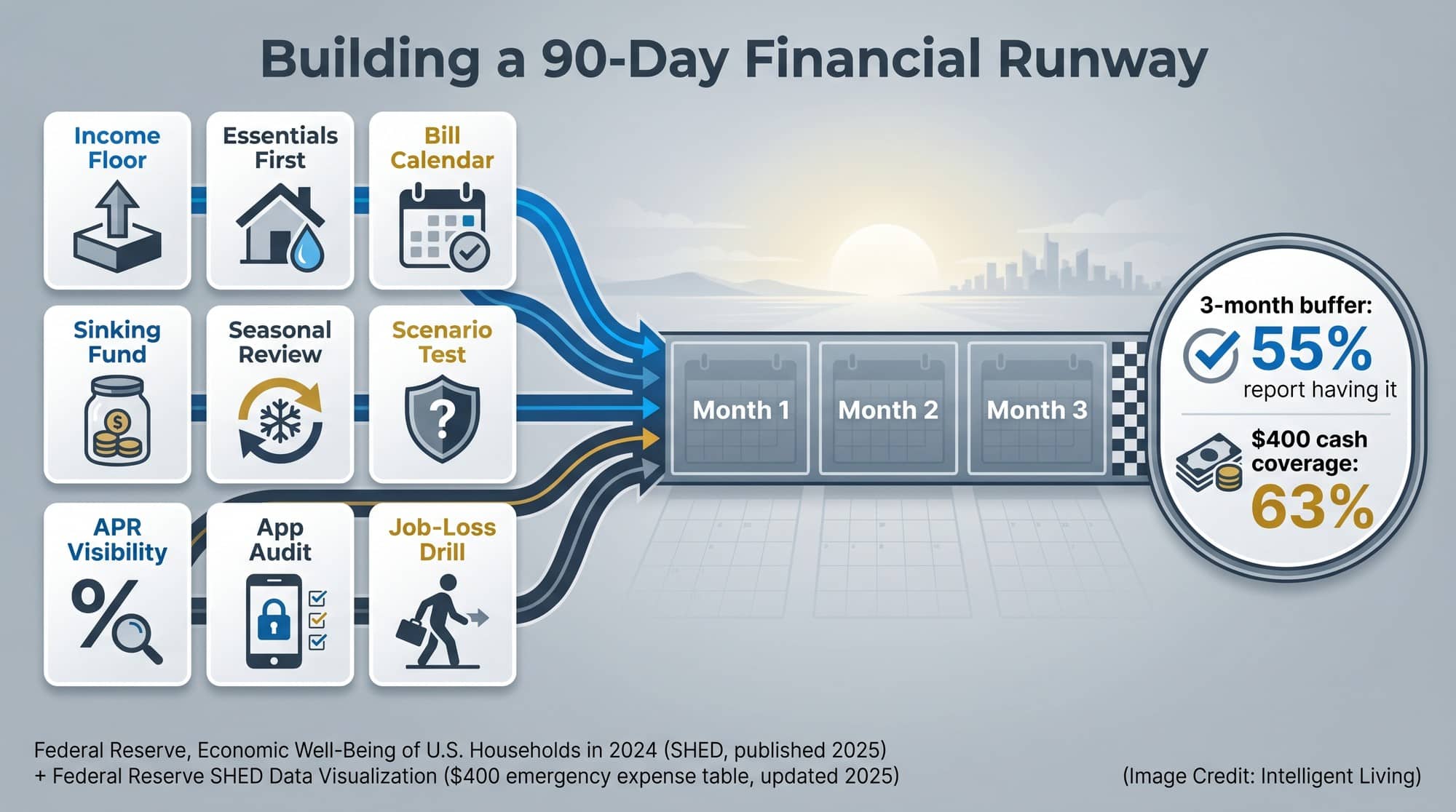
The runway works best when it becomes a routine, not a one-time clean-up. The list below focuses on small actions that keep cash flow planning, bill timing, and permission hygiene from drifting back into guesswork.
- Establish your baseline using the lowest historical income month.
- Separate essential bills from flexible spending categories.
- Use a visible bill calendar rather than relying on memory.
- Create one sinking fund for predictable annual expenses.
- Review seasonal bills before peak months arrive.
- Simulate one income-drop scenario each quarter.
- Keep APR, due dates, and minimum payments visible, since a comprehensive debt relief plan treats timing and interest as the details that quietly change outcomes.
- Treat permission hygiene like phone permissions, since establishing secure mobile device habits explains why periodic reviews stop unused access from piling up.
- Implementing a safeguarding your finances during work halts keeps essentials stable while income resets.
Applying a single-parent money organization system reinforces the same runway principle: reduce decision load so the essentials stay protected.
A useful rule of thumb is to schedule one runway review on the same day every week, even if it takes only ten minutes, because consistency matters more than perfect math.

90-Day Runway Budget Conclusion: Financial Stability Through Timing, Scenario Planning, and Digital Hygiene
A budget that survives real life prioritizes timing, clarity, and adaptability. It is built for the messy weeks, not the ideal weeks.
A 90-day runway transforms abstract financial goals into measurable coverage. A shock-proof calendar prevents avoidable fees. Scenario sliders convert fear into informed decisions. Permission hygiene reduces unnecessary digital exposure. Each piece supports the others, which is why the system stays stable when one part gets stressed.
Taken together, these systems create stability without surveillance of every dollar. The focus shifts from control to coverage, and that shift makes it easier to keep going when motivation is low.
Following a five-step financial wellness plan can make the runway feel less like a one-time project and more like a repeatable habit, especially when it is paired with a short weekly review.
Set aside one focused hour. Map income. Plot bills. Test scenarios. Audit connected apps. Relief often follows clarity, because clarity replaces guesswork with a plan.
Implementing Resilient Cash Flow Habits for Long-Term Peace
Sustaining financial peace requires a shift from passive observation to active management.
By moving to a forward-looking cash flow mapping model, you stop reacting to past spending and start directing future coverage. This system ensures that your financial resilience grows with every quarterly audit and scenario test, protecting your household against the unpredictability of shifting economic conditions.
Start your first 60-minute session today to build a runway that provides both immediate relief and a permanent foundation for growth.

90-Day Runway Budget FAQ: Essential Answers for Financial Resilience
How Can I Calculate how Long My Money Will Last?
Measure your 90-day runway by dividing your total available liquid cash by your monthly floor-month essential expenses. This calculation identifies exactly how many weeks of coverage you have if income stops or expenses surge.
What is the Best Way to Stop Bank Fees?
Preventing overdraft fees requires a visual bill calendar to identify weeks where large payments cluster. Adjusting due dates to align with pay cycles ensures that high-consequence bills arrive when cash balances are at their peak.
Why Should I Audit My Connected Bank Apps?
Trimming old app permissions follows the least privilege principle to minimize digital risk exposure. Revoking access for stale tax tools or shopping apps prevents unauthorized data sharing and keeps your financial profile secure.
How Do I Handle Variable Income as a Freelancer?
Successful income volatility smoothing involves budgeting based on your lowest historical income month. This conservative baseline creates a buffer during slow seasons and prevents over-reliance on peak earnings that may not repeat.
Does Disconnecting an App Delete My Stored Data?
Revoking permission usually stops future data sharing through open finance connectors. Removing previously collected information often requires a direct deletion request to the specific provider to ensure your data rights are fully exercised.


