
Digital landscapes for local companies are becoming tighter and more competitive every day. You’ve likely noticed that simply having a website isn’t enough when your neighbors are fighting for the same three spots in the map pack. Most potential customers never look past that first screen on their phones, making every pixel of local SEO visibility a high-stakes asset for your growth. Establishing a dominant presence requires appearing in prominent local search results where intent-driven traffic lives.
Modern search engines prioritize location accuracy and consistent business mentions across the web. Achieving visibility in map results means you must monitor real local search visibility with precision, accounting for how SERP features like business panels and local listings shift. Without a reliable citation builder, managing business listings across platforms becomes a liability rather than a strength. Duplicate listings or incorrect data can trigger a significant drop in trust, leading you to ask, “Why did my local search traffic drop?”
Transitioning to a Search Everywhere Optimization strategy requires tools that mirror how search works in the age of AI. An AI rank tracker allows you to see AI-powered search results for local businesses, uncovering how platforms like ChatGPT or Gemini interpret your Google Business Profile insights. Regular local SEO audits using geogrid and heatmap analysis identify gaps in business directories that traditional tools miss. Implementing these advanced solutions is the most effective way to ensure your brand stays visible when users ask, “How do I see where my business ranks in maps?”
How Does Local Search Optimization Improve Ranking?
SEO success frequently feels tied to where a website ranks in search results, leading many to assume that a page-one position automatically guarantees strong visibility and traffic. Modern search results are increasingly complex due to a crowded landscape of interactive features.
These diverse elements often compete for user attention:
- Detailed local maps
- Prominent business listings
- Direct featured answers
- High-resolution images
- AI-generated summaries
Competitive businesses can technically rank well yet remain overlooked if their listings appear below a map pack or are suppressed by these search features.
Local SEO visibility involves what customers actually see when they search. The metric measures whether a business appears in prominent areas like local map results, business panels, or location-based listings. Rankings matter, but visibility determines whether those rankings translate into real attention.
Visibility shifts are especially important for local businesses. Most customers are not scrolling deeply or comparing ten websites. They are choosing from what appears first and most clearly. If a business is missing from those visible spots, rankings alone will not drive results.
Analyzing visibility helps explain why traffic, calls, or visits sometimes drop even when rankings stay the same. Clear metrics also set the foundation for using better tools that reflect how search works today.

Evolution of Local Search Results and User Intent
Search results today look very different from what they did even a few years ago. A simple list of blue links is no longer the standard experience, especially when a search has local intent. Local service queries trigger results pages built around multiple competing elements.
Users typically encounter these features first:
- A map with highlighted local businesses.
- Business profiles with photos, reviews, and hours.
- Quick answers or summaries pulled from various sources.
- Website links pushed lower on the page.
Strategic visibility requires appearing in these high-interest zones to capture traffic before users scroll further.
The Compression of Mobile Search Results
On mobile, this layout becomes even more compressed. Many users make a decision before scrolling past the first screen, which means visibility at the top matters more than exact rank positions.
Evolving search layouts fundamentally alter competitive dynamics, shifting the focus from simple list positions to securing spots in high-trust zones like map results and complete business profiles.
Modern search algorithms prioritize local signals to determine prominence, weighing business information consistency and location accuracy alongside traditional website content.
Because of this, traditional rank checks can miss the bigger picture. A business may rank well on paper but still be largely unseen. Breaking down how search results are structured helps explain why visibility and rankings are no longer the same thing.

Comparative Benefits of AI Rank Tracking vs. Traditional Metrics
Traditional rank trackers report a single keyword position. While useful, the reporting misses how your business is represented in AI-powered search results.
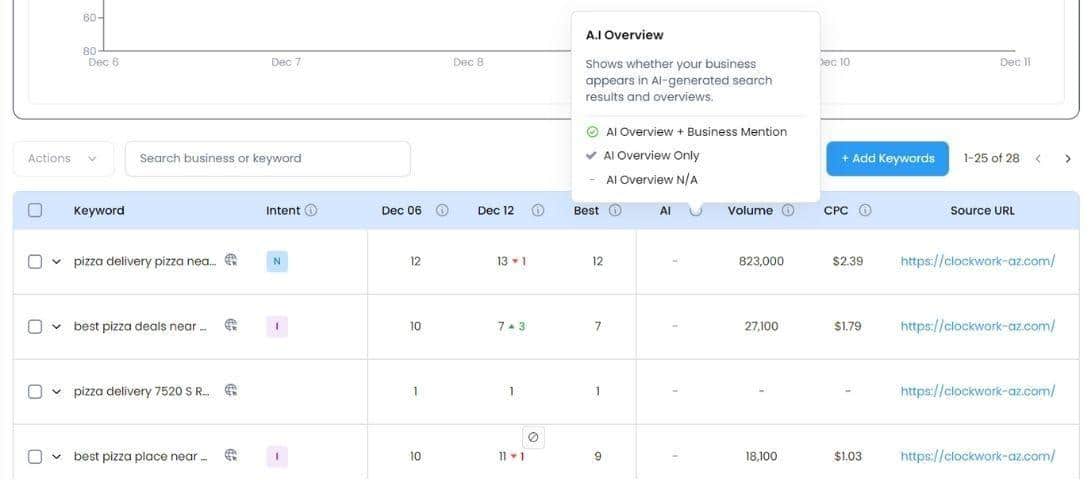
An AI rank tracker goes further. The tool monitors how your brand shows up across AI-powered search engines like ChatGPT, Google AI, Gemini, and Perplexity. This allows you to see not just ranking but also visibility, mentions, and how AI interprets your business.
Monitoring AI search environments provides deep competitive intelligence that standard reports miss. Advanced tools allow you to diagnose how these platforms represent your brand to potential customers.
Key insights from an AI rank tracker include:
- Whether AI recommends your business over competitors.
- When AI provides incorrect information about your business, such as hours, services, or locations.
- Which sources AI trusts and which competitor strategies it favors.
Gaining this transparency helps you protect your online reputation and capture opportunities that traditional SEO tools simply cannot detect.
Detailed AI insights clarify why traditional ranking reports often fail to capture real-world performance. While standard metrics might suggest stability, AI-driven recommendations are quietly shaping customer decisions behind the scenes.
For local businesses, AI rank tracking provides a complete view of how your brand appears in AI search. This helps you protect your reputation, capture opportunities, and gain actionable insights that traditional SEO tools cannot detect.

Impact of Citations on Sustained Local SEO Visibility
Citations are mentions of a business’s name, address, and phone number across the web. These listings appear on directories, maps, apps, and industry-specific sites. Even though citations have been part of local SEO for years, the mentions still play a key role in how search engines evaluate local businesses.
Algorithms utilize citations to verify that a business remains active and consistently represented online. Trust builds naturally when details align across multiple sources, whereas conflicting information creates technical uncertainty that directly suppresses visibility.
Search engines rely on business mentions to verify your physical presence and service legitimacy. These signals directly impact how often and where your brand appears in localized queries.
Citations influence local performance in several ways:
- Consistent citations help validate a business’s location and service area.
- Accurate listings reinforce consistency across search platforms.
- Data supports inclusion in map results and local listings.
- Correct entries reduce confusion caused by outdated or duplicate entries.
Solidifying these digital footprints empowers search algorithms to recommend your business with high confidence to nearby users searching for immediate solutions.
Identifying and Fixing Citation Inconsistencies
Many visibility issues start with small citation problems. An old address, a missing suite number, or a duplicate listing can weaken local signals without being obvious. These issues often go unnoticed because they do not affect website rankings directly, but they can limit how often a business appears in prominent local results.
Citations may not feel as visible as content or backlinks, but the listings quietly support local SEO behind the scenes. Keeping them accurate and aligned remains an important part of maintaining a strong local search presence.

Functional Role of a Citations Builder in Data Management
Managing citations manually can be time-consuming and error-prone, especially for businesses listed across dozens of platforms. A citation builder simplifies this process by helping fix errors, remove duplicates, and keep business information consistent across directories and apps.
A citation builder streamlines your presence by pushing accurate details to multiple directories from a single source, eliminating the need for manual one-by-one edits. This automation significantly reduces risks associated with mismatched addresses or duplicate profiles that typically weaken local signals.
Automation tools remove the manual burden of editing individual listings across dozens of platforms. Centralizing your data management ensures that updates reach every corner of the web simultaneously.
For businesses, a citations builder typically helps by:
- Distributing correct business information across trusted directories.
- Fixing inconsistencies that confuse search engines and customers.
- Identifying missing or incomplete listings.
- Reducing duplicate or outdated citations.
Effective data distribution creates a stable foundation, allowing your other marketing efforts to perform more effectively without interference from technical errors.
Maintaining data consistency supports local visibility without requiring constant manual checks. The process also makes updates easier when a business moves, changes hours, or adds new contact details.
While citations alone will not guarantee top placement, the listings provide a stable foundation for local SEO. A citation builder ensures that this foundation stays solid, allowing other efforts like content and tracking to perform more effectively.

Leveraging Local SEO Audits to Uncover Hidden Visibility Gaps
A local SEO audit helps explain why a business struggles with visibility even when basic SEO work is already done. Rather than focusing only on website rankings, the audit evaluates how a business appears across local search results, maps, and related search features.
Comprehensive audits include geogrid and heatmap analysis, Google Business Profile insights, and competitor comparisons. SERP visibility tracking and AI search mentions are also analyzed. Reviewing these areas together helps identify where visibility drops and which competitors are capturing attention.
Metrics That Define a Successful Local Audit
Professional audits pinpoint specific barriers that prevent your business from appearing in high-conversion zones. Uncovering these hidden gaps allows you to move beyond basic keyword updates.
A local SEO audit can uncover issues such as:
- Weak or inconsistent visibility in map results.
- Incomplete or underperforming Google Business Profiles.
- Competitors outranking a business in key locations.
- SERP features reducing organic exposure.
- Limited or missing presence in AI-driven search results.
Addressing these specific constraints transforms your local presence from a static listing into a dynamic visibility powerhouse.
Operating without a comprehensive audit often leads to directionless optimization efforts where content changes fail to address underlying visibility constraints. Audits provide the necessary clarity to pinpoint exactly where presence is lost and which signals require immediate reinforcement.
When paired with rank tracking and citation management, a local SEO audit supports Search Everywhere Optimization. The strategy helps businesses understand how they appear across traditional search, local maps, and AI-powered results, enabling decisions based on real visibility rather than assumptions.

Synergizing AI Rank Trackers and Citations Builders for Better Data
Tracking tools and citation tools are often treated as separate parts of local SEO, but they work best when used together. Each one fills a gap the other cannot cover on its own.
An AI rank tracker shows how visible a business is across real search results. A citation builder supports the underlying signals that help that visibility happen in the first place. When combined, the tools explain both what is happening and why it is happening.
| SEO Function | AI Rank Tracking | Citation Management |
| Primary role | Measures real search visibility | Maintains consistent business data |
| Focus area | Maps, SERP features, local layouts | Directories, listings, business profiles |
| Problem it solves | Visibility without context | Trust and data accuracy issues |
| Impact on decisions | Shows where attention is lost | Explains why visibility improves or declines |
| Best used for | Monitoring local presence changes | Strengthening local SEO foundations |
Unified data creates a sophisticated overview of local SEO performance. Moving beyond reactive adjustments to isolated metrics allows businesses to connect visibility outcomes with foundational signals, fostering more confident and focused decision-making.
Integrated data creates a more complete picture of local SEO performance. Rather than reacting to isolated metrics, businesses can connect visibility data with the signals that support it, leading to more confident and focused decisions.
Optimizing Business Decisions with Advanced Visibility Reporting
When businesses understand how they actually appear in search results, SEO decisions become easier and more effective. Visibility data removes the guesswork that often leads to wasted effort and slow progress.
Instead of relying on rankings alone, businesses can focus on what directly influences customer behavior. Seeing where listings appear, how often they are shown, and what pushes them down the page helps prioritize the right actions.
Visibility insights empower you to prioritize marketing tasks that yield the highest return. Moving away from guesswork leads to a more efficient and profitable search strategy.
With clearer visibility data, businesses are better able to:
- Decide which locations or areas need attention.
- Identify whether citation fixes are improving presence.
- Understand how competitors dominate certain results.
- Adjust strategies based on real search layouts.
Concrete evidence builds confidence in your digital growth and ensures your team stays focused on sustainable long-term results.
Data-driven visibility reporting also improves communication between stakeholders. Business owners and marketers can explain changes in traffic or calls using concrete evidence rather than assumptions. The clarity builds confidence in SEO as an ongoing process rather than a series of isolated tasks.
Local search landscapes are in a state of constant flux, yet a core principle remains unchanged: businesses that prioritize measuring what customers truly encounter are the ones best equipped to adapt, stay visible, and achieve sustainable growth.

Maximizing ROI with Visibility-Driven Search Strategies
Success in local markets requires a shift from passive monitoring to active SEO presence management. Relying on outdated metrics leaves your business vulnerable to competitors who are already optimizing for AI recommendations and map features. When you combine the precision of AI rank tracking with the stability of a citations builder, you create a feedback loop that identifies gaps and fills them before they impact your bottom line.
Adaptability is your greatest advantage in a search environment that changes weekly. You can’t control how Google or ChatGPT updates their algorithms, but you can control the accuracy of your data and the clarity of your visibility. Focusing on these pillars ensures that when a local customer searches for a service you provide, your business is the one that appears first, clearest, and most often.
Essential Guidance for Local SEO and Data Management
What makes visibility different from traditional search rankings?
Rankings tell you where a link sits in a list, while visibility measures your presence across maps, AI summaries, and local panels.
How often does an AI rank tracker update my business data?
Most modern trackers monitor changes in real-time or daily to capture how AI search engines like Gemini or ChatGPT perceive your brand.
Can a citations builder fix my business address on every platform?
Yes, these tools push your verified information to major directories and maps simultaneously to ensure your location data remains consistent everywhere.
Why do local SEO audits matter if my rankings are already high?
Audits reveal why high rankings might not be converting into calls, often finding issues like suppressed map listings or outdated business profiles.
Does voice search use the same keywords as traditional text search?
Voice search relies more on natural, conversational questions, which is why visibility tools focus on phrasing that reflects how people actually speak.

