
An exciting new device has been created by researchers at Loughborough University that has unlocked the mystery of Terahertz (THz) frequency wavelengths. This discovery has implications that will allow for new technologies in many fields including medical technologies and imaging.
Up until now, scientists have been unable to harness the power of THz waves, which sit between microwaves and infrared in the light frequency spectrum. This has led scientists to what is known as “the terahertz gap.”
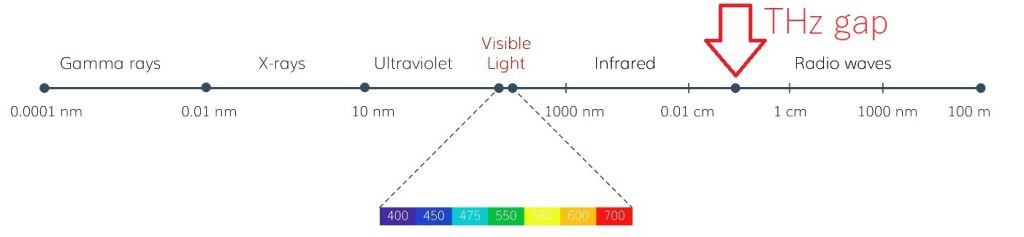
THz wavelengths range between 3mm and 30μm and provide a weak signal from their existing sources which makes them difficult to utilize.
Now, a team of physicists created a working THz amplifier, an optical transistor using graphene and a high-temperature superconductor.
Graphene is transparent, not sensitive to light, and has electrons without mass.
The massless graphene electrons become trapped between the superconductor and the graphene layers, which are then connected to a power source.
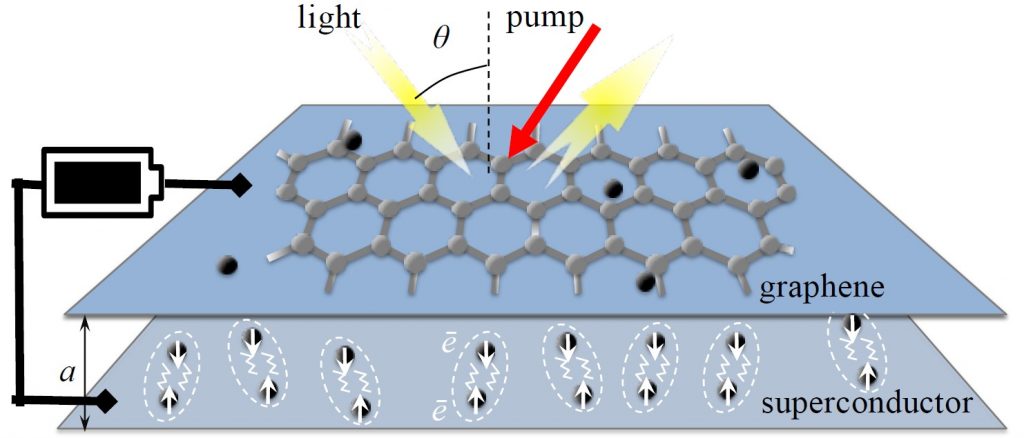
Once THz radiation contacts the outer graphene layer, the trapped particles attach themselves to the outgoing waves, which gives them more energy and more power, thus amplifying them.
Professor Fedor Kusmartsev from Loughborough’s Department of Physics explains the process:
The device has a very simple structure, consisting of two layers of graphene and superconductor, forming a sandwich. As the THz light falls on the sandwich it is reflected, like a mirror. The main point is that there will be more light reflected than fell on the device.
Professor Kusmartsev goes on to say:
It works because external energy is supplied by a battery or by light that hits the surface from other, higher frequencies in the electromagnetic spectrum. The THz photons are transformed by the graphene into massless electrons, which, in turn, are transformed back into reflected, energized, THz photons. Due to such a transformation, the THz photons take energy from the graphene—or the battery—and the weak THz signals are amplified.
They say that the terahertz frequency is the final range to be understood and adopted by humans. This new amplifier has the potential to vastly improve technology and provide us further insight into the human brain.
Here are some more quotes from the studies and what scientists are expecting to become possible as a result of this groundbreaking discovery:
The universe is full of terahertz radiation and signals all biological organisms both absorb and emit it. I expect that with such an amplifier available, we will be able to discover many mysteries of nature, for example, how chemical reactions and biological processes are going on, or how our brain operates and how we think. Microwaves, infrared, visible, X-rays and other bandwidths are vital for countless scientific and technological advancements.
“It has properties which would greatly improve vast areas of science such as imaging, spectroscopy, tomography, medical diagnosis, health monitoring, environmental control, and chemical and biological identification.”
The device we have developed will allow scientists and engineers to harness the illusive bandwidth and create the next generation of medical equipment, detection hardware, and wireless communication technology.
Hopefully, this will propel us, humans, to the next level in our evolutionary journey, helping us reach our full potential.


