
Chronic diseases significantly impact millions of lives and strain healthcare budgets globally. Traditional management often responds to symptoms rather than predicting or preventing complications. This leaves patients in cycles of emergency interventions and costly treatments. Chronic diseases lead to an estimated 41 million deaths worldwide. This high mortality rate demands a shift toward proactive care that identifies risks before they become life-threatening crises.
Healthcare data analytics provides tools to track patients’ health, identify risk factors, and personalise treatment. By converting medical data into insights, healthcare analytics improves chronic disease management, making care more predictive, efficient, and patient-centered.
Understanding Core Analytics for Chronic Conditions
Managing chronic disease requires technology that processes patient information in real time. With healthcare data analytics, medical information transforms into insights that save lives and reduce costs through predictive interventions.
Core Components of Healthcare Data Analytics Systems
Multi-source integration is crucial for effective chronic care analytics. Electronic health records, wearable device data, genomic information, and pharmacy records must work together. Cloud infrastructure provides the computational power to process millions of data points. Machine learning algorithms identify patterns that human analysis might miss.
Real-time processing allows care teams to respond to patient deterioration within hours, not days. This speed often determines whether a diabetic patient receives timely intervention or ends up in the emergency room.
Critical Data Types Driving Chronic Disease Insights
Incorporating SDOH data into analytics platforms provides a comprehensive understanding of patient risk profiles. Clinical biomarkers and laboratory trending analysis form the medical foundation for predictive models. Patient-generated health data from connected devices offers continuous monitoring capabilities traditional office visits cannot match.
Leveraging SDOH data helps healthcare providers gain insights into non-medical barriers. Factors like housing instability, food insecurity, and transportation significantly impact chronic disease outcomes.
Given the potential to reduce hospitalisations by 40%, understanding the technological infrastructure driving these improvements is essential for any healthcare organisation aiming to transform chronic care delivery.

Integrating SDOH Data for Deeper Patient Insights
While multi-source clinical data offers insights, understanding the social and environmental factors driving chronic disease progression is crucial for 80% of health outcomes. SDOH integration is the next critical step.
SDOH Meaning and Its Critical Role in Chronic Care
Social determinants of health (SDOH) encompass five key domains: economic stability, education and healthcare access, neighbourhood environment, and social context. These factors often influence health outcomes more than medical interventions alone.
Beyond basic demographics, SDOH includes variables like food desert locations, public transportation availability, and social support networks. Integrating these elements helps analytics platforms capture predictive indicators for chronic disease exacerbations.
Analytics platforms that incorporate social determinants of health recognise that these factors can be more predictive of patient outcomes than clinical data alone.
Advanced Analytics: Combining Clinical and Social Risk Factors
Analysing social factors with clinical markers, advanced algorithms create comprehensive, multi-dimensional patient profiles. Geographic stratification reveals how a zip code can predict health outcomes more than a genetic code in numerous instances. This combined approach guides targeted interventions for chronic disease management.
With an understanding of how social determinants complete the patient picture, we can explore AI and machine learning techniques that transform this data into interventions.
Advanced Analytics Techniques for Chronic Disease Management
Predictive capabilities become more meaningful when applied to specific chronic conditions. Targeted analytics can prevent a diabetic crisis and avoid costly emergency interventions.
AI-Powered Predictive Risk Stratification
Multivariate risk scoring models analyse numerous variables to forecast disease progression. Farran et al. applied a K-neural network (KNN) to identify increased risks for hypertension (94%) and diabetes (75%). These accuracy rates show how machine learning surpasses traditional risk assessment methods.
Early warning systems trigger alerts when patient data suggests complications. Care teams receive notifications days or weeks before symptoms appear, allowing for proactive interventions that prevent hospitalisations.
Real-Time Monitoring and Intervention Triggers
IoT device integration creates continuous patient monitoring networks capturing vital signs, activity levels, and medication adherence changes. Automated alert systems coordinate care team responses, ensuring no warning sign goes unnoticed.
Dynamic care plan adjustments, based on trending data, personalise treatment protocols as patient conditions evolve.
Natural Language Processing for Unstructured Data
Natural Language Processing unlocks critical insights by mining unstructured data within physician documentation and clinical notes. Social media and patient communication analysis provide context about social factors and lifestyle influences shaping chronic disease management.
These condition-specific insights become powerful when scaled to identify community-wide patterns and deploy population-level interventions, preventing chronic diseases before they develop.
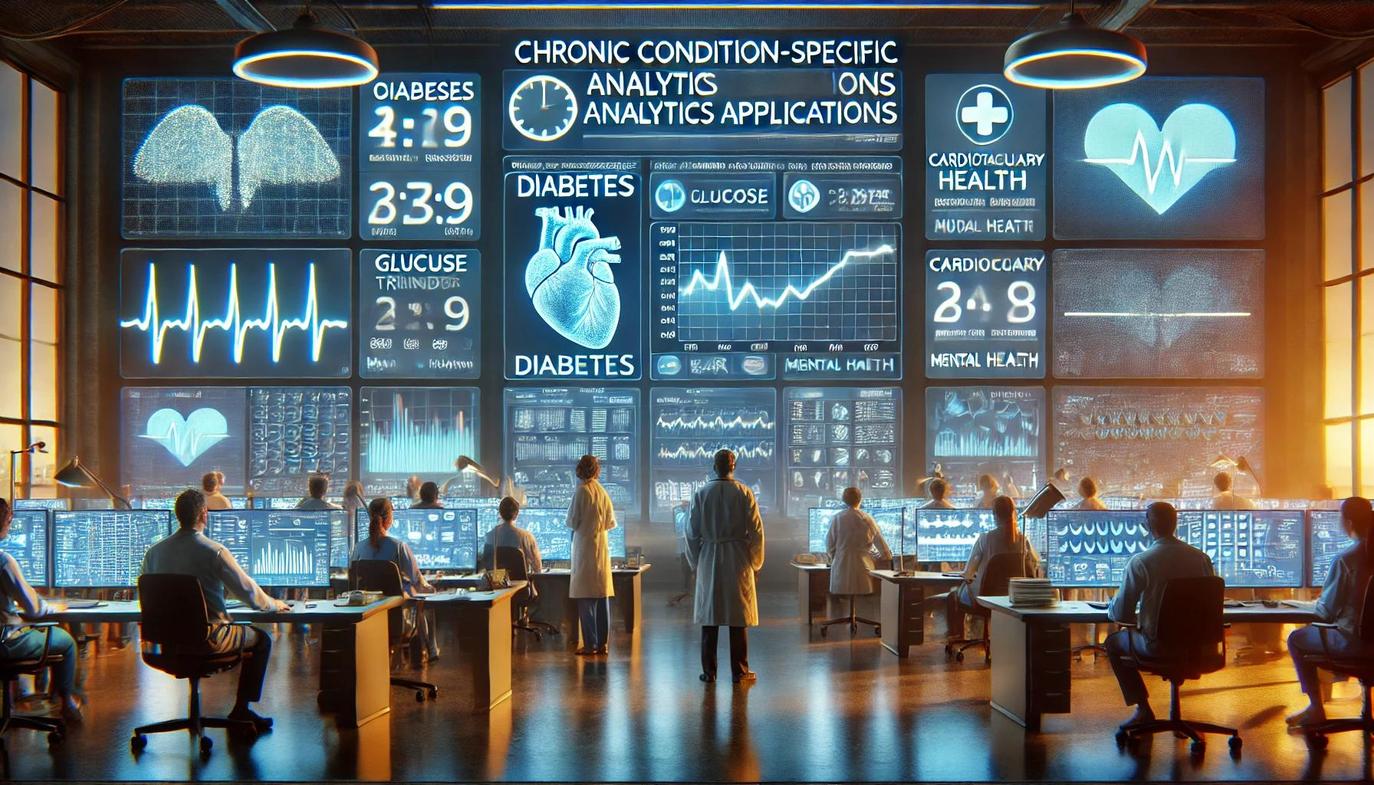
Chronic Condition-Specific Analytics Applications
Applying these advanced techniques to specific chronic conditions reveals their true potential to transform patient outcomes.
Diabetes Management Through Data Intelligence
Continuous glucose monitoring data reveals patterns of blood sugar fluctuations and optimal intervention timing. HbA1c prediction models forecast long-term control based on trends, while medication adherence tracking identifies patients at risk of treatment failure.
Cardiovascular Disease Prevention and Management
A heart failure readmission prediction achieves 85% accuracy with advanced modelling. Hypertension control improves by analysing lifestyle patterns to identify triggers that cause blood pressure spikes. Cardiac event early warning systems provide advance notice before dangerous episodes.
Mental Health Integration in Chronic Care
Automated depression screenings can identify mental health challenges that often coexist with and complicate chronic conditions. Behavioural health impact analysis reveals how psychological factors influence physical health outcomes, while integrated care coordination platforms share analytics insights across treatment teams.
Understanding the population-level impact leads to a key question for healthcare leaders: How do you build and deploy these analytics capabilities within your existing organisational structure?
Implementation Strategies for Healthcare Organisations
Overcoming Key Implementation Barriers
Even with an implementation roadmap, healthcare organisations face three barriers that can derail analytics: data quality, security, and health equity challenges. These demand strategic solutions.
Building Analytics Infrastructure
Adopting advanced data-driven care begins with selecting the right technologies for healthcare data analytics. Key components of the required technology stack include:
- Data warehouses for robust storage and management.
- Machine learning platforms to power predictive algorithms.
- Visualisation tools to translate data into actionable insights.
To succeed, it’s important to choose the right vendors that can integrate well and grow with your needs and to provide thorough training for staff so they can understand and use the analytics effectively.
Integration with Clinical Workflows
For data analytics in healthcare, optimising EHR systems to capture higher-quality data is crucial for effective processing. Clinical decision support systems present insights at the point of care, and collaboration dashboards keep care teams coordinated for high-risk patients.
Measuring Success and ROI
Key performance indicators track patient outcome improvements, cost reductions, and care quality. A comprehensive financial impact assessment justifies analytics investments by clearly demonstrating their value for organisational leadership.
As organisations overcome current implementation challenges, the healthcare analytics landscape evolves, with breakthrough technologies set to revolutionise chronic disease management.

Future Innovations in Chronic Disease Analytics
Breakthrough innovations will revolutionise chronic disease management as the healthcare analytics landscape evolves. Understanding these next-generation tools is key to unlocking new levels of patient care and operational efficiency.
Emerging Technologies and Methodologies
Several emerging technologies are set to shape the future of healthcare data analytics:
- Quantum Computing: Will enable the processing of complex disease models at unprecedented speeds.
- Blockchain Technology: Offers a secure method for sharing patient data across different healthcare networks.
- Digital Therapeutics: Can be integrated directly with analytics platforms to deliver personalised, data-driven interventions.
Precision Medicine Evolution
Genomic data integration creates customised chronic care protocols. Pharmacogenomics applications optimize medication selection based on genetic profiles, while biomarker discovery through analytics reveals new therapeutic targets.
Paving The Future With Predictive Chronic Care Analytics
Healthcare data analytics is fundamentally reshaping chronic disease management, moving beyond reactive treatments to a proactive, predictive model of care. By combining different types of data—from medical records and fitness trackers to factors like income and living conditions—healthcare providers can now spot people at risk and take action before serious problems develop. This data-driven approach not only enhances patient outcomes by delivering personalised, timely care, but it also reduces the significant financial strain that chronic conditions place on global healthcare systems.
The evolution toward this intelligent healthcare ecosystem promises a future where preventing chronic disease is as critical as treating it. As technologies like AI, quantum computing, and precision medicine continue to advance, the capacity for early detection and customised interventions will only grow. Healthcare organisations must embrace these innovations to build a more efficient, equitable, and patient-centered standard of care that ultimately saves lives by stopping crises before they begin.
Answering Your Key Questions about Health Analytics
What Are the Benefits of Using a Digital Health Monitoring Platform for Chronic Disease Management?
Enhanced monitoring allows continuous health tracking, enabling timely treatment adjustments. Real-time data collection leads to personalised care strategies, improving patient outcomes through proactive intervention rather than reactive treatment approaches.
How Does Big Data Affect Chronic Disease Management?
Consistent evidence shows that the application of data analytics in healthcare improves patient outcomes and diagnostic accuracy and reduces costs. This demonstrates significant potential benefits for chronic disease management through predictive modelling and personalised treatment protocols.
What Specific Data Analytics in Healthcare Applications Show the Most Promise for Chronic Conditions?
Predictive risk modelling, real-time monitoring systems, and personalised intervention protocols demonstrate the greatest impact. These applications identify at-risk patients early, prevent complications, and optimize treatment effectiveness through continuous data analysis.


