
Hong Kong’s top national prize in the James Dyson Award went to Sum Ming Wong (Simon Wong) and Kin Pong Li (Michael Li), students from The Chinese University of Hong Kong for their invention of the “self-sanitizing door handle.” The James Dyson Award gives local students around the world an opportunity for international competition – themed “design something that solves a problem.” It is intended to inspire and encourage students to tap their potential, designing inventions that could improve everyday life. Their self-cleaning door handle definitely solves an everyday life problem and it has the potential to make a significant contribution to public health, which is why it took the national prize.
Frédéric Gooris, a Belgian industrial designer living in Hong Kong, said:
Public health has always been a topic of public concern. The designer applied the automatic disinfection concept to door handles; if the concept could be applied to more products and situations, such as escalators, touch screens, etc., it could make a significant contribution to public health. Therefore, the design concept of automatic disinfection is very suitable for the theme of the James Dyson Award – “design something that solves a problem,” absolutely well-deserved.
What Inspired The Idea?
There was an outbreak of SARS (the global contagion respiratory disease) in Hong Kong in 2003 that resulted in 1,755 infections and 299 deaths. It really drew attention to the fact that many infections can spread quickly just by contact. With this in mind, the pair decided to design a door handle for public use to prevent infections (such as SARS, MERS, Foot and Mouth Disease and Candida Auris to name a few) from spreading. They wanted to make something that would enhance public hygiene and therefore curb the spread of sicknesses.
At the time, Wong was a student majoring in Physics at the Chinese University of Hong Kong and Li was still a primary school student. Li went on to study electrical engineering at the Royal Melbourne Institute of Technology in Australia. When the outbreak happened, they may have been young but they were smart and observant. They realized that one of the main reasons for the spread of the virus stemmed from people’s contact with things in the public realm, and door handles are a primary item.
How Does It Work?
The product functions through a combination of advanced photocatalytic technology and blacklight technology. A thin photocatalytic coating (a Titanium Dioxide (TiO2) film) on the handle is able to effectively decompose bacteria (disinfect and sterilize) when activated by a light source within. The light source is consistent (always on) because UV light is a necessity in the cleaning power of the film.
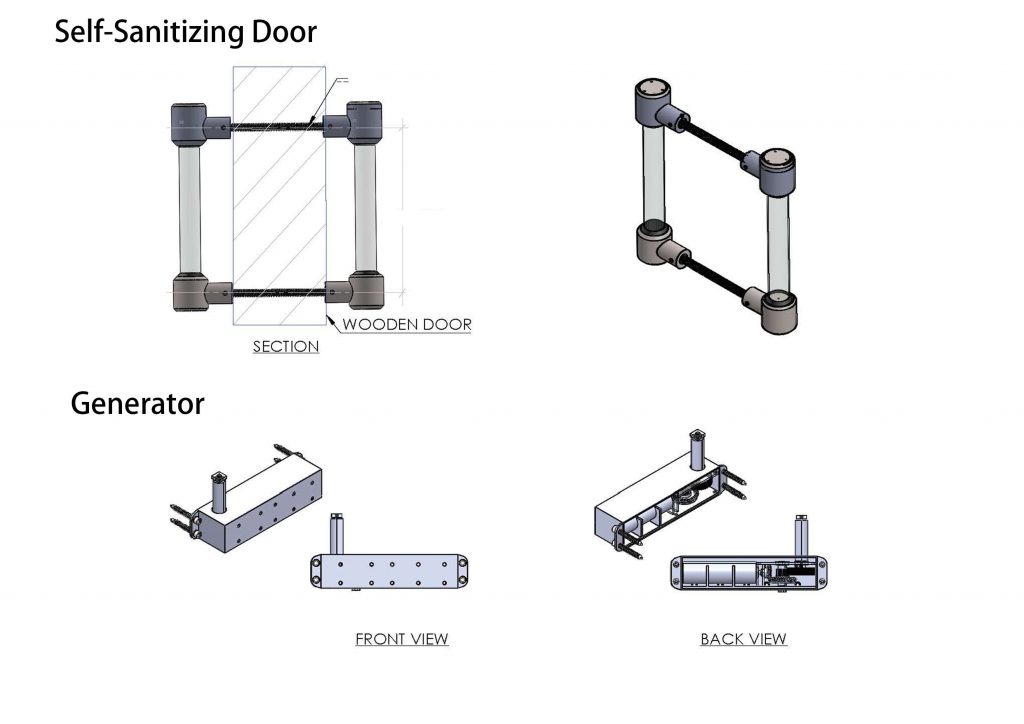
Since the light has to be on at all times, they custom-designed a mini generator built into the door handle that provides stable electricity to light up a UV LED lamp. The generator is powered by the motion of opening and closing the door. Therefore, no connection to an electricity source is needed.
Utilization And Recognition
The innovative design is simple, effective, and attractive. It’s sleek, glowing, and minimalist appearance stands out in the mix of inventions. In addition to winning the James Dyson Award, it has also received the Gold Award and it was featured in the 44th International Exhibition of Inventions of Geneva in 2016. It’s currently being used in commercial malls in Hong Kong and undergoing a trial scheme in various schools and other shopping malls.
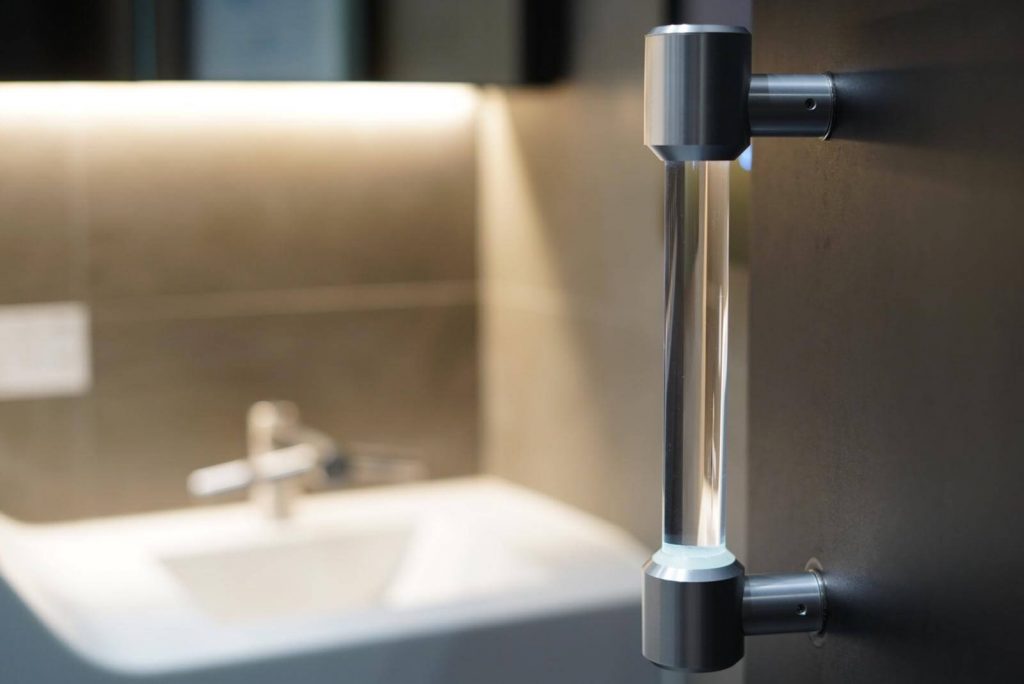
Simon pointed out that “most public environments are cleaned using chemical cleaners, which are not long-lasting and harmful to humans. The self-cleaning door handle provides durable and efficient cleaning and disinfection of the contact surface, and is expected to be incorporated in more daily products and public facilities in the future.”
What Are Their Future Plans?
Simon and Li are working on commercializing the product by connecting with public properties where there is a high risk of spreading infection, such as shopping malls, hotels, hospitals, and public toilets. They hope that in the future, the concept will be used in a variety of public facilities (such as light-touch screens) to serve as a solution to public health problems.


