
Sustainability in logistics stopped being a reporting topic years ago. It is now baked into routing decisions, fleet utilization, and delivery commitments. When a driver is rerouted because of congestion or a charging gap, that is already a sustainability decision, even if nobody labels it that way.
That shift is pushing companies toward more serious investment in transportation and logistics software development, not as an IT upgrade but as operational infrastructure. The difference is simple: older systems assume stability. Modern logistics is defined by volatility.
Fuel prices fluctuate. EV range is inconsistent. Cities introduce new restrictions without long lead times. Software that cannot respond in real time is already a constraint.
Why Legacy Logistics Systems Fail Under Electric Fleets
Most logistics platforms were designed around diesel fleets and predictable infrastructure. DHL’s work on building a sustainable vehicle fleet illustrates how deeply that assumption was embedded. Distance and delivery time were the only meaningful variables. Everything else was noise.
That model collapses with electrification.
Electric vehicles introduce variables that older systems were never designed to handle. Range depends on temperature, payload, and terrain. Charging availability changes by location and time of day. Even the same route can produce different outcomes depending on traffic and load distribution. This is exactly where sustainable transportation software starts to matter in practice, because emissions, energy use, and routing constraints become part of the same decision-making layer instead of separate reporting metrics. Fleet electrification across Southeast Asia demonstrates how quickly these variables shift when EVs enter commercial operations at scale.
Companies like UPS and DHL didn’t wait for commercial tools to catch up. UPS expanded its ORION system to reduce miles driven, while DHL built internal optimization layers for urban delivery networks. These systems work, but they are heavily customized and continuously maintained.
Off-the-shelf routing tools simply do not handle this level of variability. They produce answers, but not reliable ones.
Route Planning Is Now Energy Accounting, Not Navigation
With electric fleets, routing stops being a map problem and becomes an energy problem.
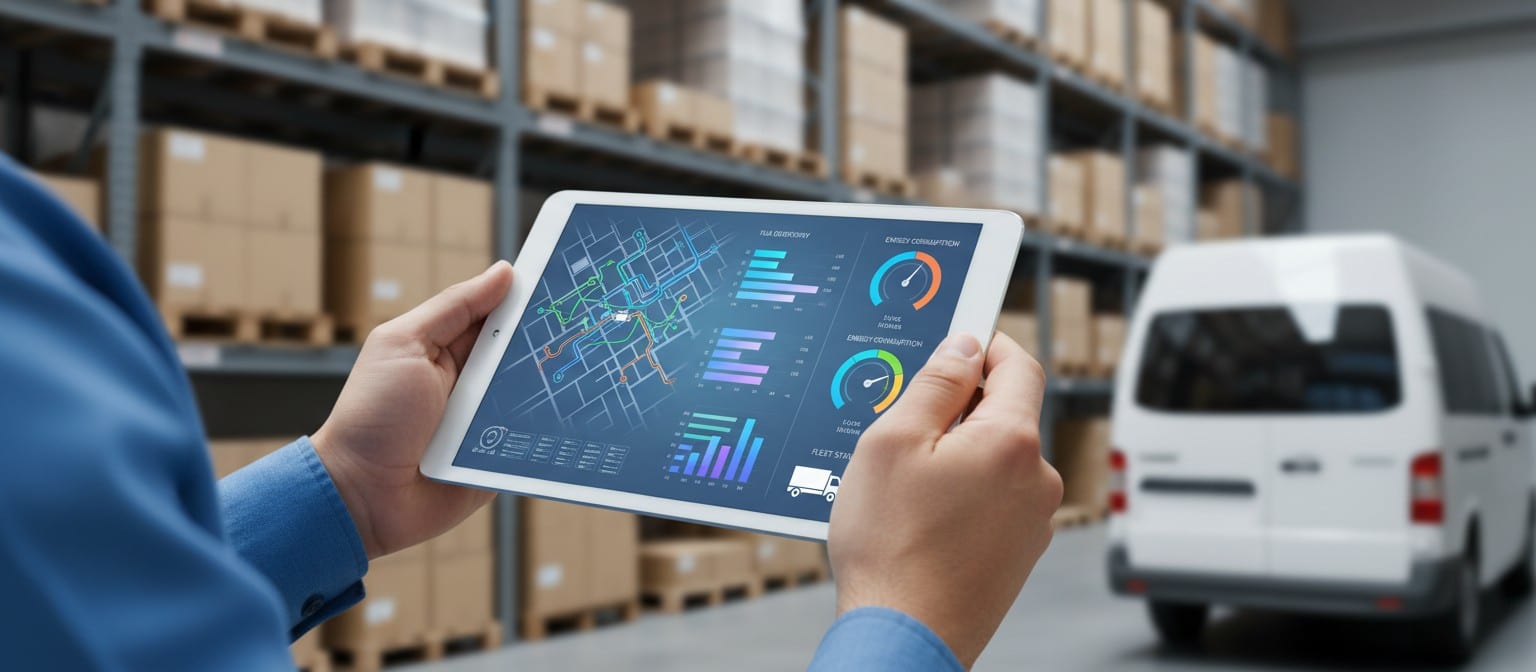
That is where EV route planning development changes the entire logic of dispatch. A usable system does not just calculate distance. It estimates energy consumption under real conditions before the vehicle even leaves the depot.
Elevation changes matter. So does payload weight. So does the weather. A cold morning in a dense urban area can reduce usable range enough to break a route that looked safe the night before.
This is where systems start to fail in practice. The math is only as good as the inputs. If telematics data is delayed or charging station availability is inaccurate, the system still produces a route—but it may not be a route that works in reality.
There is also an adoption issue that is often ignored. Drivers don’t follow systems they don’t trust. If suggested charging stops are unreliable, they bypass the system entirely. At that point, optimization is theoretical.
Data Integration Is the Real Engineering Bottleneck
Most sustainability projects fail for a reason that has nothing to do with algorithms.
The data is fragmented.
Fleet systems, warehouse platforms, and third-party APIs all operate independently. A telematics feed might update in seconds, while warehouse systems operate in batches. Traffic data is real-time in one city and delayed in another. Charging networks often expose inconsistent availability data depending on the provider.
Without a unified layer, optimization breaks down quickly.
This is where companies like Maersk have taken a more aggressive approach. Their logistics platform integrates ocean freight, port operations, and inland transport into a single system. That kind of integration is what makes green logistics software solutions operational rather than theoretical.
The tradeoff is maintenance overhead. Integration is not a one-time effort. APIs change. Vendors restructure data formats. New regions introduce new systems. The complexity does not stabilize; it compounds.
Smart Mobility Only Works When Cities and Fleets Share Systems
Urban logistics has stopped being a private optimization problem.
Cities now control key parts of delivery efficiency through emissions zones, congestion pricing, and time-based restrictions. That forces logistics companies to operate inside external rules they do not control.
This is where smart mobility platform development becomes relevant. Instead of isolated fleet systems, companies are integrating with city infrastructure platforms that coordinate traffic flow and environmental policy in real time. These connected platforms are.
In Amsterdam, delivery routes are already shaped by emissions regulations tied to specific urban zones. In Singapore, transport systems are integrated into broader national infrastructure planning, where logistics, traffic, and public transit are managed as a connected system.
The upside is better coordination. The downside is dependency. When external platforms change rules or APIs, internal logistics systems have to adapt immediately. There is no buffer.
Electrification Exposes Operational Gaps That Used to Be Invisible
Electrifying a fleet is often framed as a procurement decision. It is not.
It is a systems problem.
Charging schedules have to align with delivery windows, depot capacity, and energy pricing. A poorly timed charging cycle can erase the cost advantage of electric vehicles entirely.
This is where custom emobility software becomes essential. It is used to simulate charging scenarios, optimize energy usage across fleets, and reduce downtime caused by poor scheduling decisions.
The complexity increases when fleets are mixed. Most logistics operators are not running uniform EV fleets. They are running combinations of diesel, hybrid, and electric vehicles, often across different manufacturers and charging standards.
Companies like Tesla avoid this fragmentation because they control both hardware and software. Logistics companies do not have that advantage, which is why custom systems become necessary instead of optional.
Sustainability Economics Depend on Execution, Not Intent
The assumption that sustainable logistics is always more expensive is only partially correct.
Upfront costs are real. EV fleets require infrastructure investment. Software systems require redesign. Integration takes time and engineering effort.
But operational costs move in the opposite direction over time. Fuel costs drop. Maintenance becomes more predictable. Route efficiency improves when systems are accurate enough to reduce empty miles.
The problem is timing. Savings do not arrive evenly. Urban delivery networks tend to see benefits faster because routes are predictable and infrastructure density is higher. Long-haul logistics remains harder due to charging availability and route variability.
There is no clean ROI curve. Some operations improve quickly. Others take years.
Modern Architecture Is What Makes Real-Time Logistics Possible
None of this works on legacy monolithic systems built for batch processing.
Real-time logistics requires systems that can process continuous streams of data and respond immediately to changes in conditions. That is why many companies are moving toward microservices-based architectures using platforms like Node.js.
These architectures allow routing, telematics, charging optimization, and forecasting systems to evolve independently. A failure in one component does not necessarily collapse the entire system.
The tradeoff is operational complexity. Distributed systems are harder to debug. Observability becomes a requirement, not a nice-to-have. Engineering teams need stronger discipline around deployment, monitoring, and failure handling.

What Actually Separates Functional Systems From Fragile Ones
Most logistics companies now have sustainability goals. Very few have systems that enforce those goals at the operational level without manual intervention.
The difference is not strategy. It is a system design.
When routing, charging, and fleet utilization are tightly integrated, sustainability becomes a byproduct of normal operations. When they are not, it becomes a reporting exercise.
The companies that are getting this right are not just buying better tools. They are building systems that reflect how logistics actually behaves under constraint: messy, time-sensitive, and dependent on infrastructure that is outside their control.


