
Inside a battery, there are two electrodes – a cathode and an anode – both of which are immersed in a liquid electrolyte that conducts ions as the battery charges and discharges. The organic electrolytes being used in lithium-ion batteries that power most laptops, phones, and electric vehicles today are expensive and potentially hazardous because they’re flammable. The worse part is, they grow increasingly more costly and flammable as they become fast-charging and high-performing. However, it’s has a high energy density, so it remains the material of choice. An aqueous material could work, but it doesn’t maintain performance well.
Nikhil Koratkar, professor of mechanical, aerospace, and nuclear engineering at Rensselaer, said:
If you apply too much voltage to water it electrolyzes, meaning the water breaks up into hydrogen and oxygen. This is a problem because then you get outgassing, and the electrolyte is consumed. So usually, this material has a minimal voltage window.
But now, a team of engineers at Rensselaer Polytechnic Institute in the US has managed to successfully assemble a substantially safer, fast-charging lithium battery that still performs well and uses aqueous electrolytes instead of the typical organic electrolytes. It is non-flammable and cost-efficient, and since it is aqueous, it isn’t sensitive to moisture in the manufacturing process, meaning its more comfortable to work with and, therefore, less expensive. The research is published in Energy Storage Materials.
To make the battery, Koratkar and his team used lithium manganese oxide for the cathode, niobium tungsten oxide for the anode, and a water-in-salt electrolyte – a particular type of aqueous electrolyte which is less likely to electrolyze. Koratkar said the material they employed as the anode is a complex oxide that had not been explored in an aqueous battery before.
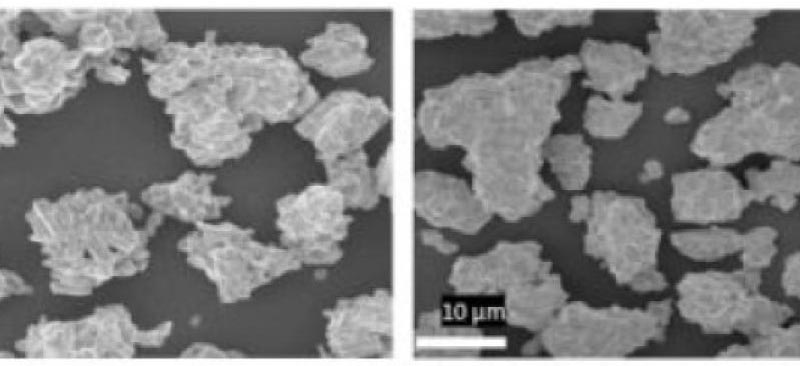
Koratkar said:
It turns out that niobium tungsten oxide is outstanding in terms of energy stored per unit of volume. Volumetrically, this was by far the best result that we have seen in an aqueous lithium-ion battery. The cell had a volumetric capacity of 200 Ah/l at a 1C charging rate, which is much higher than a state-of-art graphite anode at 50 to 110 Ah/l.
The niobium tungsten oxide gives the battery proper energy storage because it is relatively heavy and dense. The crystal structure enables quick charging thanks to its well-defined channels (tunnels) that allow lithium ions to diffuse quickly. It is a rarity for an aqueous battery to be able to store a large amount of charge per unit volume and possess the fast-charging capability. Achieving this kind of performance, with improved safety and at a low cost, could be a game-changer for emerging applications such as electric vehicles, portable electronics, and grid storage.


