
From plastics made from walnut shells and seafood shells to plastic made from cotton waste to plastics made of non-recyclable waste, researchers worldwide are finding creative ways to make nature-friendly versions of plastic that won’t harm the planet. To add to the list of unique biodegradable and compostable plastics, a researcher and professor at the University of Valle de Atemajac in Zapopan, Mexico, has developed one made from the juice of the prickly pear cactus.

Sandra Pascoe Ortiz has developed a bioplastic that takes advantage of the properties of this common species of succulent plant that is found all throughout Mexican deserts, as well as in much of the American continent. It does not require crude oil like traditional plastics, and it has the ability to disappear in three months outdoors or in just two weeks if in contact with water.
Ortiz told Forbes:
“There were some publications that spoke of different materials with which biodegradable plastics could be made, including some plants. In this case the nopal cactus has certain chemical characteristics with which I thought it could be feasible to obtain a polymer, that if it was combined with some other substances, all of them natural, a non-toxic biodegradable plastic would be obtained. The process is a mixture of compounds whose base is the nopal. It’s totally non-toxic, all the materials we use could be ingested both by animals or humans and they wouldn’t cause any harm.”
Ortiz herself even tasted the material during the development of the research to prove its safety if consumed by animals in the wild or sea creatures in the oceans. This means that even if any of this material makes its way into the ocean, it won’t be a problem if eaten, and even if not eaten, it will soon enough dissolve and disappear.
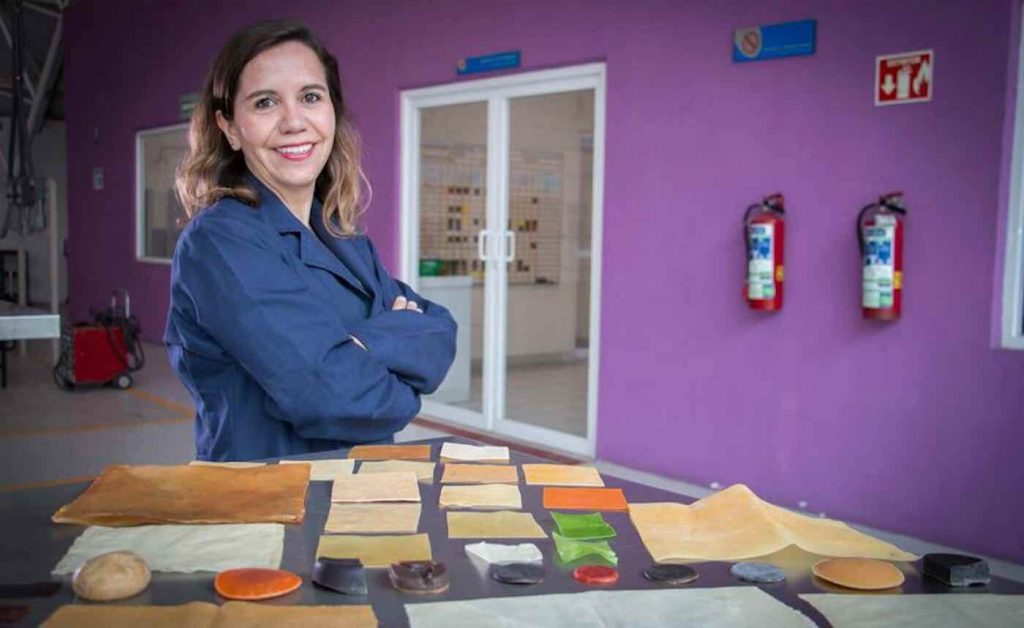
What initially sparked this project was a science fair of the Department of Exact Sciences and Engineering in the chemistry class with industrial engineering students of the career. They realized that the mucilage some plant secretes could be used. From this, she decided to start a research project in a formal way.
At first, they were working with three plants: the Nopal (cactus) and the aloe, chosen for their rapid production and abundance in Jalisco, and the Pitayo, for being a regional species. In the end, the Nopal proved to be the best choice. “What I did was to try some formulations of mixtures, not to reach polymerization at best, but the characteristics of the cactus drool were improved, and that is what I started working with,” said Ortiz. Together, the professor and her students attempted to obtain plastic using cactus as raw material.
How It’s Made:
- First, they extract the juice. The raw material of this bioplastic comes from the thickest liquid found in cactus juice.
- Then, other natural substances such as glycerin and natural proteins are added, and, in some cases, natural dyes are used as well to improve the appearance and consistency of the product.
Ortiz’s research team is currently experimenting with different types of bioplastic formulas to test characteristics such as resistance or elasticity. “We are in the stage of mechanical tests to know if by changing the composition of the cactus, the properties of the bioplastic change,” she said.

For now, they are perfecting this plastic for simple purposes such as cling wrap; but they will continue to develop other prototypes with greater strength and volume. Eventually, they hope to use this plastic for a wide range of products. “From a brainstorm with students from the marketing and industrial engineering degrees, six applications for bioplastics were obtained; some of them were, for example, the development of accounts for jewelry, packaging for solids and small bag making,” Ortiz explained.
Once they find the most suitable formula for the elaboration of this product and after it’s subjected to more resistance tests, they will seek to develop and standardize the technology to produce the bioplastic on a massive scale. Ortiz says that “at this moment some tests of applications are being made, what is needed is to carry out the necessary tests in the possible applications and to go from the process in the laboratory to an industrial process.”
She concluded:
“I believe that it is never too late to start changing things. Every day there is a new opportunity to do things better, so if we each do what we have to do, there is another opportunity to reverse all the damage we have done to the planet.”


