
With a mission to address some of the major challenges facing society through innovations in materials design and performance, a team of Deakin University textile and fiber scientists have discovered how to turn plant waste into a biodegradable material that could replace environmentally-damaging plastics, primarily those used for packaging and other throwaway items.
Dr. Maryam Naebe said:
We want to lead and inspire innovations in materials science and engineering that have a transformational impact on society. Our mission at Deakin’s Institute for Frontier Materials (IFM) is to keep pushing the boundaries of materials science in order to raise living standards across the globe – by redesigning materials for a circular economy, innovating with natural materials, and imparting them with extraordinary qualities.
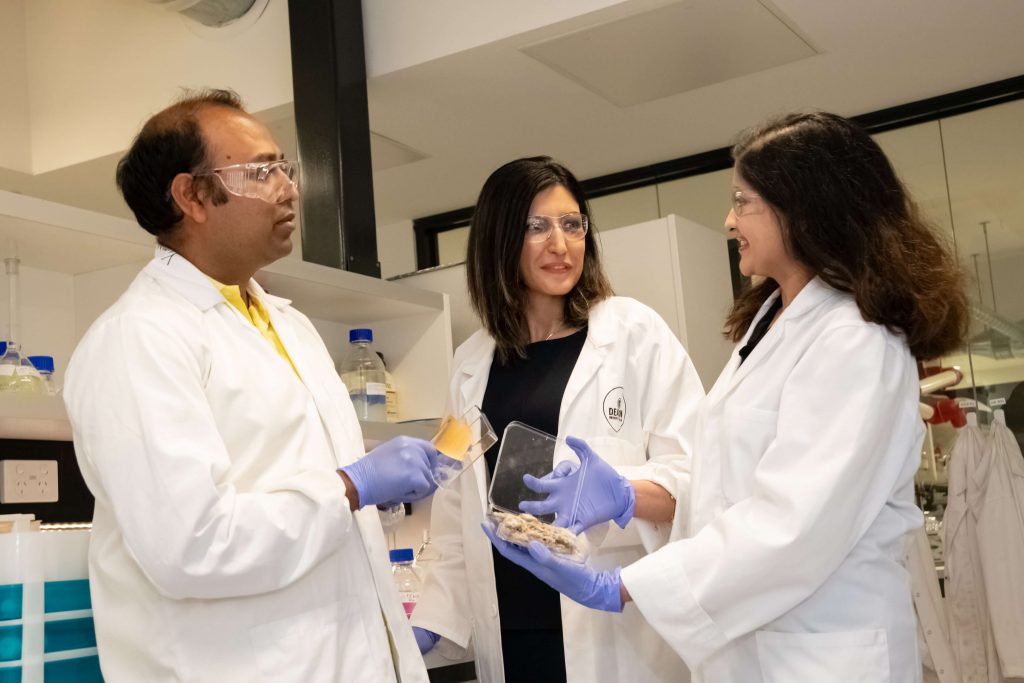
Led by Dr. Naebe, the team developed the bioplastic by repurposing cotton gin trash – the seeds, stems, short fibers and other waste by-products left behind from the ginning process used to separate cotton fibers.
Dr. Naebe said:
About 29 million tons of cotton lint is produced each year but up to a third of that ends up as cotton gin trash, where it’s then sent to landfill or burned, representing a major environmental impact and lost material value. Adding value to this waste product will give cotton growers and farmers an additional income stream, while also offering a sustainable alternative to harmful synthetic plastics.
Their achievement in transforming cotton gin trash to bioplastic is part of a project which they have been working on for over 18 months. Here’s how they did it:
- They dissolved the cotton leftovers using environmentally-friendly chemicals.
- Then, they re-cast the recovered biopolymer into a useable bioplastic film.
- What they ended up with was a material that is suitable for a range of applications, such as bale wrap, fertilizer, and cottonseed packaging.
 Dr. Naebe said:
Cotton gin trash is a promising source of renewable biomass, because when it’s broken down the resulting organic polymer can potentially be converted into a versatile biodegradable material. Compared to synthetic plastics, our bioplastic is made without the need for toxic chemicals – which makes it safer and cheaper to produce at a mass scale – and it has the added bonus of contributing to the circular economy. The bioplastic can biodegrade and turn into soil, which will then in turn be used to grow cotton, resulting in cotton gin trash during the ginning process, which can then be repurposed again into bioplastic.
Now the team is testing if, and how, their process could work with other organic waste and fibrous plant materials such as lemongrass, hemp, almond shells, wheat straw, wood sawdust, and wood shavings.
Image credit: Deakin University


