
In Michael Crichton’s Jurassic Park novel, scientists extracted blood-sucking insects from amber, removed the dinosaur blood from their stomach, and separated the DNA. Then they improved the DNA using computers and injected it into alligator eggs, which then later hatched into baby dinosaurs.
This science fiction novel is becoming all too real, as Paleontologists have recently announced the discovery of dinosaur DNA preserved inside a 75 million-year-old dinosaur fossil. In addition to the DNA, the team claims they found evidence of proteins, chromosomes, and cartilage cells, which means these can survive much longer than previously thought.
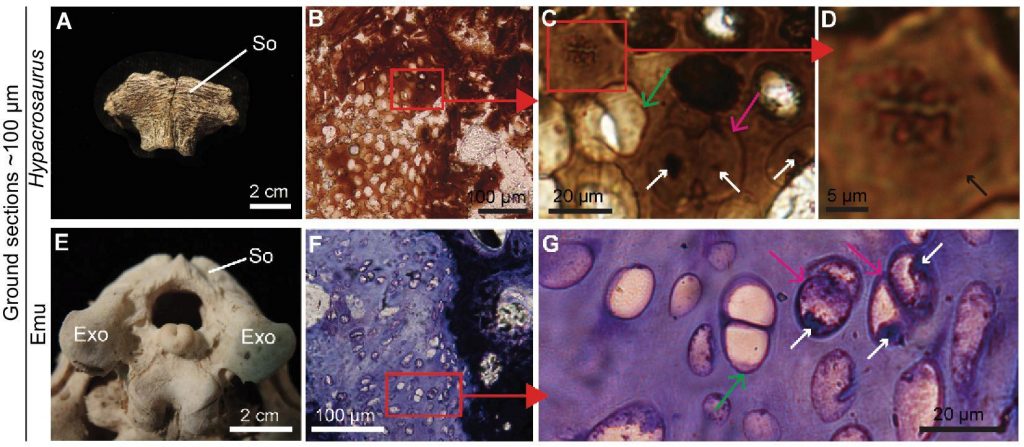
The discovery was made by researchers from North Carolina State University and the Chinese Academy of Sciences, who published their research in the journal National Science Review. The team analyzed the skull fragments of Hypacrosaurus, a duck-billed herbivore from the Cretaceous period, and found evidence of remarkably well-preserved cartilage cells. One of them contained structures that resembled chromosomes, while two of them were still linked in a way that looked like the final stages of cell division. These particular specimens the researchers analyzed were “nestlings,” meaning they were not old enough to leave their nest when they died.

Next, the team wanted to check whether any original proteins or molecules could still be preserved. So, they conducted two detailed analyses on other Hypacrosaurus skulls from the same nesting ground and compared the results to young emu skulls that are much more recent, as they are currently living in Australia.
The first analysis was an immunological test, which comprises applying a substance that reacts if it detects antibodies from a specific cell type. In this test, the substance reacted to antibodies of Collagen II, which is a protein generally found in animal cartilage. These findings suggest that remnants of the original protein are still present.
Of course, the reaction was much weaker for the dinosaur samples than the young emus. Also, the emus’ staining was spread across the whole sample, whereas in the dinosaur, it was localized in only one spot.
The second test involved the team searching for dinosaur DNA by isolating individual cartilage cells from the Hypacrosaurus and applying two separate staining substances that bind to DNA fragments. The staining occurred in the same pattern projected for modern cells.
Alida Bailleul, co-lead author of the study, said:
These new exciting results add to growing evidence that cells and some of their biomolecules can persist in deep-time. They suggest DNA can preserve for tens of millions of years, and we hope that this study will encourage scientists working on ancient DNA to push current limits and to use the new methodology in order to reveal all the unknown molecular secrets that ancient tissues have.
In the past, similar discoveries have had their share of criticism. In 2007, Dr. Mary Schweitzer, co-lead author on this study, found proteins and other soft tissues preserved in the femur of a Tyrannosaurus rex. However, some scientists argued that the data was misinterpreted, while others suggested that while the fossil was in the ground, it formed bacterial biofilms, which could have looked similar under the microscope. Another study indicated that the dinosaur samples might have been mixed up with ostrich DNA in the lab, where they were examining the samples.
Given these previous critics, the team was able to improve their study and make it more precise than previous examinations. They highlight that microbes do not produce Collagen II, so bacterial biofilms wouldn’t result in the tests coming back positive. The team also conducted comparisons to emu samples in completely different labs, so there would be no chance of cross-contamination. Finally, biofilms would create entirely different patterns in the DNA staining tests than what was seen in the samples.


