
Last year we showed you the completion of Europe’s first underwater restaurant situated at the southernmost point of the Norwegian coastline, in a place named Lindesnes. This year we’ve got an even bigger sunken building to tell you about, which will be located on the other side of the world, 60ft beneath the surface of the Caribbean Sea, off the coast of Curaçao. Currently, it’s only designed, but when built, it will be the world’s largest underwater habitat for advanced oceanic research.
The masterminds of the project are renowned aquanaut and conservationist Fabien Cousteau, the grandson of legendary ocean explorer Jacques Cousteau, and industrial designer Yves Béhar of the design firm Fuseproject – who partnered with Rutgers University, Northeastern University, and the Caribbean Research and Management of Biodiversity Foundation to make it happen. They plan to have it built within three years.
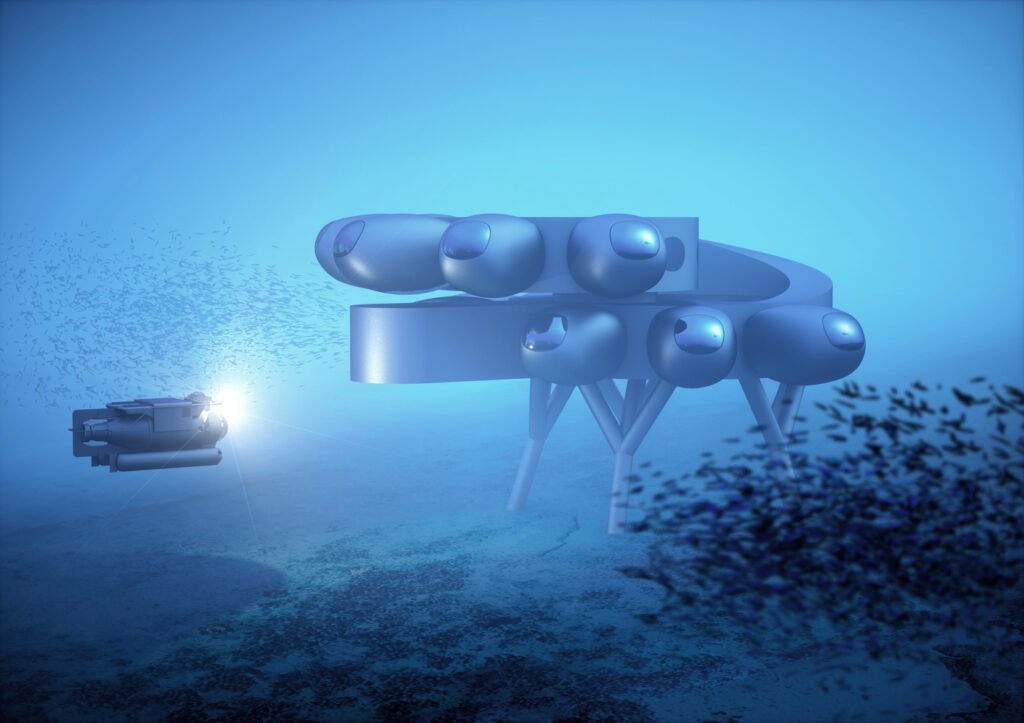
Designer Béhar told CNN:
We’ve worked recently on a lot of small living environments. We’ve worked on robotic furniture for tiny apartments. So, I think we had a good sense of how to design for comfort in constrained environments. That said, the underwater environment is completely different.
We wanted it to be new and different and inspiring and futuristic. So (we looked) at everything from science fiction to modular housing to Japanese pod (hotels). The design is also meant to echo ocean life, with its structure inspired by the shape of coral polyps.
The building consists of two circular structures stacked on top of each other and twisted, so the top of the bottom one is exposed and lined with windows to let in as much light as possible. The side of these circles is lined with a row of protruding bubble-like pods, which will be assigned each a different purpose, including personal quarters, a video production facility, laboratories, and medical bays. The pods will be detachable, and the biggest one is a moon pool for docking submarines and entering/exiting the facility.
Proteus will be powered by ocean thermal energy conversion, solar, and wind energy. It will also feature a greenhouse for food.
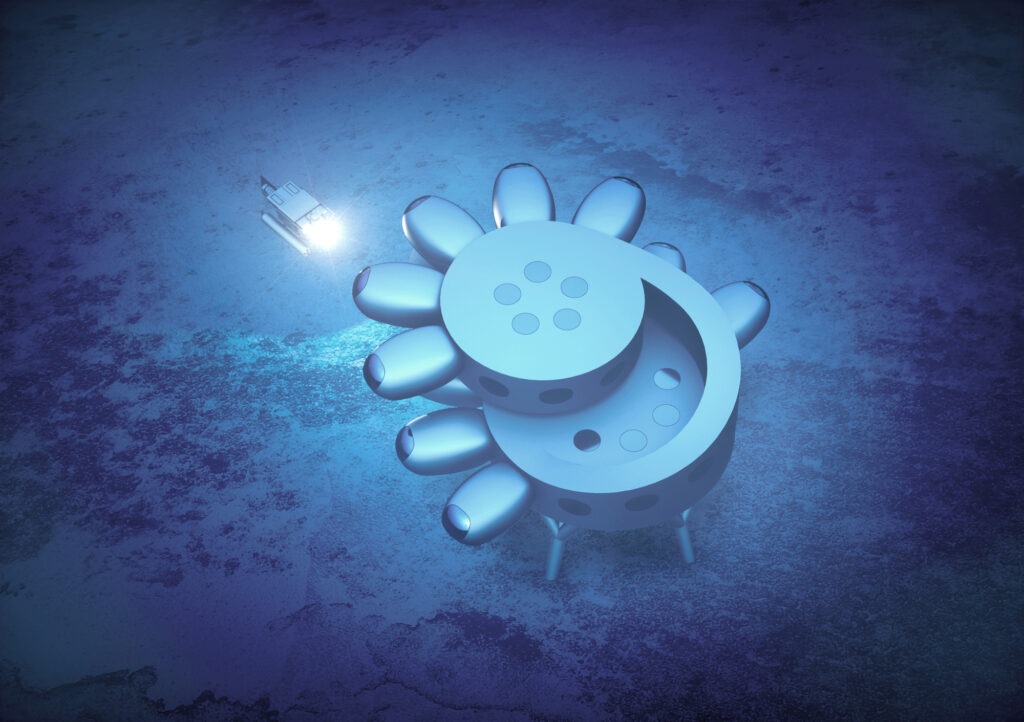
The Fabien Cousteau Ocean Learning Center (FCOLC) envisions Proteus to be the underwater version of the International Space Station. The 4,000-square-foot modular station is called Proteus, and it will provide a home and laboratories for up to twelve marine biologists and researchers from across the planet who are studying humanity’s critical concerns such as, food sustainability, scientific discoveries like new marine life, the effects of climate change, and medicinal breakthroughs. The world’s leading government agencies, academics, and corporations will be able to collaborate in the spirit of collective knowledge to advance science for the benefit of Earth and humanity, irrespective of borders.
Cousteau said:
Ocean exploration is 1,000 times more important than space exploration for — selfishly — our survival, for our trajectory into the future. It’s our life support system. It is the very reason why we exist in the first place.
According to the National Oceanic and Atmospheric Administration (NOAA) estimates, humanity has explored about 5% of the oceans that cover 71% of the world’s surface. Furthermore, only 19% of it has been mapped (thanks to The Nippon Foundation-GEBCO’s Seabed 2030 Project) – an achievement that was just recently accomplished – with 13% of that having been mapped in the last three years alone.

Yet, space exploration receives more funding and attention. Cousteau hopes to change that by filming and then broadcasting from Proteus to show the world all the treasures the ocean contains.
Cousteau said:
Imagine if you found something amazing — whether it be microcosmic like a pharmaceutical, or macrocosmic like the next greatest animal — if you could show it to classrooms and universities. Our mission is to be able to translate complex science into something that the average person not only maybe will understand, but fall in love with.

But why build a place to stay underwater instead of just diving every day and returning to a lab on land? There are two main reasons which include: the ability to remain underwater day and night and for more extended periods; and eliminating the need for divers to have to decompress daily. Marine habitats allow scientists to spend all day researching because they are already saturated, meaning their bloodstream is equalized to the pressure of the surrounding water. This dramatically accelerates their research capacity.


