
London plans to make its popular rail network ‘the London Underground’ zero-emissions by 2030 and to have the entire city carbon neutral by 2050. The city will start working towards this goal by transforming the network to be powered entirely by renewable energy.
One of the UK’s most significant consumers and London’s largest electricity consumer is Transport for London (TfL). It uses around 1.6TWh per year, which is the same amount of energy to power 437,000 regular homes. Without counting the trams, over-ground trains, and buses, the tube alone consumes roughly 1.2TWh each year.
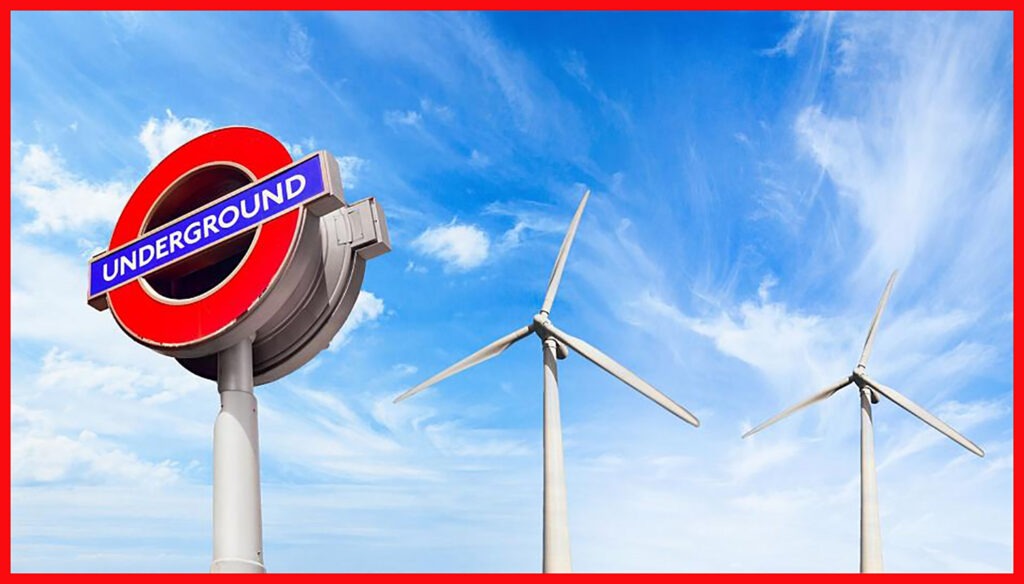
A British Business Energy study shows that it would require 5.6 million solar panels or 200 wind turbines to power the network entirely on renewables for one year. That’s a lot of solar panels! It would fill the same amount of land as the London Borough of Kensington and Chelsea, which is 12.12 km².
The London Underground already has 16% of its energy used to power the network from renewable sources. Rather than filling up precious land with solar panels and wind turbines to make up the rest, London City Hall has released energy requirements for the Underground so they can buy the electricity from renewable energy suppliers.
Sadiq Khan, the Mayor of London, explained:
As one of the single biggest purchasers of energy in London, it is important that TfL leads the way on green energy. This is a vital step towards my ambitions for TfL – and London – to be zero-carbon by 2030.
London City Hall plans to expand the use of renewables to its entire estate, which includes all of the TfL networks along with the energy requirements of the fire services and police. The move was praised by environmental organizations, including the Renewable Energy Association and Greenpeace.
Khan said:
This work to secure cost-effective and renewable energy for the rail network, with ambitions to include the wider [Greater London Authority] group and beyond, will play a key role in London’s green recovery and accelerating action on the climate emergency.
Nearly 50% of UK businesses are working on the computer at home due to COVID-19. If 45% of London’s residents continued to work at home in the future, it would save more than 460,000 kWh of electricity, which is the same as powering 46,000 houses every day.


