
A group of scientists at the Research Institute of Molecular Pathology in Austria has broken a new record for sequencing the largest animal genome to date – the endangered, air-breathing, Australian lungfish (Neoceratodus forsteri).
This lungfish is one of the few living relatives of the first land vertebrates. Its genome comprises 43 billion base pairs, which are around 14 times larger than the human genome and 30% larger than the previous record-holder: the axolotl, a Mexican amphibian that the team sequenced in 2018.

Siegfried Schloissnig and his colleagues used high-powered computer sequencers to piece together the lungfish genome. They used several copies of the genome, fragmented into tiny pieces of DNA, to account for inherent errors that the sequencers introduce. After all these fragments were sequenced, the team reassemble the fragments into a complete genome using algorithms.
Schloissnig estimates that the final result took approximately 100,000 hours of computer processing power. The research was published on January 18 in the journal Nature.
The Australian lungfish lives in still waters and slow-flowing rivers of south-east Queensland. According to Schloissnig, the lungfish has changed very little in appearance since the era when animals began evolving from a water-based to a terrestrial-based lifestyle. The animal has a single dorsal lung, allowing it to breathe air at the water’s surface, and its fins are flipper-like and fleshy.
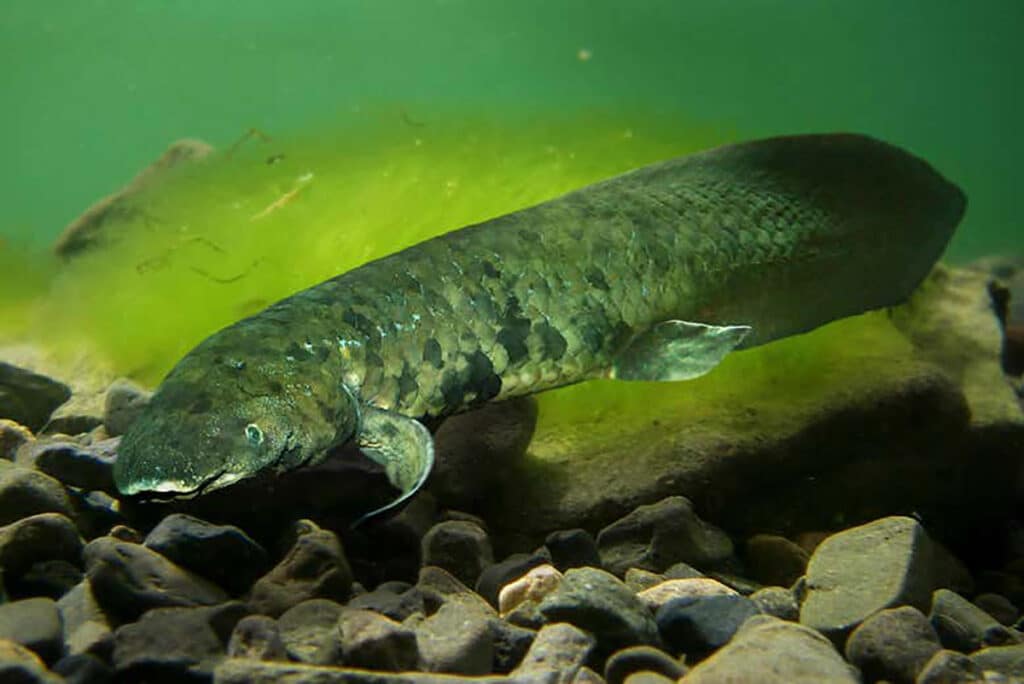
Previously, it was unknown whether lungfish or coelacanths (a now-rare group of archaic fish found near Indonesia in the Indian Ocean) were more closely related to land-based vertebrates, like mammals and birds.
The new genomic study shows unequivocal evidence that lungfish are more closely connected to the evolutionary line that led to four-legged animals. Coelacanths diverged earlier, while lungfish branched off from the line around 420 million years ago. “In order to get out of the water, you need to adapt towards a terrestrial lifestyle. You have to be able to breathe air; you have to be able to smell,” added Schloissnig.
The genome sequence also revealed that the Australian lungfish is similar to amphibians when it comes to the number and expression levels of genes linked with the development of articulated limbs and lungs and the ability to detect air-borne smells. “When you look at it from a genomic perspective, it is genomically halfway between a fish and a land-based vertebrate,” Schloissnig concluded.
The newly sequenced lungfish genome can teach us about adaptions to life on land and shed light on how particular genomes evolve to be so large.


