
Australian scientists from the Chalker Lab at Flinders University have developed a promising new manufacturing and recycling technique for making “green’ bricks and other construction material. The method – called reactive compression molding – can make bricks from waste plant fibers, recycled PVC, or sand by using a remarkable new kind of rubber polymer that was discovered by the team.
Co-author and research collaborator Dr. Louisa Esdaile said:
This important research looks at ways to repurpose and recycle materials so that these materials are multi-use by design. Such technology is important in a circular economy.

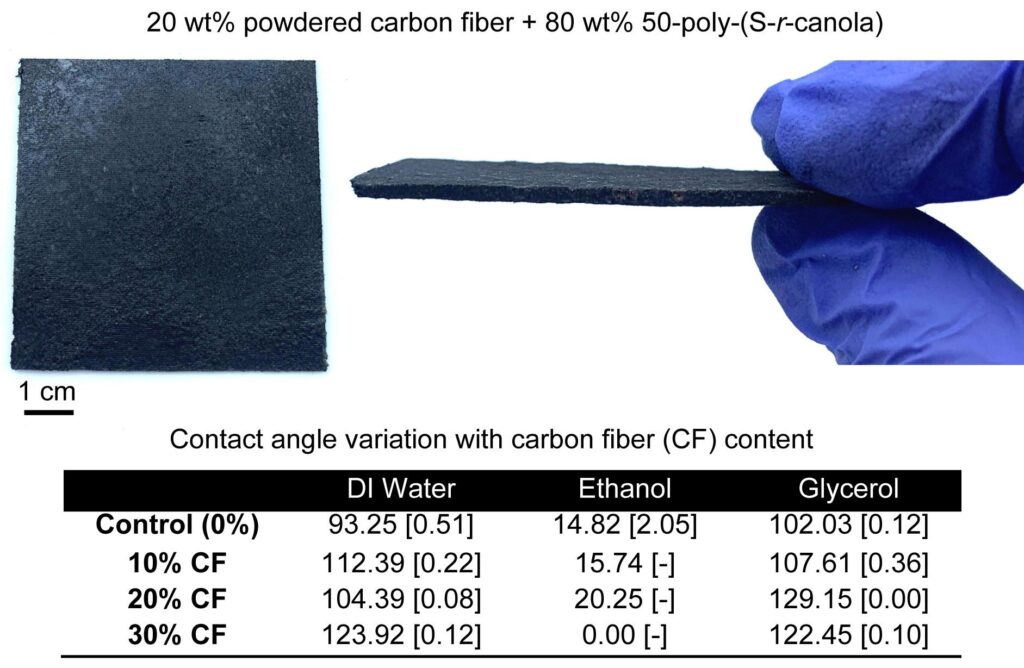
The revolutionary material can be stretched and compressed but doesn’t melt. It’s made from canola oil and sulfur. The particular chemical structure of the sulfur backbone is what enables all the pieces of rubber to bond together. The rubber polymer can be heated and compressed with fillers to entirely new composites, including more sustainable building blocks, insulation, or even concrete replacement.
Justin Chalker, an organic chemistry researcher, and Flinders University Associate Professor said:
This method could produce materials that may one day replace non-recyclable construction materials, bricks, and even concrete replacement.
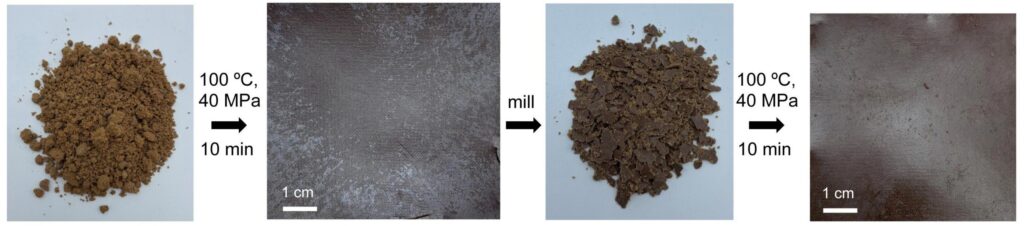
The powdered rubber can be used to make rubber coatings, tubing, or bumpers too.
Nic Lundquist, the lead author, and a Flinders Ph.D. said:
This new recycling method and new composites are an important step forward in making sustainable construction materials, and the rubber material can be repeatedly ground up and recycled. The rubber particles also can be first used to purify water and then repurposed into a rubber mat or tubing. This is also important because there are currently few methods to recycle PVC or carbon fiber.
The construction industry globally accounts for about 18% of all greenhouse gas emissions. Concrete production alone contributes to an estimated over 8% of those emissions – primarily due to the cement, a finite resource that is heavily polluting in its creation. Smarter alternative material options, such as this novel rubber polymer by the Flinders scientists, are essential in our fight against climate change.
Other construction materials recently developed using recycled materials to promote a circular economy include polymer concrete made from recycled glass, bendable concrete made from wood and waste, bricks made from 90% recycled construction materials, as well as bricks made from plastic and organic waste.


