
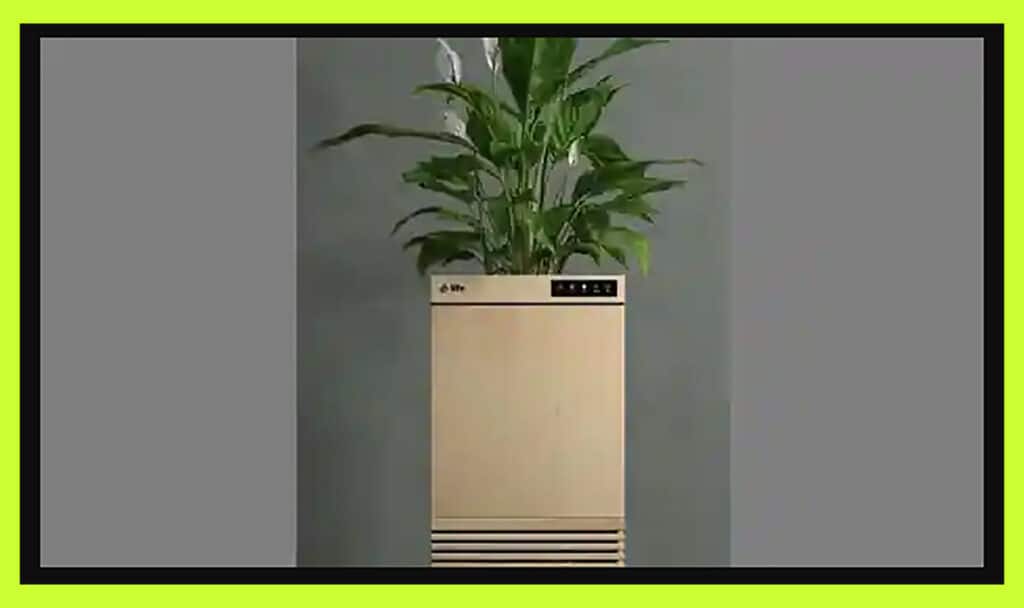
Scientists from the Indian Institutes of Technology (IIT) Ropar, IIT Kanpur, and the Faculty of Management Studies of Delhi University have joined forces to develop a living plant-based smart air purifier. Dubbed ‘Ubreathe Life,’ the device amplifies the air purification process in indoor spaces.
IIT Ropar’s startup company, Urban Air Laboratory, claims it’s the world’s first ‘Smart Bio-Filter’ that can make the air quality fresh. The smart filter was developed at IIT Ropar, a designated iHub—Agriculture & Water Technology Development Hub by the Indian Government’s Department of Science and Technology.

How does the air purifier work? It cleans the air via an integrated living plant. The air in the room connects to the leaves, then makes its way to the soil and roots, where pollutants are purified. This device uses novel technology, including the ‘Urban Munnar Effect’ and patent-pending “Breathing Roots,” to amplify the plants’ phytoremediation process. This bioremediation process uses plants to remove and destroy contaminants in the groundwater and soil.
‘Ubreathe Life’ improves air quality by removing gaseous, particulate, and biological contaminants while enhancing oxygen levels via plants, UV disinfection, charcoal filters, pre-filters, and HEPA filters fitted into a wooden box.
The smart purifier includes a centrifugal fan that creates suction pressure and releases clean air from the roots through the opening in a 360-degree manner. The specific plants tested for the ‘Ubreathe Life’ purifier include snake plant, peace lily, spider plant, and more. All of the tested plants showed excellent results in purifying indoor air. To see which species are considered the strongest air-purifying plants, see our complete guide.
It is worth being precise about which pollutants a device like this can actually shift. Particulates and VOCs are where botanical filtration does real work. Carbon dioxide is a different story, because ventilation alone is what governs it indoors, and a passive potted plant cannot change that. We explain the difference in our guide to indoor CO2 levels, and why plants cannot beat a ventilation ceiling.
Sanjay Maurya, the CEO of Ubreathe, explained, “The consumer need not water the plant regularly as there is a built-in water reservoir with a capacity of 150ml, which acts as a buffer for plant requirements. In addition, the device supplies water to the roots whenever it gets too dry.”
According to Professor Rajeev Ahuja from IIT Ropar, the Air Quality Index for a room size of 150 sq. ft. drops from 311 to 39 in only fifteen minutes after using the ‘Ubreathe Life’ air purifier. Ahuja claimed that this is the world’s first living plant-based air purifier and could prove to be a game-changer.
A few months ago, we saw another excellent example of how plants could help purify air quality. Two European architects developed algae-filled plastic curtains to turn building facades into “living walls” that clean dirty outside air and remove CO2.


