
There is a hard ceiling on what ventilation can achieve indoors, and almost nobody knows it exists. Open the windows, turn up the fan, and replace the air filters, and the lowest carbon dioxide level you will ever reach is the level of the air outside. You can match the outdoors. You can never beat it.
That ceiling is becoming a problem. Outdoor carbon dioxide is running above 427 parts per million and is projected to climb as high as 936 ppm within fifty years. Every new building standard, every air change per hour, every piece of ventilation engineering is calibrated to hit a number that is itself quietly rising.
Researchers at the Yale Center for Ecosystems and Architecture, working with teams from NYU Tandon, Purdue, and the engineering firm Buro Happold, think there is a way around the ceiling that does not rely on outdoor air at all. Their approach, detailed in a paper published online in August 2026 in Energy and Buildings, puts photosynthesising biology inside the building envelope and uses it to actively pull carbon dioxide out of room air rather than merely diluting it. Their models indicate that some room configurations could push indoor carbon dioxide below the outdoor baseline, a result conventional HVAC physically cannot produce.
It is an early-stage finding, not a product, and the honest version of the story is more interesting than the headline version. This is what the research actually shows, why your houseplants will never do it, and what it would take to build a room that breathes.
Why Ventilation Has a Ceiling, and Why It Is Rising
Carbon dioxide in a non-industrial building comes almost entirely from people breathing. That makes it an unusually useful tracer: when CO2 climbs, it means the room is under-ventilated, and whatever else is building up alongside it, such as humidity, VOCs and odors, is likely building up too.
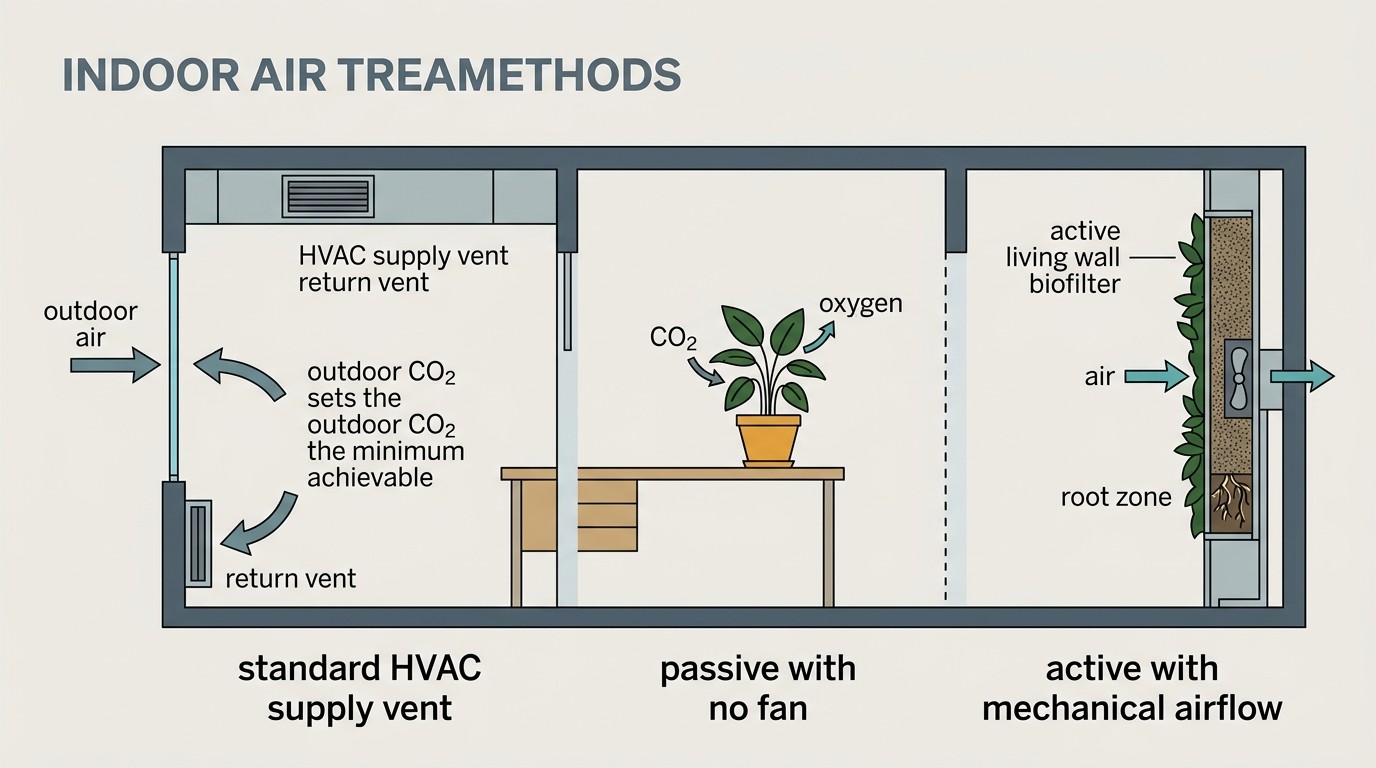
But the same property that makes CO2 a good tracer defines the ceiling. Because the outdoor air being drawn in is itself CO2-laden, diluting indoor air can only ever pull indoor concentration down toward the outdoor number. It cannot pull it lower. The American Society of Heating, Refrigerating and Air-Conditioning Engineers is explicit that indoor CO2 is a useful diagnostic tool only when understood alongside its limitations and that claims that Standard 62.1 requires CO2 to stay under a fixed threshold are incorrect. The same document notes that the 1,000 ppm figure was carried in the 1989 edition of the standard and later removed because it was routinely misread.
As the outdoor baseline rises, that ceiling rises with it. A room drawing outdoor air will simply track the outdoor concentration upward, and every ventilation specification calibrated against a fixed target inherits that drift. The Yale team’s own highlights, put it more bluntly still, state that prevalent HVAC paradigms are rendered ineffective as atmospheric CO2 rises.
Meanwhile, indoor pollutant levels in cities are already running two to ten times higher than outdoors, and urban residents spend roughly ninety percent of their lives inside. The Yale paper also points to growing concern that chronic exposure to elevated CO2, even in the non-acutely-toxic range, may contribute to systemic inflammation, bone demineralization, and oxidative stress.
Crucially, the research body itself is more cautious than the headlines. ASHRAE’s position on indoor carbon dioxide is that existing evidence for direct impacts of CO2 on health, wellbeing, learning, and work performance at commonly observed indoor concentrations “is inconsistent,” and that this evidence does not currently justify changes to ventilation and air quality standards, regulations, or guidelines.
That is an important caveat to hold onto, and it is the reason the interesting question here is not “are CO2 levels bad for you” but “what can actually be done about them.”

What the Controlled Studies Actually Show
The health case for caring about indoor CO2 levels is contested, but it is not empty. Two controlled experiments underpin most of the argument, and both are worth knowing on their own terms.
A 2012 study led by Usha Satish placed participants in an office-like chamber at 600, 1,000, and 2,500 ppm. At 1,000 ppm, decision-making performance fell on six of nine scales. At 2,500 ppm, seven scales dropped sharply, while one scale, focused activity, actually improved.
In 2016, Joseph Allen and colleagues at Harvard and Syracuse ran a controlled crossover trial in which office workers spent a day under conventional conditions and days under green building conditions. Cognitive scores came in 61 percent higher on the green day and 101 percent higher on the two green-plus days, with CO2 and VOCs independently associated with the results.
Neither study settles what ASHRAE calls inconsistent evidence. Both were small, and later work has produced mixed results. But they help explain why the 1,000 ppm figure lingers in building design long after it was removed from the standard: it keeps turning up in the data.
What the Yale Research Actually Found
The paper, “Assessing building-integrated bioremediation infrastructure within the context of unsustainable rising atmospheric CO2,” was led by Phoebe Mankiewicz Ledins, with Anna Dyson, founding director of Yale CEA, as senior author. Co-authors came from Purdue, Buro Happold, NYU Tandon, Rensselaer Polytechnic Institute, and Weill Cornell Medicine. The team’s objective was to test whether biogenic systems could decouple indoor CO2 from outdoor conditions entirely.
Their central finding is a design insight, and it is larger than the headline suggests. When the researchers modelled bioremediation modules across common operating conditions, they found a 43-fold spread in carbon dioxide remediation capacity purely as a function of airflow orientation and light intensity. In other words, two identical installations could differ in performance by more than an order of magnitude based on design choices alone.
That number is the real story, and it is the reason indoor CO2 levels research is moving from a ventilation engineering question into a building design question. It also explains something that has dogged this field for years: plant-based air treatment has a long record of results nobody can reproduce, and a design spread this wide is a plausible reason why. When you understand that design variables, not biology, dominate performance, you can start specifying systems properly rather than buying them on aesthetics.
Using architectural, HVAC, and computational fluid dynamics modelling, the team also found that a range of scales and spatial configurations could, under the conditions evaluated, reduce indoor CO2 below outdoor baselines while delivering what they describe as biophilia and microbiome-diversification co-benefits. The abstract also notes that these models were shown to be viable across “a range of real building conditions.”
It is worth being precise about the status of this work. The paper is computational and modelling-based, drawing on the group’s prior experimental active green wall program. The accessible record does not name specific plant species, chamber volumes or measured light levels, so anyone claiming specific measured ppm figures from this study is overstating it. What is solid: the 43-fold performance range, the viability of sub-outdoor-baseline configurations under modelling, and the framing of ventilation as a system approaching its structural limit.
Why Your Houseplants Will Never Do This
This is where most indoor-plant coverage goes wrong and where a lot of readers have been misled. Potted plants do photosynthesise, and they do take in carbon dioxide. The problem is one of magnitude, and it is severe.
Researchers have repeatedly attempted the arithmetic. A 2018 review of applied horticultural biotechnology for indoor air, published in the Journal of People, Plants and Environment by Fraser Torpy, Thomas Pettit, and Peter Irga, found that normal indoor light levels were insufficient to support adequate photosynthesis for useful CO2 removal, and that in a full-sized building a meaningful effect would require a very large number of plants plus substantial additional lighting. Later work sharpened the number: researchers have reported that typical houseplants need light intensities of roughly 22,000 lux, achieved only with dedicated grow lighting, before they can meaningfully shift a 1,000 ppm indoor concentration.
The most quoted figure in this argument comes from Drexel University, whose 2019 reanalysis of three decades of chamber studies concluded that matching what an open window already does would take somewhere between 10 and 1,000 plants per square metre of floor space. A 2024 study of real offices found no significant link at all between plant numbers and corrected CO2 concentration. Those results do not contradict the Yale work. They describe the passive case it is designed to replace.
Engineered versions of the same idea already exist in small form. The Ubreathe Life unit packages living plants into a powered purifier, and moss-based walls such as CityTree have been deployed outdoors on the same principle.
A separate line of work reached a similar conclusion about algae and microalgae systems, which are far more metabolically efficient than houseplants but require engineered bioreactors, nutrient supply, and precise control to function. Without those conditions, they can make things worse: under low light, plants respire and add CO2 to a room rather than removing it.
That is the reason your houseplants are not the answer, and it is also why the flowerpot in the corner is not comparable to what the Yale group is describing. Their systems draw air through a growing medium rather than letting leaves passively exchange gases with room air, giving them a far greater contact surface and a controllable delivery rate.
For context on where plant-based methods do genuinely earn their place, our guide to the best indoor plants for air purification covers the volatile organic compounds that potted plants genuinely can help with and explains the limits of the evidence honestly. For the wider picture, see our breakdown of the role of indoor plants in air quality and our list of the top ten air-purifying plants for the home. Carbon dioxide is simply not that compound.

Airflow and Light: The Two Variables Everyone Gets Wrong
How the main approaches to indoor CO2 compare:
| Approach | Mechanism | Can it go below outdoor CO2? | Real-world status |
|---|---|---|---|
| Mechanical ventilation | Exchanges indoor air for outdoor air | No. Outdoor concentration is the floor. | Universal and required by code |
| Potted houseplants | Passive gas exchange at leaf surfaces | No. Respiration exceeds photosynthesis at indoor light levels. | Common, but ineffective for CO2 |
| Active living wall biofilter | Fans push room air through the root zone and growing medium | Modelled as possible, pending experimental validation | Early commercial systems exist |
| Algal or microbial bioreactor | Engineered reactors metabolising CO2 into biomass | Technically possible | Requires nutrients, light, and tight process control |
| HEPA or carbon air purifier | Filters particulates and some gases | No. CO2 passes straight through. | Widely owned, no CO2 benefit |
The most useful thing the Yale work offers anyone designing or specifying a biological air system is a diagnosis of why previous attempts have been unreliable. Two design variables dominate everything else, and both are routinely specified wrongly.
Airflow orientation determines whether air passes through the root zone or merely past it. An active living wall uses fans, or direct HVAC integration, to push room air through the growing medium rather than allowing passive diffusion. One review of green systems indoors notes that an active green wall integrated with HVAC lowered CO2 in a 25 square metre room, while a 15 square metre living wall in a 140 cubic metre office delivered a 20 percent cut in the ventilation energy needed and reduced CO2 by between 5 and 50 percent depending on light conditions. The same 15 square metre figure is worth holding onto, because it is a small installation in a modest room. The practical ceiling is not a technical curiosity.
Experiments at the University of Technology Sydney put firmer numbers on the same point. Their Chlorophytum modules removed 80 percent of chamber CO2 with the fans off, and a further 10 percent once the fans ran. Under strong light, a single square metre of wall with substrate ventilation offset roughly 16 percent of one occupant’s respiratory CO2, which works out to about twenty small modules to balance a single person.
Light intensity determines whether photosynthesis exceeds respiration at all. This is the variable most often overlooked, and getting it wrong is what turns a carbon-removal system into a carbon source. Experimental work published in Building and Environment in 2022 on a living wall combined with air conditioning found CO2 reduced by roughly ten percent, with the system maintaining air velocity between 0.20 and 0.30 m/s. Other passive living wall trials have found full LED illumination cutting cumulative CO2 exposure by up to 44 percent, and pulse tests showing reductions approaching 39 percent under LEDs. That last study is notable for its conclusion rather than its numbers, which is that passive living walls should be treated as complementary biological sinks rather than substitutes for ventilation. That is also, notably, the finding closest to what the Yale modelling work implies.
Here is the practical takeaway for anyone with a plant wall, a moss wall or a mossy air purifier at home. IL has previously looked at algae-filled building facades designed to strip CO2 from the air and microalgae systems that out-produce three hundred trees, and the same distinction applies: the mechanism matters far more than the novelty. Performance is not a property of the product. It is a property of how air is routed through it and how much light reaches it. A beautiful panel in a dim corner is, from a carbon dioxide perspective, decorative.
What Still Needs to Happen Before This Reaches a Building
Honest assessment requires naming the gaps. The Yale paper is a modelling and feasibility contribution, and several substantial steps sit between a computational result and a product on a wall.
- Validation at full scale. The sub-outdoor-baseline finding comes from architectural, HVAC and CFD modelling. Large-scale experimental confirmation in occupied buildings with published CO2 datasets is the obvious next requirement, and it is the evidence the research community will want first.
- Operational maintenance. Biofilters are living systems with irrigation, nutrient and microbial management requirements, unlike a filter you swap every three months, and there is as yet no standard maintenance regime comparable to the ASHRAE filter-change schedule that building operators already follow.
- No standardised performance metric. The field lacks an agreed equivalent of clean air delivery rate for biological systems. One trade study of living wall biofilters reported an average clean air delivery rate of about 40 litres of “virtual outside air” per square metre, rising to 80 to 100 litres with larger fans. Virtual outside air is a way of expressing cleansed air as a substitute for outdoor make-up air. It is a useful convention, but it is not standardised, and that study noted its results were still being prepared for peer-reviewed publication.
- Plant and substrate selection. Species, growing medium and root-zone depth all determine microbial surface area and airflow behaviour. There is no equivalent of the 1989 NASA clean air study that would let buyers compare products on a single axis, which is a central problem we flagged in our review of air-purifying plants and what the evidence actually supports.
- Integration with existing systems. For most buildings, the realistic deployment is a biofilter connected to existing HVAC ductwork, not a replacement for it, which is also how the Yale team frames it. Ventilation still has to handle everything biology cannot, and the paper does not claim otherwise.
There is also a genuine question about whether this is better framed as an air quality technology or an energy technology. A biofilter that reduces required outdoor air volume reduces the heating and cooling load of moving that air, which in a heating-dominated climate could be a considerably more commercially compelling number than the CO2 figure itself. The Yale group is pursuing that angle, and it is one of the more interesting unexplored angles here.
What You Can Do Now, Without a Living Wall
None of this is relevant to a reader who just wants their own home to feel less stuffy, and that reader is most of us. The practical ladder is shorter and less exciting than the research, but it works.
- Measure before you act. A basic indoor CO2 monitor costs very little and tells you something ventilation advice cannot. If a room reads consistently under 800 ppm when occupied, it is adequately ventilated. If it sits above 1,200 ppm with the windows shut, that is your answer.
- Ventilate for the actual occupants present. Ventilation rates are generally specified per person, which means an under-occupied meeting room is over-ventilated and a packed one is starved. Adjusting supply air to actual headcount is among the cheapest building interventions available. If you are planning work on a specific room rather than a whole system, our room-by-room guide to indoor air quality upgrades that optimise ventilation covers the practical options.
- Understand that 1,000 ppm is not a health limit. This is the most common misunderstanding in consumer air-quality content. CO2 below 1,000 ppm has long been treated as a marker of acceptable ventilation, and Health Canada’s residential indoor air quality guidelines note that the 1,000 ppm figure reflects a ventilation rate per occupant rather than a toxicity boundary. Carbon dioxide is considered non-toxic well above typical indoor levels. The symptoms people attribute to CO2 are usually a proxy for everything else accumulating alongside it.
- Keep lights high on any plant installation. If you have a plant wall or an active biofilter, lighting and airflow are the two variables that determine whether it works at all. This is the cheapest real improvement available to anyone who already owns one. If you are weighing mechanical options instead, our guide to sizing a mini split covers the ventilation calculations, and our breakdown of the latest ENERGY STAR heat pump rules covers the standards behind them.
- Treat VOCs and CO2 as separate problems. Potted plants, activated carbon and ventilation products each address different pollutants. A room can have excellent ventilation and still have poor air quality, and the reverse is also true. Our guide to creating a healthy home with good air quality covers the other half of that equation.
Frequently Asked Questions
Can plants actually reduce CO2 in a room?
Some plants and biological systems can, but ordinary houseplants cannot meaningfully. Photosynthesis rates at typical indoor light levels are too low to offset the CO2 a room’s occupants generate, and under dim conditions plants respire and add CO2 instead. The systems that do work draw air through a large growing medium with mechanical airflow and strong lighting, which is a different proposition from a potted plant.
What is a good indoor CO2 level?
For ventilation purposes, under roughly 800 to 1,000 ppm in an occupied room indicates adequate outdoor air supply. Understanding your indoor CO2 levels is the single most useful diagnostic a homeowner can run, because it converts a vague feeling of stuffiness into a number you can act on. It is a ventilation indicator rather than a health threshold. ASHRAE is explicit that indoor CO2 does not determine overall air quality, since temperature, humidity, particulates and gas pollutants all matter independently.
Is 1,000 ppm dangerous?
No. CO2 is considered non-toxic at concentrations far above typical indoor levels, and OSHA’s permissible workplace exposure limit is 5,000 ppm. However, elevated CO2 reliably signals under-ventilation, which means other pollutants and bioeffluents are likely accumulating too. That is why CO2 is best read as a proxy rather than a direct hazard.
How much CO2 do people produce indoors?
Human metabolism is effectively the only significant source in a non-industrial building, which is what makes CO2 such a clean tracer for ventilation. That also sets the scale: any biological system has to contend with the respiration of everyone in the room, and the photosynthesis has to exceed it net of the plant’s own respiration.
The Real Story Is a Design Problem
It would be easy to write this as “plants beat air conditioning,” and that would be wrong. Passive plants do not beat ventilation, and the Yale paper does not claim they do. What the research actually establishes is narrower and more interesting: that the ceiling on ventilation is real, that it is rising as atmospheric CO2 climbs, and that a properly engineered biological system can be designed to sit below it.
The 43-fold performance range is the detail that should stick with you. It means the difference between a biofilter that works and one that does not is not the product you bought. It is airflow orientation and light intensity, two decisions that are usually made by aesthetics rather than engineering. Fix those and the biology starts to pay. Leave them and a living wall is a very expensive houseplant.
As outdoor CO2 approaches its projected high, the assumption that fresh indoor air has a fixed quality will stop holding. Buildings that assume it, whether that assumption sits in a mechanical system or a tenant, will be increasingly mismatched to the world outside. Preparing for that is a design problem, and design problems have solutions.


