
Antarctica’s surrounding floating ice platforms (ice shelves) are vast yet highly vulnerable to collapse events caused by runoff and melting. And the rising temperatures that accompany climate change aren’t helping the situation. On the contrary, the hotter it gets, the more the ice melts, causing destabilization. This decade has already put the region through the most severe heatwaves on record, so the future’s looking pretty bleak.
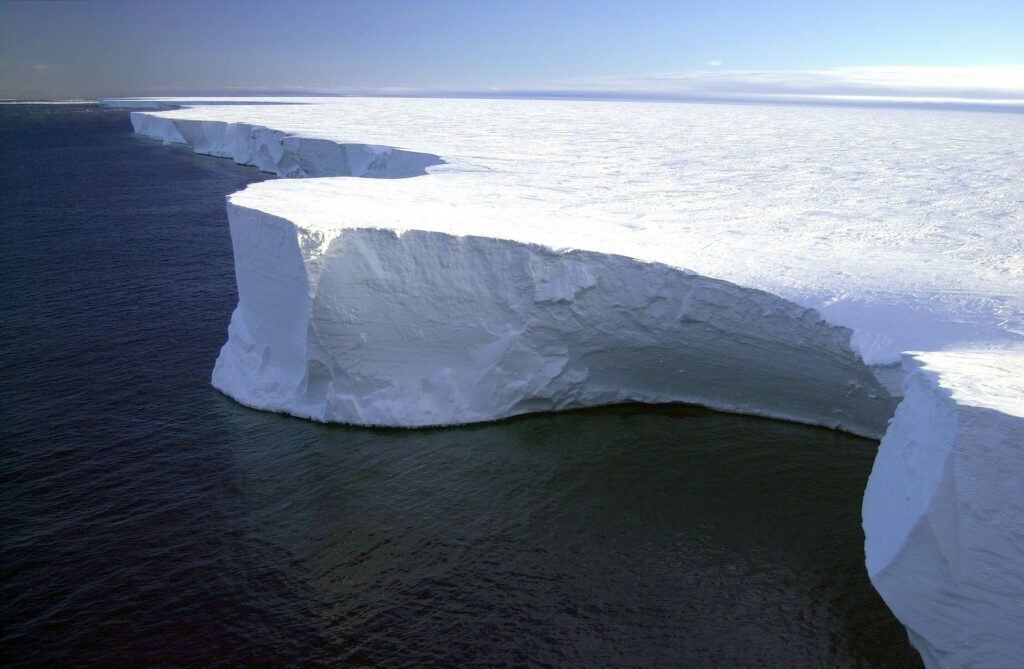
A new University of Reading-led study forecasts just how much ice could be lost around Antarctica if we fail to reduce planet-heating emissions with the urgency the move requires. It estimates that 34% of the continent’s ice shelf (including 67% of the Antarctic Peninsula) could collapse if global temperatures reach 4°C above pre-industrial levels. The findings bolster arguments for bolder climate policies.
Lead author Ella Gilbert, a research scientist at the University of Reading, told The Conversation:
“At 1.5°C, just 14% of Antarctica’s ice shelf area would be at risk.”
Limiting temperature rise to 2°C would halve the area at risk while also avoiding significant sea-level rise.
Gilbert explained in a statement:
“Ice shelves are important buffers preventing glaciers on land from flowing freely into the ocean and contributing to sea-level rise. When they collapse, it’s like a giant cork being removed from a bottle, allowing unimaginable amounts of water from glaciers to pour into the sea.
We know that when melted ice accumulates on the surface of ice shelves, it can make them fracture and collapse spectacularly. Previous research has given us the bigger picture in terms of predicting Antarctic ice shelf decline. Still, our new study uses the latest modeling techniques to fill in the finer detail and provide more precise projections.”
Check out my piece for @ConversationUK on how & why #Antarctica's #IceShelves are at risk as global #temperatures risehttps://t.co/FHexybvWll
— Dr Ella Gilbert (@Dr_Gilbz) April 9, 2021
These permanent ice platforms are floating in the ocean, attached to the coastline. Ice at the surface of these shelves melts every summer and trickles down into small air gaps in the underlying now layer where it refreezes. But, if there’s been little snowfall and lots of melting because it’s too hot, the water pools on the surface or into crevasses, widening and deepening them. Eventually, the ice shelf fractures and collapses into the sea.
Gilbert concluded:
“The findings highlight the importance of limiting global temperature increases as set out in the Paris Agreement if we are to avoid the worst consequences of climate change, including sea-level rise. If temperatures continue to rise at current rates, we may lose more Antarctic ice shelves in the coming decades. Limiting warming will not just be good for Antarctica—preserving ice shelves means less global sea-level rise, and that’s good for us all.”
All the more reason we need to push our leaders towards a quick end to the use of all fossil fuels! https://t.co/yrNUgjbkYG
— Food & Water Watch (@foodandwater) April 8, 2021
Low-lying coastal regions, like the small island nations of Tuvalu and Vanuatu in the South Pacific Ocean, face the most substantial risk from sea-level rise, Gilbert told CNN:
“However, coastal areas all over the world would be vulnerable, and countries with fewer resources available to mitigate and adapt to sea-level rise will see worse consequences.”
Previous research published earlier this year analyzing projections from the U.N. Intergovernmental Panel on Climate Change’s Fifth Assessment Report and the body’s Special Report on the Ocean and Cryosphere in a Changing Climate found that sea-level rise projections are “on the money” when tested against tide-gauge and satellite observations.
John Church of the University of New South Wales’s Climate Change Research Center and co-author of that study said at the time:
“If we continue with large ongoing emissions as we are at present, we will commit the world to meters of sea-level rise over coming centuries.”
According to a United Nations analysis, current emissions reduction plans are dramatically out of line with the 2015 Paris climate agreement to keep temperature rise to below 2°C, preferably 1.5°C. Therefore, parties to the Paris agreement update their nationally determined contributions (aka emissions reduction commitments) ahead of COP26 (November’s United Nations climate summit).


