
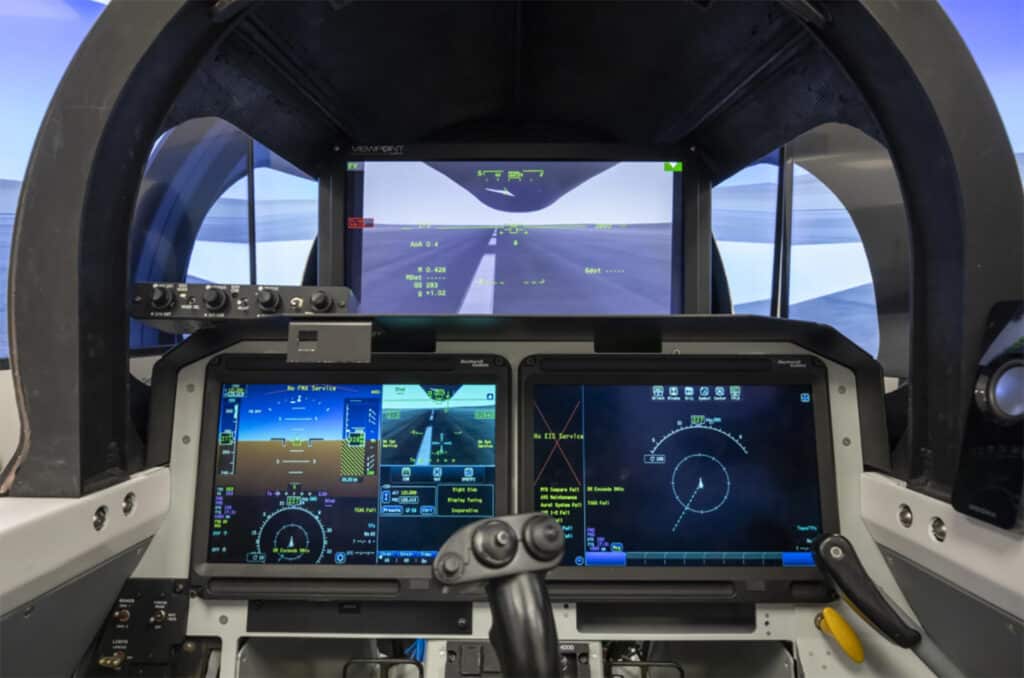
At the Langley Research Center in Virginia, USA, NASA has completed its final round of testing on the eXternal Vision System (XVS) 4K video screen for the agency’s X-59 Quiet SuperSonic Technology (QueSST) aircraft. The XVS is designed to replace x-59’s forward-facing flight deck window and will offer “an augmented reality view of the pilot’s forward line-of-sight along with graphical flight data overlays.”
Droop-Nose Design
A droop-nose design was one of the most distinctive features of the Anglo-French Concorde, a British–French turbojet-powered supersonic passenger airliner operated from 1976 until 2003.
When parked and during full flight, Concorde’s nose raised in the conventional straight position, and a glass heat shield slid into place, giving the aircraft the aerodynamics to fly faster than the speed of sound. However, the nose must be lowered for take-off, landing, and taxi because it’s almost impossible to look out the windshield with it up as the view is blocked.
While the droop-nose design was a brilliant solution to offer the flight crew a wider field of view, NASA takes a different approach.
Augmented Display
The X-59 will fly overland at supersonic speeds, but its wings and fuselage are designed to dissipate the notorious sonic boom, unlike other supersonic aircraft. Thus, that sound is reduced to being no louder than closing a car door. Since this modification puts a lot of constraints on different parts of the aircraft’s design, a droop nose might be a practical option.
Aerospace engineers see windows as a weak point on aircraft, and therefore, dislike them. This is why NASA has chosen to deal with the vision problem caused by the X-59’s elongated nose and the low-sitting cockpit by removing the forward window entirely. Instead, they’ve opted for a 4K video screen that gives the pilot a view of what’s ahead and provides flight data for take-offs, approaches, and landings on an augmented display.
Flight Tests
Flight testing involved NASA installing the XVS in a twin-engine Beechcraft King Air UC-12B turboprop aircraft, with a camera in the plane’s nose. In addition, the display was installed in King Air’s cabin and the XVS pallet comprising the computer processors, video distribution, network equipment, and power distribution components.
Once the installation was completed, one pilot flew the plane while another pilot in the cabin observed the new XVS screen. The King Air went through several flight scenarios with this setup, allowing engineers to make a side-by-side comparison of both pilots by measuring the time it took each to press a button, indicating that they had seen a target.

Installation Plans
Aside from the successful flight tests, NASA also conducted vibration tests of the pallet to ensure that it could withstand the flight conditions expected in the X-59. Through these tests, NASA gathered information to perfect the system’s overall design and construction before installing it in the supersonic demonstrator aircraft.
Now that the testing phase is completed, the XVS pallet has been shipped to Lockheed Martins’ Skunk Works facility in Palmdale, California, for installation in the supersonic X-59.


