
Mindfulness and anxiety have a fascinating inverse relationship, backed by substantial scientific evidence. Research shows mindfulness-based therapy reduces anxiety symptoms with a moderate effect size of 0.63 across general populations. However, this number jumps dramatically to 0.97 in patients specifically diagnosed with anxiety disorders, demonstrating nearly double the impact.
We’ve compiled this beginner’s guide because mindfulness meditation for anxiety isn’t just a passing wellness trend. In fact, studies involving over 1,100 participants demonstrate that mindfulness techniques change brain structures associated with attention and emotion regulation. These changes consequently help reduce worry and rumination—two key mechanisms that fuel anxiety.
Throughout this article, we’ll explore practical mindfulness exercises for anxiety that anyone can implement, regardless of experience level. For those wondering if meditation helps with anxiety, the science suggests a clear yes; this guide provides the exact steps to begin a journey toward greater inner peace.
Understanding the Powerful Link Between Mindfulness and Anxiety
The practice of mindfulness stands in stark contrast to our everyday mental activities. Initially developed from Buddhist traditions with a 2,500-year history, mindfulness teaches us to intentionally attend to our experiences with curiosity and compassion.
Understanding Mindfulness as Present-Moment Awareness
Mindfulness is the practice of directing attention to the present moment while adopting a nonjudgmental perspective toward experiences. This approach includes two essential components: attention and acceptance. The attention component involves tuning into your experiences in the present moment, while acceptance requires observing those feelings without judgment.
When practicing mindfulness meditation for anxiety, you’re essentially training yourself to:
- Monitor current experiences rather than predicting future events
- Notice direct sensations instead of getting caught up in stories about the experience
- Approach internal experiences with kindness rather than criticism
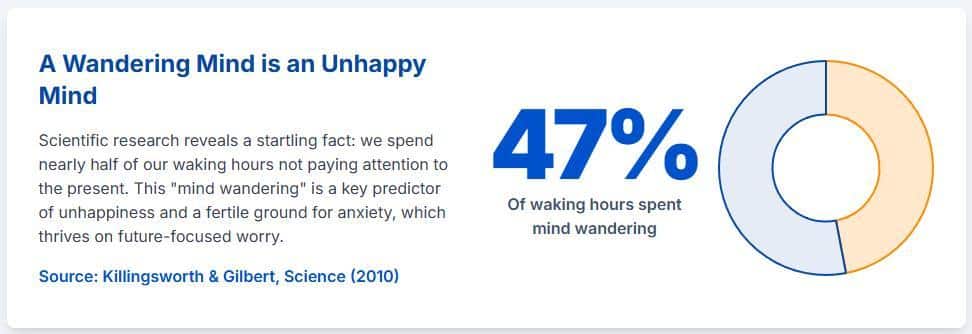
Studies show that approximately 47% of our waking hours are spent mind wandering, which subsequently predicts unhappiness. Furthermore, the capacity to keep one’s mind focused on the present moment correlates with higher psychological well-being.
The Link Between Anxiety and Future-Focused Thinking
Anxiety thrives primarily on anticipation of what might happen next.
This is reflected in clinical findings. For example, clinical anxiety is associated with increased frequency of neural and physiological responses toward the anticipation of negative future events. Additionally, depression is linked with reduced expectancy of positive future events.
This future-focused worry cycle creates a persistent pattern where the mind constructs negative scenarios that may never materialize. The tendency to anticipate negative outcomes leads to risk-avoidant decision-making patterns, creating a self-reinforcing cycle of anxious thoughts.
Why Mindfulness Is Gaining Popularity in Mental Health
Mindfulness techniques have gained substantial traction in mental health treatment due to their proven effectiveness. Mindfulness-based stress reduction (MBSR) is just as effective as escitalopram (Lexapro) in treating adults with anxiety disorders.
A comprehensive review examining 47 trials found mindfulness-based therapy was especially effective for reducing stress, anxiety, and depression. Beyond merely reducing symptoms, mindfulness influences two different stress pathways in the brain, changing structures and activity in regions associated with attention and emotion regulation.
The growing popularity also stems from mindfulness being a trainable skill that creates distance between thoughts and reactions. Rather than being swept away by anxious thinking, mindfulness helps us observe thoughts as passing mental events, giving us choice in how we respond.

How Science Proves Mindfulness Calms an Anxious Brain
Neurobiological evidence reveals why mindfulness and anxiety operate as opposing forces in the brain. The science reveals sophisticated mechanisms explaining meditation’s effectiveness beyond mere relaxation.
How Mindfulness Changes Brain Activity
Brain imaging studies show that mindfulness meditation practices create measurable changes in key brain regions. Research reveals structural and functional changes in areas primarily involved in attention systems, emotion regulation, and self-referential processing.
One study demonstrated that changes in brain activity in subjects who learned to meditate held steady even when they weren’t meditating. Moreover, researchers found that an 8-week mindfulness program increased cortical thickness in participants’ brains. This suggests neuroplastic changes occurred in several key areas, including:
- The prefrontal cortex (decision-making and impulse control)
- The insula (body awareness and emotional self-awareness)
- The amygdala (fear center with reduced activity after training)
Reducing the Stress Response Through Awareness
Mindfulness influences two different stress pathways in the brain, changing structures and activity in regions associated with attention and emotion regulation. This physiological impact extends throughout the body—studies show meditation reduces cortisol, C-reactive protein, blood pressure, heart rate, triglycerides, and tumor necrosis factor-alpha.
The stress-buffering theory explains that acceptance is the main ingredient in mindfulness training that enables adaptive responses to stress. This acceptance buffers habitual appraisals and responses, facilitating new coping strategies.
Improving Emotional Regulation and Cognitive Flexibility
Mindfulness meditation enhances cognitive flexibility—our ability to adapt mental strategies under changing conditions. Path analysis research confirms that mindfulness training improves cognitive flexibility, with this effect fully mediated by “non-reactivity” by week six of practice.
Cross-sectional studies comparing experienced meditators with non-meditators found that those who meditated performed significantly better on all measures of attention. Furthermore, mindfulness training improves a process called “deautomatization.” This skill is the ability to interrupt automated responses and react non-habitually to challenging situations—precisely what’s needed during an anxiety episode.

How Mindfulness Works: The Four Pillars of Anxiety Relief
Understanding the psychological mechanisms behind mindfulness reveals why it is so effective for anxiety management. While conventional treatments often address symptoms, mindfulness directly targets the underlying mental processes that fuel anxiety disorders.
Worry: Breaking the Cycle of Future-Focused Fear
At its core, anxiety thrives on anticipatory thinking about potential negative outcomes. Mindfulness counteracts this pattern by enhancing attentional control – arguably one of its primary mechanisms. By training the mind to anchor in present-moment experiences, mindfulness reduces negativity bias and broadens the attentional field to include neutral and positive stimuli. Throughout practice, this ability to maintain present focus gradually weakens the grip of future-focused fears.
Rumination: Letting Go of Repetitive Negative Thoughts
Repetitive negative thinking, or rumination, acts as an emotional magnifier that strengthens depression’s effect on thinking. Studies identify rumination as a central mechanism triggering depressive disorders. Research shows it exacerbates distress through four key pathways:
- Strengthening negative thoughts
- Interfering with effective problem-solving
- Disrupting instrumental behavior
- Reducing sensitivity to changing environments
Mindfulness disrupts this cycle by shifting attention to the present moment, thereby preventing the continuation of disruptive thinking patterns.
Reappraisal: Seeing Thoughts as Temporary Events
Mindfulness enhances cognitive flexibility, allowing individuals to reinterpret stressful situations more adaptively. Research demonstrates that the practice of mindfulness enables a process called “decentering”—stepping back and creating psychological distance from negative thoughts. Accordingly, studies show that increases in decentering are associated with decreased anxiety among mindfulness-based intervention participants.
Suppression: Why Avoidance Doesn’t Work
Attempting to suppress unwanted thoughts paradoxically increases their frequency—a phenomenon called “thought rebounding.” Harvard research on “white bears and other unwanted thoughts” confirms that thought suppression leads to persistent recurrence of the very thoughts one tries to avoid. In contrast, mindfulness teaches acceptance of thoughts without judgment, an approach that ultimately diminishes their emotional impact.
Self-Awareness: Building a Non-Judgmental Mindset
The practice of non-judgmental awareness remains central to mindfulness effectiveness. Given that rumination encourages hyper-vigilant responses to negative feelings, mindfulness develops awareness about our thinking while performing a protective role against these states. This approach enables individuals to observe thoughts as events passing through consciousness without becoming entangled in them, creating space between stimulus and response.

Your Toolkit: Simple Mindfulness Exercises for Immediate Relief
Practical tools for applying mindfulness to anxiety create tangible relief through simple daily exercises. These evidence-based techniques require no special equipment—just your attention and a willingness to practice.
Mindfulness Meditation for Anxiety: A Simple Breathing Practice
To begin a basic breathing practice, find a comfortable position with your back straight and feet flat on the floor. Close your eyes and focus exclusively on your breath moving in and out of your body. When distracting thoughts arise, simply acknowledge them and return your attention to breathing.
Diaphragmatic or “belly breathing” specifically counteracts the shallow breathing pattern associated with anxiety by engaging the parasympathetic nervous system. For a structured exercise, try square breathing: inhale for four counts, hold for four, exhale for four, and pause for four before repeating.
Body Scan to Reconnect With Physical Sensations
The body scan meditation helps you recognize where you hold tension without trying to change anything. Lie comfortably with your back supported and systematically direct your attention from head to toe (or vice versa). Notice sensations in each body part—warmth, coolness, tingling, or tightness. As you observe each area, many people experience the body naturally releasing tension in response to this gentle awareness. This practice reconnects you with physical sensations rather than anxious thoughts.
Labeling Thoughts and Emotions Without Judgment
Labeling involves quietly naming what you’re experiencing: “thinking,” “worrying,” or more specifically “anger,” “fear,” or “planning.” This creates psychological distance between you and your thoughts. Research shows this practice activates the prefrontal cortex while reducing amygdala activity, helping regulate emotional responses. Remember, you are not your thoughts—they come and go while you remain yourself.
Using Mindful Walking to Ground Yourself
Mindful walking transforms an ordinary activity into a meditation. Rather than walking on autopilot, pay deliberate attention to each movement—the sensation of your feet touching the ground, your balance shifting, and your arms swinging naturally. Simultaneously notice your surroundings with full awareness. This technique proves particularly effective during heightened anxiety, as it combines physical movement with present-moment focus.
Creating a Daily Mindfulness Habit
To make mindfulness second nature, remember that consistency matters more than duration. Start with just five minutes daily, gradually increasing as comfort grows. Choose anchor moments in your daily routine—perhaps your morning shower, the first sip of coffee, or returning home from work—to practice full presence. Setting calendar reminders or connecting practice to existing habits helps establish consistency over time.

A Final Word on Your Mindfulness Journey
Present-moment awareness directly counteracts the future-focused thinking that fuels anxiety, while neurobiological changes in the brain explain why these simple techniques yield significant results. Remember that mindfulness works by breaking worry cycles, reducing rumination, and building non-judgmental self-awareness. Consistency matters more than perfection; starting with just five minutes daily can gradually reshape your relationship with anxious thoughts.
The journey toward inner peace doesn’t require special equipment but rather a willingness to pause, breathe, and observe. Although anxiety can feel overwhelming, simply returning to the present moment provides a reliable path forward. Your mind deserves the same care you give your physical health, so consider incorporating one mindfulness technique from this guide into your routine. The distance between anxiety and calm is often just a few mindful breaths away.
Answering Your Questions on Mindfulness
What’s the Main Difference Between Mindfulness and Meditation?
Mindfulness is the quality of being present and fully engaged with whatever you’re doing at the moment. Meditation is the specific practice you do to cultivate that quality, often by setting aside time to sit and focus on your breath or bodily sensations.
How Long Does It Take to See Results From Mindfulness for Anxiety?
While some people feel calmer after a single session, neuroscientific studies show measurable changes in the brain after about eight weeks of consistent practice. The key is regular, daily effort, even if it’s just for a few minutes.
Can Mindfulness Make Anxiety Worse at First?
For some, sitting quietly can initially heighten awareness of anxious thoughts. This is a normal part of the process. The goal isn’t to eliminate thoughts but to change your relationship with them by observing them without judgment, which ultimately reduces their power.
Do I Need to Sit Still to Practice Mindfulness?
Not at all. While seated meditation is common, you can practice mindfulness through many activities. Mindful walking, eating, or even washing dishes are excellent ways to ground yourself in the present moment and integrate this skill into your daily life.


