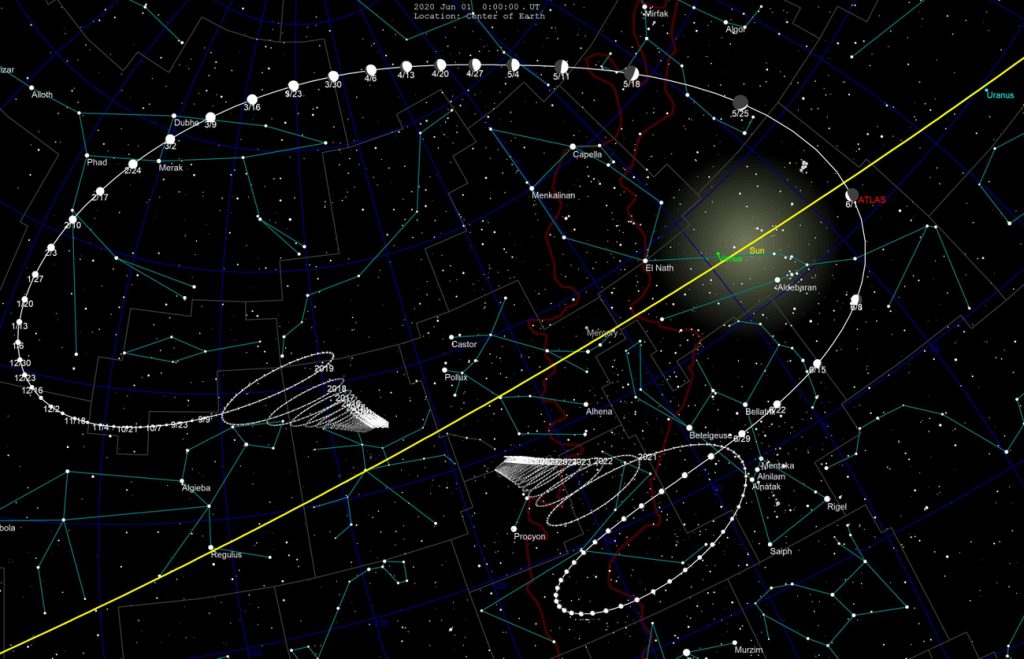
Comets are by far one of the most incredible sights to see in the sky. Experiencing that beautiful moment is something you will never forget; the beauty of comets stays in our memories forever. If you were never lucky enough to see a comet before, your luck might be changing. Now, comet Atlas is racing towards the inner solar system, and it could be the brightest comet seen in the sky in over twenty years. It will be so bright that it could potentially be visible during the day in May.
“Out to sea, the calm lagoon waters were darkening, while the comets overhead glowed brighter, omens in the gloaming.”― Julian May, Perseus Spur
In December 2019, the comet was discovered by astronomers at the Asteroid Terrestrial-impact Last Alert System (ATLAS) in Hawaii. The ATLAS observatory, operating since 2017, was designed to protect the planet Earth from asteroids by detecting near-Earth objects. Every year, the observatory spots roughly 100 space rocks measuring around 100 feet (30 meters) in diameter, and sometimes it discovers comets. The same survey made history again in July 2025 when it spotted 3I/ATLAS, only the third confirmed interstellar object to pass through our solar system.
In January, when the astronomers discovered comet Atlas, also known as C/2019 Y4, it was exceedingly dim. However, the comet became 4,000 times brighter in just a month! The astronomers were shocked because this increase was much more significant than what they predicted. They believe that it could mean that the comet will be exceptionally bright.

Karl Battams, from the Naval Research Lab, said, “Comet ATLAS continues to brighten much faster than expected. Some predictions for its peak brightness now border on the absurd.”
The comet, currently in the constellation of Ursa Major, is following the same path taken by “the Great Comet of 1844.” In January 1845, the Great Comet was so bright that the naked eye could see it without using a telescope.
An 1850s report by The Astronomical Journal stated, “During the latter part of December and the first week in January, it was a brilliant object in the southern hemisphere, equaling, it is said, in brightness the celebrated comet of Halley in its last appearance.”
During these first weeks of April, Comet Atlas may also be visible to the naked eye under dark, cloudless skies. In May, the comet will begin to shine with a green hue, and as long as it doesn’t get damaged from the heat of the sun, then it could be bright enough to be seen during the day.
Comets are not easy to predict. In 1974, some astronomers believed Comet Kohoutek would be bright enough to lighten the night sky, but it never happened. Also, in 1990 and 2013, there were similar expectations from Comets Austin and ISON.
However, if Comet Atlas fails to live up to its expectations, we will not be alive to see it again because it won’t return till another 6,000 years.