
A novel device developed by scientists at the Chinese Academy of Sciences allows you to generate electricity from your swinging arms while walking. It’s a low-cost, wearable electric generator that harvests wind energy from a light breeze.
It’s a micro-energy source that can power sensors and small LEDs. The invention could be revolutionary because most of the available wind is too gentle to push commercial wind turbine blades.
Senior author Ya Yang of the Chinese Academy of Sciences said:
You can collect all the breeze in your everyday life. We once placed our nanogenerator on a person’s arm, and a swinging arm’s airflow was enough to generate power.
The device is a nanogenerator (not a turbine) made of two plastic strips housed in a tube that flutter (clap together) when there is airflow. It gathers energy through the triboelectric effect – the same phenomenon that generates static electricity. It happens when a material becomes electrically charged after separation from another material, in this case, the two strips.
If you ever rubbed a balloon on your head, heard the crackle of static electricity, and saw your hair stand up, then you understand the mechanism at work here. That energy is being bottled up and stored for future use.
Lead author Dr. Ya Yang of the Chinese Academy of Sciences said:
Our goal is to solve the issues that traditional wind turbines can’t solve. Unlike wind turbines that use coils and magnets, where the costs are fixed, we can pick and choose low-cost materials for our device.
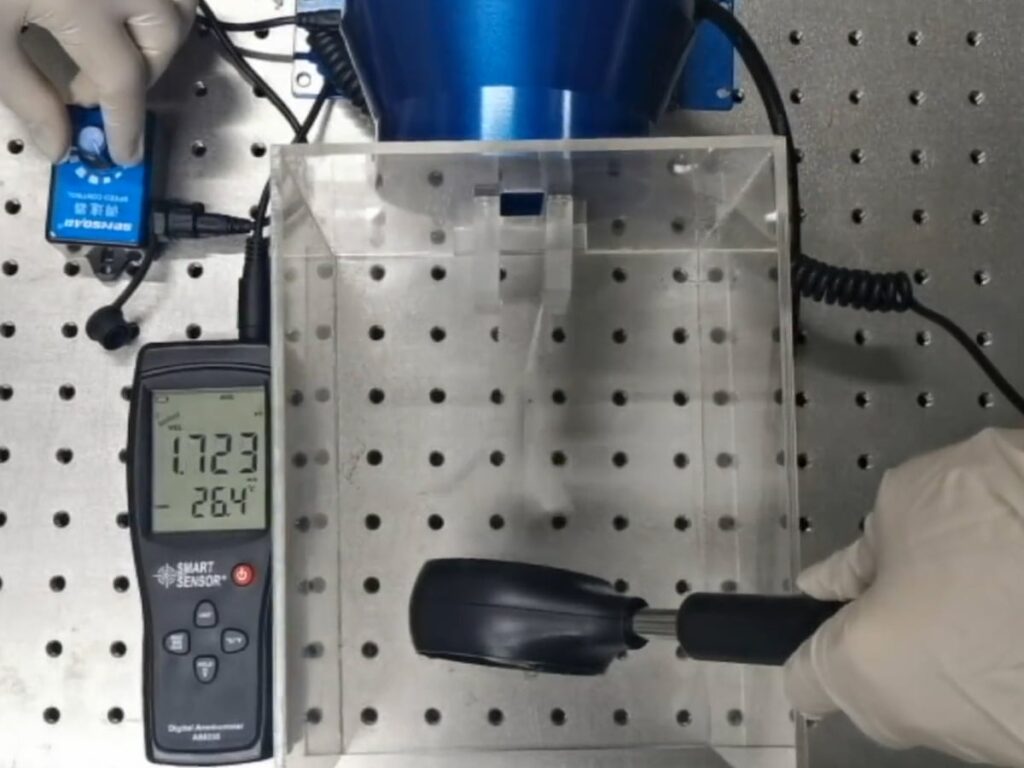
A gentle breeze of 1.6 m/s (3.6 mph) is enough to power the device. However, it works best at a speed that ensures the plastic strips flutter in sync – at a velocity between 4 to 8 m/s (8.9 to 17.9 mph). The device’s wind-to-energy conversion efficiency is 3.23% — which may seem low, but it’s higher than comparable energy-scavenging devices.
Richard Cochrane of the University of Exeter, who was not involved in the study, said:
We won’t see this innovation replacing the big turbines, but we are seeing increasing numbers of these sorts of technologies being used for energy harvesting …providing power in places that are otherwise quite hard to get electricity to.
The researchers have managed to power up 100 LED lights and temperature sensors so far. Yang said:
Our intention isn’t to replace existing wind power generation technology. Our goal is to solve the issues that traditional wind turbines can’t solve. Unlike wind turbines that use coils and magnets, where the costs are fixed, we can pick and choose low-cost materials for our device. Our device can also be safely applied to nature reserves or cities because it doesn’t have rotating structures.
I’m hoping to scale up the device to produce 1,000 watts, so it’s competitive with traditional wind turbines. We can place these devices where traditional wind turbines can’t reach. We can put it in the mountains or on the top of buildings for sustainable energy.
The next phase of the project is to make the nanogenerator even tinier and with higher efficiency. The ultimate goal is to combine it with small electronic devices such as phones to provide continuous sustainable electric power.


