
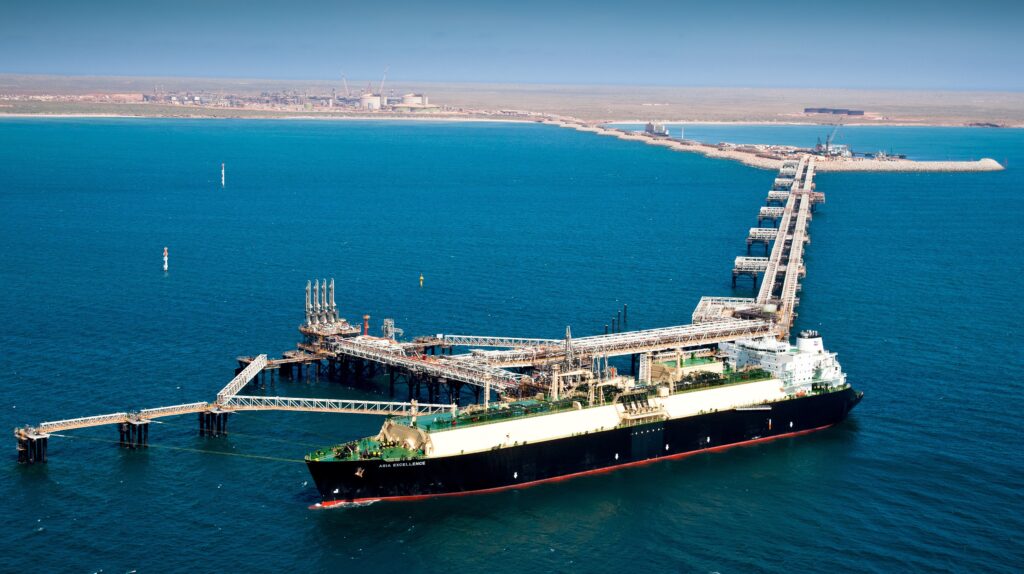
Chevron’s enormous $55 billion Gorgon LNG plant in Western Australia was allowed to be built under the condition that the company capture 80% of carbon emissions from the project over five years and inject them into a reservoir under Barrow Island. The facility became operational in 2016, but storage didn’t start until years later in 2019.
This is the nation’s largest liquefied natural gas (LNG) development, and Chevron’s failure to capture the emissions contributed a substantial amount to Australia’s emissions increase. Half of the entire country’s annual carbon dioxide emissions during those three years were linked to WA’s Gorgon LNG plant’s failure to bury the greenhouse gas underground!
The project’s carbon capture and storage technology (CCS) is considered a landmark development, one that has long-promised to limit emissions from fossil fuels. It’s the only large-scale CCS project in operation in Australia. It cost $2.5bn and was backed by $60m in federal government funding. Yet technicalities along the way caused substantial delays, and as a result, millions of tons of CO2 emissions were released into the atmosphere.
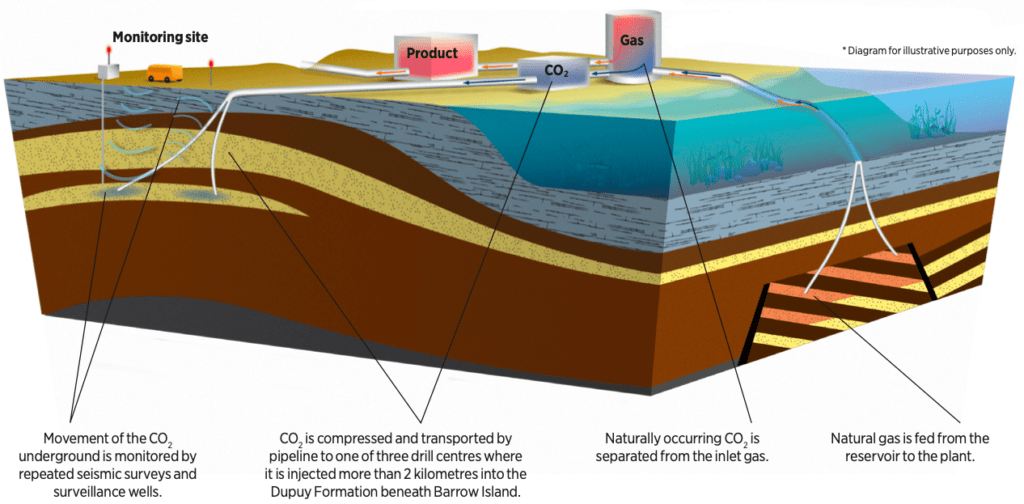
When Chevron extracts gas from the Gorgon reservoir, it contains natural gas mixed with carbon dioxide. Then, it has to separate the two greenhouse gases to isolate the natural gas for liquefaction. The CO2 was being released into the air since the CCS wasn’t working to channel it into the ground. The CCS project was expected to capture up to 4 million tons of emissions yearly. Now Chevron Australia must be held accountable by paying for carbon offsets.
The Australia Institute’s climate and energy director Richie Merzian said:
Chevron, and its partners Shell and ExxonMobil, failed to bury emissions from the Gorgon site for years after it started operating in 2016, and the impact in 2017-18 was huge resulting in over half of Australia’s increase in annual emissions. Chevron is still in emission-reduction debt for the last three years of carbon pollution. This carbon debt is greater than the annual fossil fuel emissions of 12 Pacific Island countries.
Carbon capture and storage has been a long-running marketing tool to try to bury the fossil fuel industry’s dirty reputation. CCS should only be used in sectors where there are no other alternatives available and that doesn’t extend to energy generation or fossil fuel extraction.
This failure to comply with its agreement could see the company hit with a $100 million-plus bill for carbon offsets. The exact number will be known in 2021 when Chevron has to account for its excess emissions for the five-year rolling period. And although that may sound like a lot of money, just know that the energy giant’s operations recorded an $8.4 billion profit last year, so that fine will merely make a dent in its earnings.
Of course, Chevron did request a waiver from the WA government to pay offset emissions only from 2018 onward. But environment minister Stephen Dawson was sticking to the recommendation of the WA Environmental Protection Authority and ruled that it must account for emissions from 2016 to 2021. He says the government is committed to making sure companies meet their environmental commitments.
Dawson said:
We have a responsibility to deliver positive environmental outcomes, based on robust scientific inquiry. The injection of carbon dioxide underground is a complex matter which requires serious consideration by the state and the proponent.
Some people think they should start paying for offsets now, not at the end of the five years. Piers Verstegen, director of the Conservation Council of Western Australia, said:
It’s clear they’re not going to be able to meet the requirement. Chevron has dragged this out for long enough now. They should start sourcing carbon credits in Western Australia. Doing so could create a lot of jobs in tree planting or renewable energy.
The Gordon LNG plant is Australia’s highest greenhouse gas emitting gas project. It released almost 9 million tons of CO2 equivalent greenhouse gas emissions in 2018-19 alone. That figure includes the excess CO2 emissions before the CCS came online, and escaped methane during the extraction and processing procedures.


