
The cognitive decline that comes with age could be slowed down, or even reversed, with a new drug that tampers down inflammation in the brain. A team of scientists from the University of California, Ben-Gurion University, and Berkeley conducted a study with mice to test out the drug’s efficiency. They found that senile mice given the drug had reduced signs of brain inflammation, and they were able to learn new tasks better, almost as well as mice half their age. The study has been published in the journal Science Translational Medicine.
Daniela Kaufer, a UC Berkeley professor of integrative biology and a senior author, conducted this research along with Alon Friedman of Ben-Gurion University of the Negev in Israel and Dalhousie University in Canada.
They said: “We tend to think about the aged brain in the same way we think about neurodegeneration: Age involves loss of function and dead cells. But our new data tell a different story about why the aged brain is not functioning well: It is because of this “fog” of inflammatory load. But when you remove that inflammatory fog, within days the aged brain acts like a young brain. It is a really, really optimistic finding, in terms of the capacity for plasticity that exists in the brain. We can reverse brain aging.”
The successful outcome of this treatment on mice is in line with a new view of what causes dementia and confusion that often accompanies aging. It supports the growing body of research on the blood-brain barrier – the filtration system that prevents toxic things in the blood from leaking into the brain – and how its failure leads to inflammation of the organ.
If the blood-brain barrier is working well, it prevents molecules or infectious organisms in the blood from reaching the brain. If it’s not working well and becomes “leaky,” it lets in chemicals that cause inflammation and a cascade of cell death. According to Friedman’s magnetic resonance imaging (MRI) studies, almost 60% of adults end up with leaky blood-brain barriers after the age of 70.
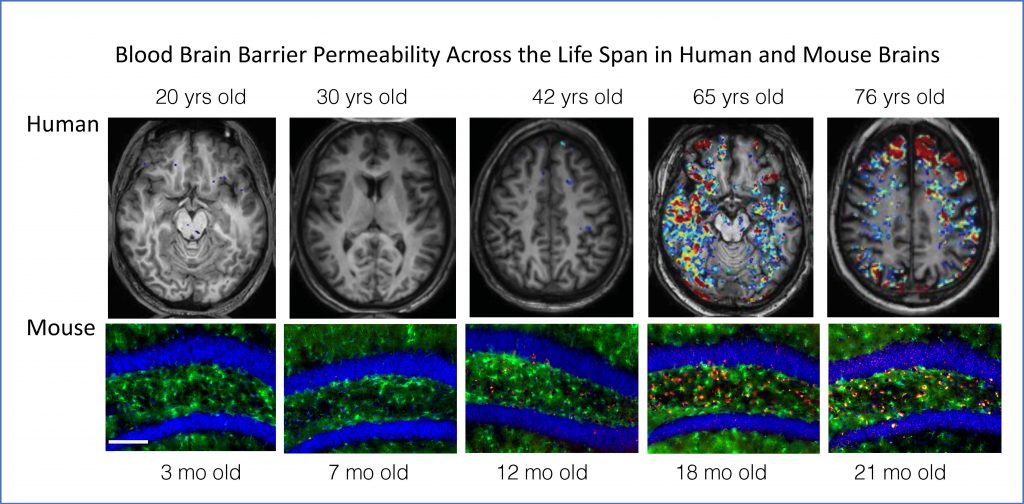
This study, combined with a previous one by the same researchers collaborating with Dan Milikovsky of Ben-Gurion University, provides doctors with two biomarkers: abnormal brain rhythms detectable by EEG and leaky barriers detectable by MRI. The previous study explains the fog induced by a leaky brain barrier and how EEGs can detect it. The two biomarkers can be used to flag patients with blood-brain barrier problems and suggest drugs to slow or reverse the consequences.
Kaufer said, “We now have two biomarkers that tell you exactly where the blood-brain barrier is leaking, so you can select patients for treatment and make decisions about how long you give the drug. You can follow them, and when the blood-brain barrier is healed, you no longer need the drug.”
Friedman and Kaufer linked the problem of a leaky blood-brain barrier and inflammation to a blood protein called albumin back in 2007. Then, in 2009 they showed how albumin leaks into the brain after trauma and binds to the TGF-β (TGF-beta) receptor in brain cells called astrocytes, which triggers a cascade of inflammatory responses. The inflammation then damages other brain cells and neural circuits, eventually resulting in decreased inhibition and increased excitation of neurons, as well as an inclination toward seizures. Therefore, leakiness in the barrier was solidly linked to albumin and an overexcited TGF-β receptor.

In the new study, the researchers showed that introducing albumin into the brains of young mice made them look old within only a week. The albumin-treated mice had hyperexcitability in the brain, were more susceptible to seizures, and navigated a maze as poorly as aged mice.
Kaufer said, “When we infused albumin into the brains of young mice, we recapitulated aging of the brain: the gene expression, the inflammatory response, resilience to induced seizures and mortality after seizures, performance in a maze. And when we recorded their brain activity, we found these paroxysmal slow wave events. And all were specific to the site we infused. So, doing this is sufficient to get an aged phenotype of this very young brain.”
However, when they genetically engineered the mice to knock out the TGF-β receptor in astrocytes after they’d reached old age, the brain of the senile mice looked young again. The rodents were resistant to induced seizures too, and they learned how to navigate a maze like a young mouse.
Kaufer said, “Altogether, the evidence points to a dysfunction in the brain’s blood filtration system as one of the earliest triggers of neurological aging. A parallel discovery has revealed how the protein EPS8 builds up with age to trigger toxic protein clumping linked to ALS and Huntington’s in the aging brain.”
Friedman then developed an MRI imaging technique specifically focused on detecting leakage in the blood-brain barrier – called dynamic contrast-enhanced (DCE) imaging – and discovered there was more leakage in people with higher cognitive dysfunction. Meanwhile, Kaufer analyzed brain tissue from humans and found evidence of albumin in aged brains and increased neuroinflammation and TGF-β production with age.
Now, the pair are collaborating with Hart to launch a company to develop a drug to heal the blood-brain barrier. They hope by stopping the leakage, they’ll reduce brain inflammation and prevent permanent damage after a concussion, stroke, or other traumatic brain injury and, eventually, help those with dementia as well.


