
High-powered lasers are used in various applications, from manufacturing cars, planes, and medical devices to scientific research and deep-space communications. However, the ongoing development of stronger versions needs a reimagining of the components that control their light beams. This has led a group of Harvard engineers to resort to diamonds, one of the strongest known materials, to create a novel mirror that can withstand laser pulses powerful enough to melt steel.
The new mirror was created to address some of the flaws in today’s high-powered continuous-wave laser systems. For example, the mirrors that steer the beams in these lasers are formed by thin layers of materials with various optical characteristics. If one of those layers has even a minor flaw, the laser will burn through the mirror rather than reflect off it, undoing the entire process.
A more straightforward approach could be to use a single material for the entire mirror to limit the chance of flaws. However, accomplishing this isn’t as simple as grabbing one of the most robust materials you can find and putting it to work. To build their novel diamond mirror, the engineers had to apply cutting-edge etching techniques originally meant to carve nanoscale features in diamonds for use in quantum communications and optics. “We thought, why not use what we developed for quantum applications and use it for something more classical,” recalled Haig Atikian, first author of the paper.
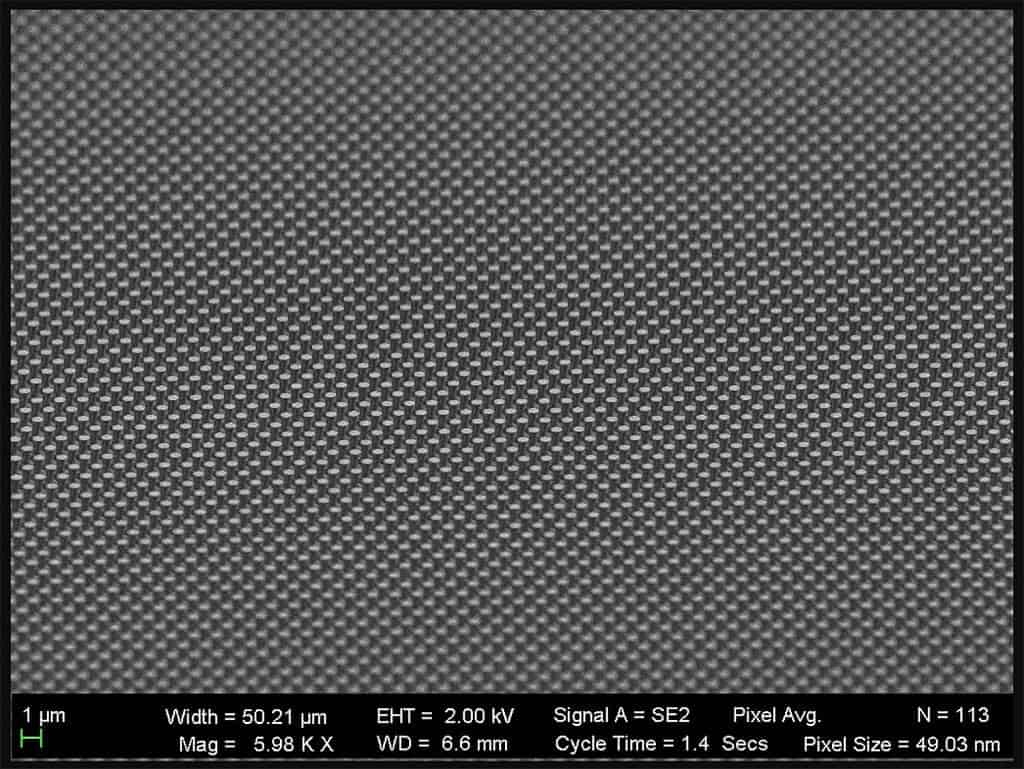
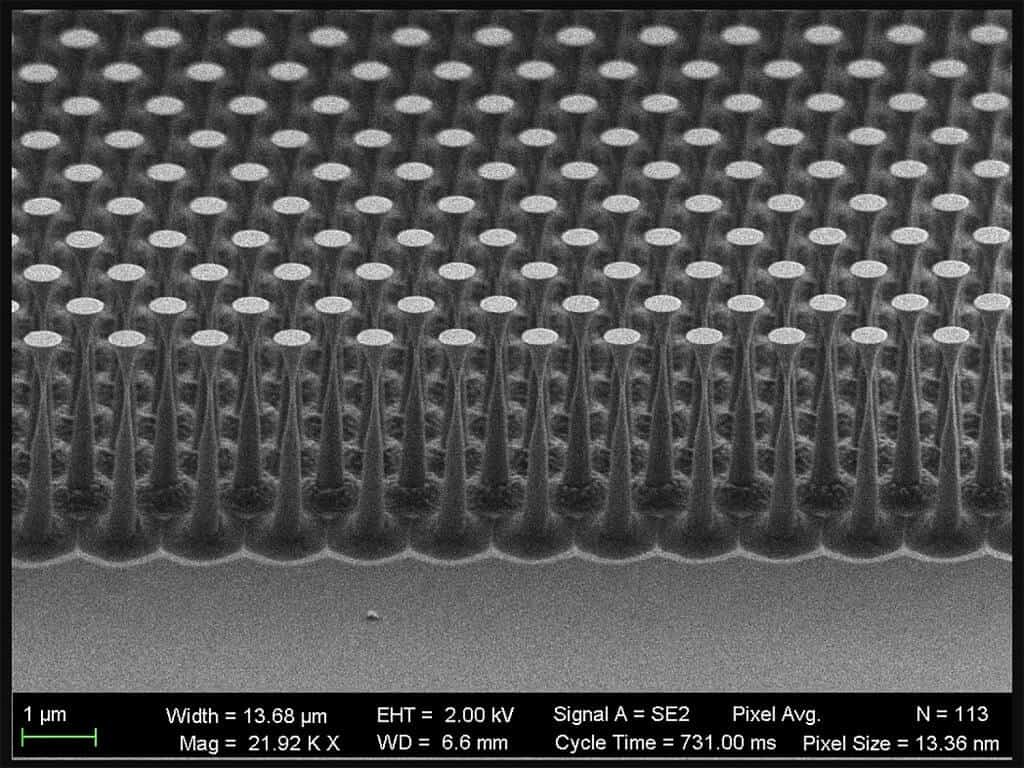
An ion beam was used to etch minuscule golf-tee-shaped features on the surface of a 0.1 x 0.1 in (3 × 3 mm) thin diamond sheet. These structures are responsible for the diamond mirror’s reflecting properties, with scientists determining that 98.9% reflectivity is the perfect balance for long-term durability. “You can make reflectors that are 99.999% reflective, but those have 10-20 layers, which is fine for low power laser but certainly wouldn’t be able to withstand high powers,” added Neil Sinclair, co-author of the paper.
The researchers put their new mirror to the test by placing it in front of a 10-kW laser used by the US Navy for research, which is powerful enough to burn through steel. Remarkably, the mirror was unharmed in the process.
Atikian explained:
“The selling point with this research is that we had a 10-kilowatt laser-focused down into a 750-micron spot on a 3-by-3-millimeter diamond, which is a lot of energy focused down on a very small spot, and we didn’t burn it. This is important because as laser systems become more and more power-hungry, you need to come up with creative ways to make the optical components more robust.”
The researchers are currently looking into commercializing the technology and envision their new diamond mirrors being employed in semiconductor manufacturing, defense and industrial manufacturing, and deep-space communications.
Marko Loncar, the senior author of the paper, concluded:
“Our one-material mirror approach eliminates the thermal stress issues that are detrimental to conventional mirrors, formed by multi-material stacks when they are irradiated with large optical powers. As a result, this approach has the potential to improve or create new applications of high-power lasers.”
The research was published on May 11, 2022, in Nature Communications.


