
Durian, the fruit famous for its pungent smell that’s so strong it has been banned from some public transportation systems, can be turned into a form of energy storage to power electronics. As strange as it sounds, scientists from the University of Sydney have developed a way to transform durian waste into a super-capacitator that can charge laptops, phones, and more. The research has been published in the Journal of Energy Storage.
Associate Professor Vincent Gomes said:
Durian waste, as a zero-cost substance that the community wants to get rid of urgently due to its repulsive, nauseous smell, is a sustainable source that can transform the waste into a product to substantially reduce the cost of energy storage through our chemical-free, green synthesis protocol.
Gomes’s team is one of the many groups of researchers searching for new methods to develop energy storage devices that possess a high energy density to meet the challenges of the climate emergency. Taking a creative route, the team took on durian and jackfruit as a main ingredient to create electrochemical supercapacitors.
Gomes said:
Super-capacitors are like energy reservoirs that dole out energy smoothly. They can quickly store large amounts of energy within a small battery-sized device and then supply energy to charge electronic devices, such as mobile phones, tablets, and laptops, within a few seconds.
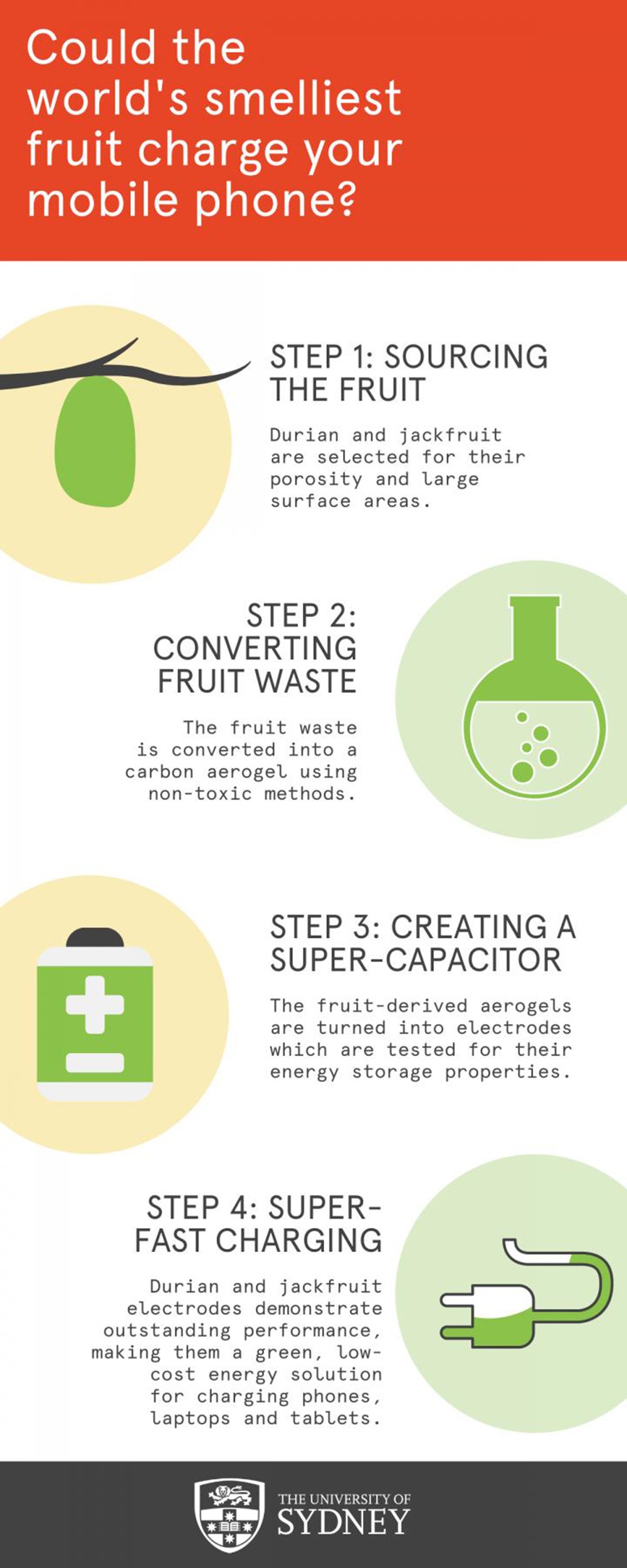
The Study
- The researchers purchased durian and jackfruit from a market.
- They set aside the fruits’ waste portions (biomass) to be turned into supercapacitors.
- Then, the team used a non-toxic and non-hazardous green engineering method to transform the biomass into stable carbon gels. It involved heating the biomass in water and then freeze-drying the remains.
- They used the fruit-derived aerogels to make electrodes.
Carbon aerogels are incredibly light and highly porous, which makes for a great super-capacitator. The material can be used for a range of applications. The fruit-derived aerogel the team made was found to be more efficient than current synthetic ones made from activated carbon.
Gomes said:
Durian waste was selected based on the excellent template nature provides for making porous aerogels. The durian and jack-fruit super-capacitors perform much better than the materials currently in use and are comparable, if not better, than the expensive and exotic graphene-based materials.
We have reached a point where we must urgently discover and produce ways to create and store energy using sustainably-sourced materials that do not contribute to global warming.
With sustainability as a top priority now, Gomes believes naturally-derived supercapacitors will lead the way for developing high-efficiency energy storage devices.


