
If the climate crisis isn’t handled correctly, it could burden generations to come with lifelong health problems. It is already hurting our health now, challenging the overburdened health system, and undermining the medical progress achieved in the past century.
According to a new report that has been published in the medical journal The Lancet, children born today onward could be living on a planet with an average temperature that’s 7.2 degrees Fahrenheit (4 degrees Celsius) warmer by their 71st birthday. That is if the world continues to produce the same amount of carbon emissions. That might not seem like much, a 7.2-degree difference, and it’s not really in terms of one day or season to the next. But, as an average increase in temperature overall, it is a devastating amount for our health.
The report says:
A business as usual trajectory will result in a fundamentally altered world. The life of every child born today will be profoundly affected by climate change. Without accelerated intervention, this new era will come to define the health of people at every stage of their lives.
A world that much warmer overall would suffer from more famine, disease, an increase in major mental health problems, and early death from natural disasters such as heatwaves and fire. The most vulnerable would be affected severely – with the poor, the elderly, people with underlying health conditions, and children feigning for their lives. But everyone else will be affected as well.
Dr. Jonathan Patz, a director of the Global Health Institute and professor at the University of Wisconsin-Madison, who wasn’t involved with the report, said:
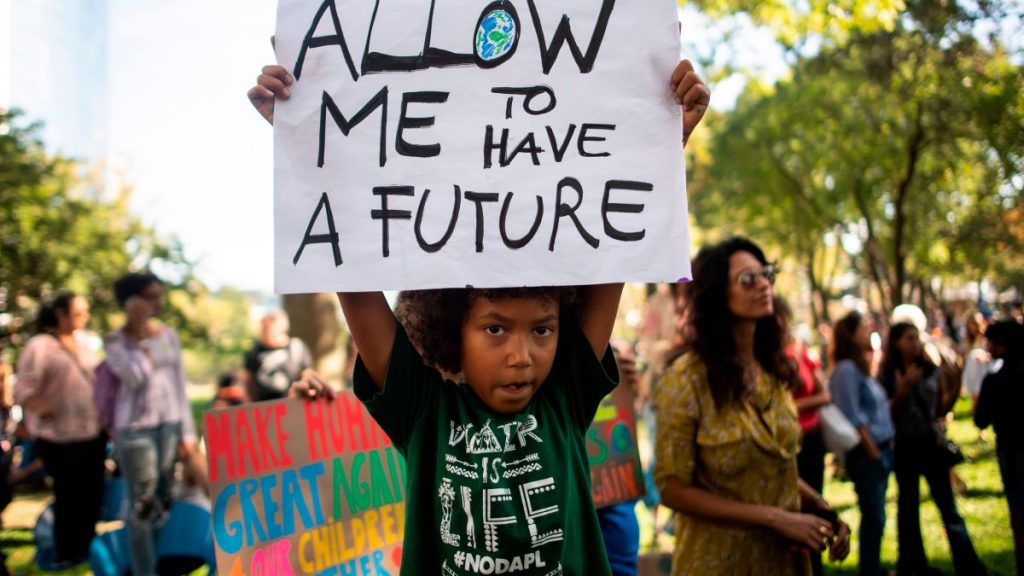
The public doesn’t fully see this as a human health crisis. Maybe polar bears were our early indicator — the proverbial canary in the coal mine. But when you talk about this crisis, the bear images should be replaced with pictures of children.
Children are suffering from the climate crisis. They are suffering from asthma, diarrheal disease, dengue fever. It is so important for the public to understand the climate crisis is absolutely a human health crisis.
All of this horror could be avoided if the world would take on bold action to curb carbon emissions.
Lead author of the report, Dr. Renee Sallas, an emergency medicine physician at Massachusetts General Hospital and clinical instructor of emergency medicine at Harvard Medical School, said:
As an emergency medicine doctor, the hardest cases for me to help are the ones where don’t have a treatment, but in this case, we have a treatment available.
By “treatment,” she means the goals laid out in the Paris Climate Agreement – which are: to restrain global heating to 1.5 degrees Celsius by cutting greenhouse gas emissions to at least 45% of 2010 levels by 2030, then getting to net-zero by 2050.
To make this happen, nations need to act more aggressively with the actions required to make this happen. CNN illustrates what the world would be like if they do with the following examples:
A child born in London today would no longer use electricity generated by coal by their 6th birthday if the UK met its climate goal.
A child born in France today wouldn’t be driving a gas- or diesel-fueled car by their 21st birthday if the country met its climate goal.
Unfortunately, for now, there has been “inadequate global progress” according to the report. Patz, who has pioneering research that shows the health risks of the climate crisis, said:
The world has yet to see a response from governments that matches the scale of the challenge. Prices for renewable energy sources make them competitive with fossil fuels, yet ironically this report shows too many countries still continue to subsidize fossil fuels. That is very concerning. It is a time of urgency. And the health benefits from clean energy far outweigh the investment costs.
Not all was dread and gloom in the report, however. They do write of reasons to be hopeful. For example, the world’s largest carbon emitter – China – continues to reduce its reliance on coal to generate electricity. Also, more people are driving electric vehicles with an increase of 20.6% between 2015 and 2016.
Todd Pugatch, an associate professor at Oregon State University, who was not involved with the report, said:
I think raising awareness through rigorous science can only benefit policymakers and the public at large, as it could lead to sound policy that would be feasible from a political standpoint. This report contributes to this important discussion. The more we contribute to this rigorous evidence base of the real threat of the climate crisis, hopefully, it will have a policy impact.
Over 120 experts from 35 agencies and institutions worked on this new report. Everyone involved hopes that it can be used by policymakers to prevent severe threats to public health and further damage from natural disasters brought upon by global warming.


