
There is a natural process of carbon sequestration known as the carbonate-silicate cycle, in which the greenhouse gas gets stored in rock. Over billions of years, 99.9% of all CO2 on Earth has been reserved this way. With today’s rising urgency to remove large amounts of carbon dioxide from the atmosphere, some scientists came up with the idea of speeding up the carbonate-silicate cycle so it could be applied as a method of combating climate change by naturally removing CO2 from the air. Project Vesta is a non-profit organization dedicated to solving the climate crisis through this sort of approach.
Tom Green of Project Vesta said:
“The current pandemic is a grave reminder of how interconnected we all are. It shows us that solidarity and intergenerational cooperation can be mobilized to face a crisis. While the world’s attention, rightly, is on the pandemic, we must also come together to face the deeper, longer-term crisis looming over the horizon: climate change.
The world is moving toward a place where people are starting to believe more in climate change and more that we need to do something about it. In five to 10 years, I think we’ll be living in a world where there’s massive support for carbon capture.”
Emission reduction is not enough because too much greenhouse gas emissions for too long have been spewed into the sky. In the IPCC’s most recent summary report, it says that staying below 2°C of temperature increase will involve a net-negative emission (around two gigatons of CO2 per year) by 2100.
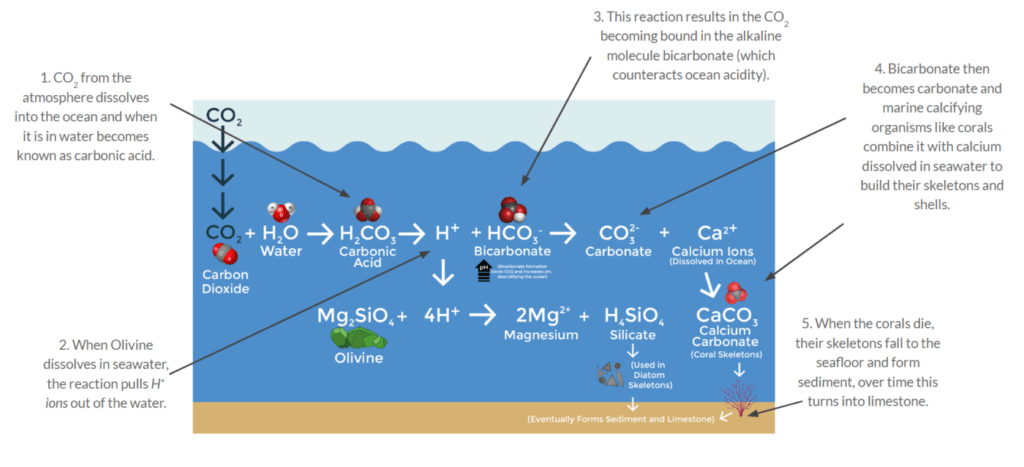
And in steps Project Vesta with its process called ‘coastal enhanced weathering’ that’s backed by thirty years of research. The process involves covering a coastline with an abundant mineral called olivine that’s found in the gemstone peridot. The olivine is first ground down to the size of sand and then scattered. The waves then grind down the sand further, accelerating the mineral’s job of removing CO2 from the atmosphere and carrying it down to the depths of the ocean, where it becomes permanently fixed in limestone. As a bonus, the mineral also de-acidifies the sea.

Project Vesta cofounder, Eric Matzner, said:
“Reducing emissions is not enough to solve the climate crisis. We need a solution that removes gigatons of carbon dioxide emissions a year and we need it now. Once we prove our approach through pilot studies, we can implement it at scale through an open-source platform.”
The organization has already located the testing site for its innovative green sand carbon dioxide reduction method – a set of coves in the Caribbean. In one of the inlets, it will spread the green volcanic mineral across the beach. The other will be left alone and serve as a control to the study. The green sand experiment is expected to take up to two years before attaining answers. There are still many questions, such as how it will affect the environment, how much the waves will speed up the processes, how well can the carbon uptake be measured, and how readily the public will embrace the idea.
All the research up to this point has shown green sand works and has provided strong evidence that is an affordable and scalable solution. It is understood that the method captures twenty times more CO2 than the extraction and transportation of the olivine. Furthermore, if deployed across only 2% of the world’s beaches, it could capture 100% of human emissions. And the best part is that it’s permanent (unlike trees, for example, which re-release the CO2 they absorbed when they die).
Roger Aines, head of the Carbon Initiative at Lawrence Livermore National Lab, said:
“This is one of the great untapped opportunities in carbon dioxide removal. A cubic kilometer of ultramafic rock, which contains high levels of magnesium, can absorb a billion tons of carbon dioxide. We mine rock on that scale all the time. There’s nothing else that has that kind of scalability in all the solutions we have.”
The pilot study in the Caribbean begins this year thanks to a significant donation made by the company Stripe, who pre-paid Project Vesta to remove 3,333 tons of carbon dioxide for $75 a ton. The contribution is part of the company’s sustainability commitment to spend a minimum of $1 million annually on negative-emissions projects.
Project Vesta plans to get scientists to the site by the end of the year. Immediately after spreading the olivine across the beach, they’ll begin monitoring first how rapidly the particles are broken down by the waves and washed away. Meanwhile, they’ll measure how carbon levels, acidity, and marine life shift in the cove and further offshore. Then they will compare their findings to the control site. Since there are many uncertainties around coastal weathering, this study will serve to fill in those scientific blanks and ultimately demonstrate that it works quickly and can be done cheaply.


