
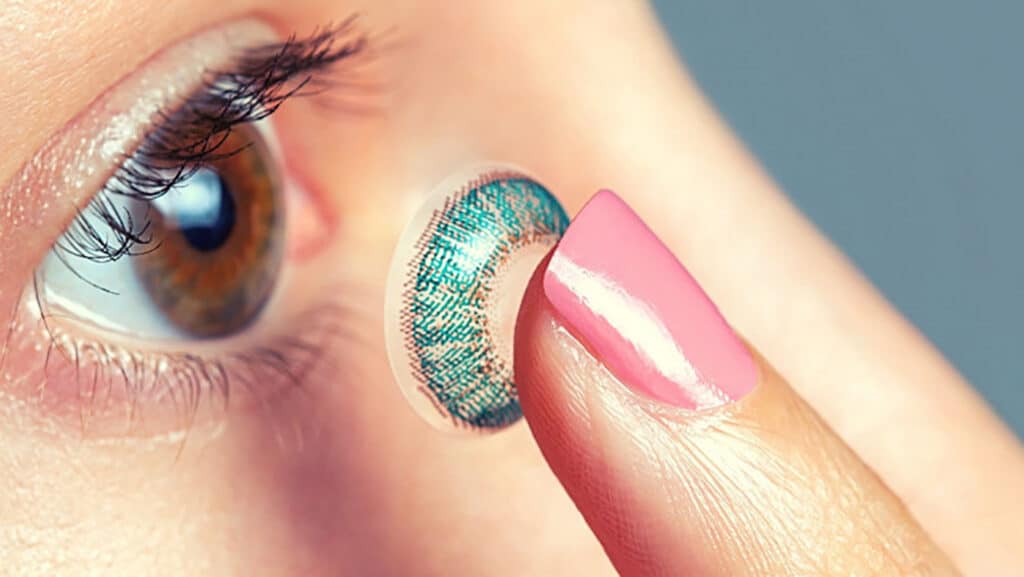
Humans wear contact lenses to improve their vision of the external world. Over the years, engineers have been working on developing intelligent contact lenses that also monitor the internal world—the vital signs of the human body. However, contact lenses with implanted sensors for measuring intraocular pressure (IOP) lack the required sensitivity to function correctly, are too bulky and rigid, and partly block vision—until now.
According to a study published in Biomedical Engineering, a breakthrough design – a soft, transparent contact lens that can take quantitative measurements of IOP in real time via a smartphone – was successfully tested in participants. Most importantly, the device performed all functions wirelessly without inducing inflammation to the ten human volunteers. This innovation could have critical benefits for people suffering from glaucoma.
Intelligent Contact Lens
The innovative contact lens uses a wireless antenna, capacitors, a strain sensor, a stretchable interconnecting metal, resistors, and an integrated circuit for wireless communication. It can measure basic vital signs, such as body temperature, heart rate, the heart’s electric activity, lactate, glucose, and alcohol concentrations in bodily fluids like tears, saliva, and sweat. Frequently measuring all of these vital signs is crucial in the diagnosis of a broad range of illnesses.
The eyes are an appropriate source to measure these vital signs since they can reveal electrical sensors to endless samples of tear fluids. If a wearable device could record and report signals from the eye, such as those detected through colored contacts for brown eyes, it could diagnose several diseases from eye conditions. However, a recent study focused on the technology’s capacity to detect Glaucoma.
What is Glaucoma? It is an optic neuropathy that can lead to irreversible vision loss. IOP is the only risk factor that researchers are sure we can control, meaning the only way we have of treating glaucoma is to lower IOP.
Measuring the IOP is typically performed with several forms of tonometry, but they lack the required clinical specificity for fully effective monitoring. The new intelligent contact lens was designed to overcome this – as a wearable sensing technology that keeps physical contact with the cornea and detects the expansion of the corneal limbus (a primary symptom of a boost in IOP.
Challenges
While the new contact lens can monitor a crucial Glaucoma signifier with minimally-invasive technology comparable to typical contact lenses, there are still challenges ahead for the innovative design before it can be executed on a commercial scale. For example, conventional sensors using semiconductors or metals lack the sensitivity to detect subtle lens deformations that IOP fluctuations create — specifically, lens deformations of 0.03% in tensile strain per mm Hg.
In addition, complex circuitry is required to intensify the biosensor’s signal so that the data from the lenses isn’t faded out in background electromagnetic noise. Stiff electronic materials in the metallic antennas, sensors, interconnecting structures, and integrated circuits can block human vision — and possibly damage the eyelid and the cornea. Nobody wants to put a contact lens in their eye if it’s going to cut up the interior of their eyelid.
Lastly, measuring the biosignals from the contact lenses takes bulky equipment that can’t be transported around easily, limiting a wearer’s range of motion.
There’s much to accomplish before these intelligent contact lenses become available to the public. However, this study represents a commendable breakthrough — one that paves the way for a new and straightforward approach of monitoring, diagnosing, and assisting in treating awful illnesses, such as Glaucoma.
Other Innovative Contact lenses
Last year, researchers developed a contact lens that zooms in and out at the wearers’ command. Eye movements control the lens, so if the user wants to zoom in, they just have to blink twice.


