
Researchers at Vienna University of Technology or TU Wien (Vienna) have discovered a new type of material that allows small sensors and processors to supply themselves with energy wirelessly. They accomplish this effectively through temperature differences. Their research has been published in the journal Nature.
Thermoelectric materials can convert heat into electrical energy; this is called the Seebeck effect. When there is a different temperature at two ends of the material, an electric voltage is generated, and the current starts to flow. The ZT value measures the amount of electrical energy generated at a given temperature. The higher the ZT value, the better the material’s thermoelectric properties.
Previously the highest ZT value measured was between 2.5 and 2.8. The scientists at TU Wien have now developed a new material that has a ZT value of 5 to 6. The material consists of a thin layer of iron, vanadium, tungsten, and aluminum applied to a silicon crystal.
Years in the making
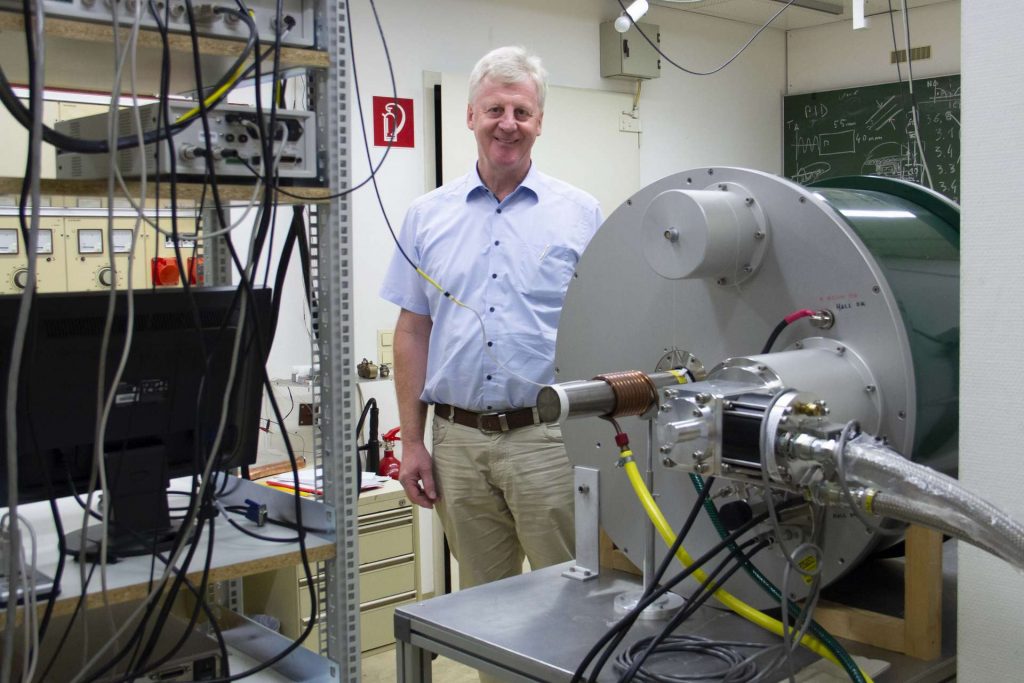
Back in 2013, Professor Ernst Bauer established the Christian Doppler Laboratory for Thermoelectricity, at TU Wien, where they have been studying different thermoelectric materials for different applications. Professor Bauer also works for the Institute of Solid State Physics at TU Wien, where he explains thermoelectric materials:
“A good thermoelectric material must show a strong Seebeck effect, and it has to meet two important requirements that are difficult to reconcile. On the one hand, it should conduct electricity as well as possible; on the other hand, it should transport heat as poorly as possible. This is a challenge because electrical conductivity and thermal conductivity are usually closely related.” “On the one hand, it should conduct electricity as well as possible; on the other hand, it should transport heat as poorly as possible. This is a challenge because electrical conductivity and thermal conductivity are usually closely related.”
Professor Bauer goes on to say: “The atoms in this material are usually arranged in a strictly regular pattern in a so-called face-centered cubic lattice. The distance between two iron atoms is always the same, and the same is true for the other types of atoms. The whole crystal is therefore completely regular.”
However, the scientists discovered something amazing. When you apply a thin layer of the material to silicon, it radically changes the structure. The atoms still form a cubic pattern, but now they become arranged in a space-centered structure, which completely randomizes the distribution of the atoms. Bauer explains: “Two iron atoms may sit next to each other, the places next to them may be occupied by vanadium or aluminum, and there is no longer any rule that dictates where the next iron atom is to be found in the crystal.”
With this special mix, a very low electrical resistance is achieved, which determines how the electrons move in the solid and protects it from a scattering process. The irregularities in the crystal inhibit the lattice vibrations, lowering the thermal conductivity and keeping the temperature down.
The new material developed by scientists at TU Wien features a low electrical resistance that effectively incorporates heat resistors, ensuring the efficient management of temperature in computer processors and small electronics. This advancement allows these devices to produce power at low temperatures, offering potential applications in various settings, including production plants and factories, where a large number of sensors can generate their own power using these small thermoelectric devices.
This new material is extremely compact, adaptable, and very effective, which makes it perfect for providing energy to computer processors and other small electronics. This will allow the devices to produce their power at low temperatures. Professor Bauer talks about using these devices in production plants and factories, where they would be able to communicate with each other.
“If you need a large number of sensors in a factory, you can’t wire all of them together. It’s much smarter for the sensors to be able to generate their own power using a small thermoelectric device,” said Bauer.
Being able to double the ZT value that has previously been in use is a great discovery and will most certainly lead to many new useful applications. Hopefully, this can be put to use in laptops and cell phones as well to help keep the temperature down.


