
Many animals have magnetoreception – a sense which allows them to detect the Earth’s magnetic field. They use it to perceive direction, location, and altitude. For most of these animals, it’s how they know where they are in the world and navigate — for example, birds and dogs. However, scientists are still looking to find the magnetosensory organ responsible for this sense’s biological mechanisms.
A new study on the Ansell’s mole-rat (Fukomys anselli, Bathyergidae, Rodentia) is the first to identify a magnetoreceptive organ in a mammal. Previous studies found that the microphthalmia (having small eyes) subterranean rodents possess innate magnetic orientation behavior. They had theorized that the magnetoreceptors could be located in their tiny eyes.

Kai Caspar and colleagues at the University of Duisburg-Essen in Germany have been studying the funny animal for quite some time. They found that its sense of the Earth’s magnetic field is affected by intense magnetic pulses but not radio frequencies and works independently of light.
In the wild, the species of mole rat involved in this research is known for digging extended, underground tunnels, but they have very poor eyesight. Their eyes – up to just 2 mm in diameter – can only sense light and dark. But even with their terrible sight, they have a sense of direction and always build their nests in the south-eastern.
Kai Caspar, a zoologist and lead author, told New Scientist:
They do not orient by vision. Vision is more or less completely unimportant for them.
In an earlier study, the team used anesthesia to disrupt the function of the mole-rats’ eyes. The drug inhibited their ability to place their nest in the preferred southeast location, but not their ability to detect light and shadows. Unfortunately, they couldn’t be sure that the anesthesia wasn’t impacting other organs, so they had to conduct a follow-up study to remove the animals’ eyes (enucleation) surgically. Half of them kept their eyes as a control group.
For 18 months following the surgery, the researchers observed the animals. The enucleation didn’t lead to changes in routine behaviors (feeding, locomotion, and socializing). They carried on digging, play-fighting, and grooming each other as usual and in the same way as the control group.
The team wrote in their paper:
All enucleated animals were fully immersed members of their respective family groups, and many successfully bred and raised offspring.
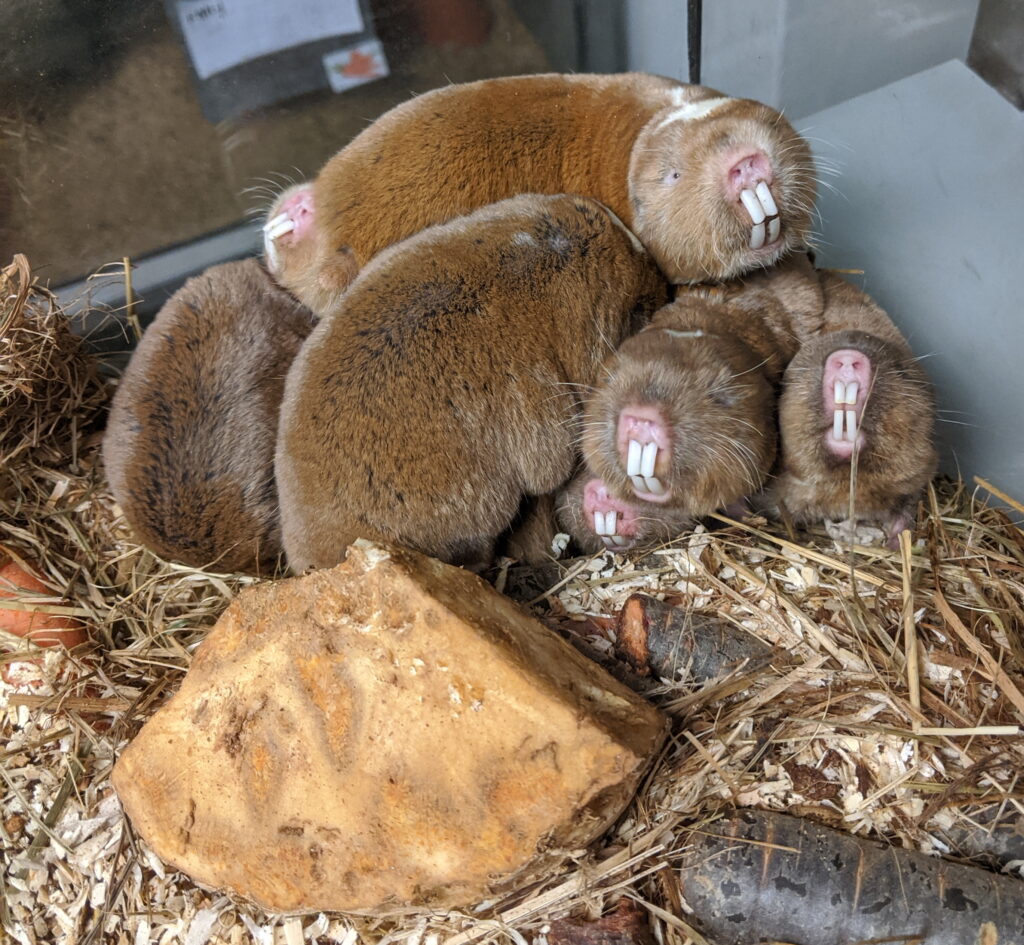
The Ansell’s mole-rat is a very cooperative social species. They live in colonies of around ten individuals in nature and sometimes even linking with other territories by joining tunnels. The enucleation did not disrupt this sense of connection.
What did change, was their well-established nest-building survey. The control animals continued to build their nest in the magnetic southeast, while enucleated mole-rats made nests in random magnetic orientations.
The team wrote:
We conclude that the removal of the eyes led to a permanent impairment of the magnetic sense. Our study is the first to identify a magnetoreceptive organ in a mammal.
The team speculated that there could be magnetite-based receptors in the cornea responsible for the sense. A future study may involve examining the eyes closely under electron-microscopy and through spectroscopy to find out for sure.


