
USNC-Tech (Ultra Safe Nuclear Technologies) has delivered a new Nuclear Thermal Propulsion (NTP) engine concept to NASA. The engine is allegedly safer and more reliable than previous NTP designs and has far greater efficiency than a chemical rocket. The concept could help grasp the goal of using nuclear propulsion to revolutionize deep space travel and drastically cut down on Earth-Mars travel time to as little as three months.
Since electric space propulsion systems have such low thrust and chemical rockets are already near their theoretical limits, rocket engineers are continuously searching for new ways to build more powerful, more efficient engines using nuclear energy.
Such nuclear rockets could potentially have several times the efficiency of the chemical variants. However, a significant challenge is to produce a nuclear reactor that’s light-weight and safe enough to use outside the Earth’s atmosphere – specifically if there’s a crew on the spacecraft.
Dr. Michael Eades, USNC-Tech’s chief engineer, said:
We want to lead the effort to open new frontiers in space and do it quickly and safely. Our engine maximizes the use of proven technology, eliminates failure modes of previous NTP concepts, and has a specific impulse more than twice that of chemical systems.
The concept involves UNSC-Tech using a Fully Ceramic Micro-encapsulated (FCM) fuel to power the engine’s reactor. FCM is based on High-Assay Low Enriched Uranium (HALEU) acquired from recovered civilian nuclear energy and is enhanced to between 5 and 20% – more significant than civilian reactors and less than naval reactors. Finally, the fuel is encapsulated into particles coated with zirconium carbide (ZrC).
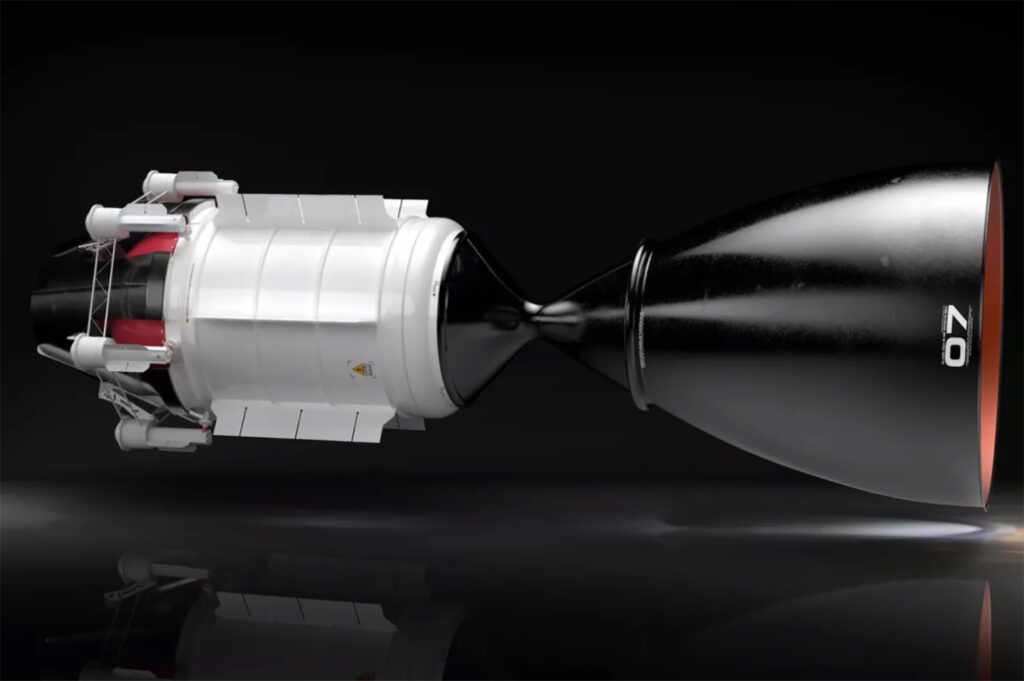
USNC-Tech claims the fuel can operate at high temperatures and is more rugged than conventional nuclear fuels, producing a safer reactor with a higher thrust that could previously only be attained via highly-enriched uranium.
Dr. Paolo Venneri, USNC-Tech’s CEO, added:
Key to USNC-Tech’s design is a conscious overlap between terrestrial and space reactor technologies. This allows us to leverage the advancements in nuclear technology and infrastructure from terrestrial systems and apply them to our space reactors.
The project is sponsored by NASA and is part of a study managed by Analytical Mechanics Associates for the space agency concerning the NTP flight demonstration. USNC-Tech highlights that the concept was specifically “designed to enable a successful near-term system demonstration and reduce barriers to full-scale deployment.” However, a sixth month round trip to Mars is undoubtedly still some way down the line.
DARPA has also assigned Gryphon Technologies engineering firm to develop a HALEU NTP system for the Draco Program. Once complete, the US military will be able to carry out missions in cislunar space.


