
Recent investigations into nearly 200 global food systems have brought a startling reality to the forefront of agricultural discourse. Almost every society on Earth is physically unable to provide a balanced diet for its people without external assistance.
While the dream of total independence sounds like a relic of the past, comprehensive agricultural assessments published in Nature Food identified one surprising exception. This discovery compels a thorough reevaluation of nutritional security in an era where climate instability and political friction can suddenly halt vital shipments.
Guyana has emerged as a unique case study in what it takes to balance the scales between local food production and nutritional demand. A BBC Science Focus analysis clarifies that this small nation distinguishes itself as the world’s sole nation capable of providing for its citizens across all seven major food groups without relying on imports. Examining why so many industrial giants fail to match this achievement helps uncover the difference between merely surviving and building a system that can actually endure.
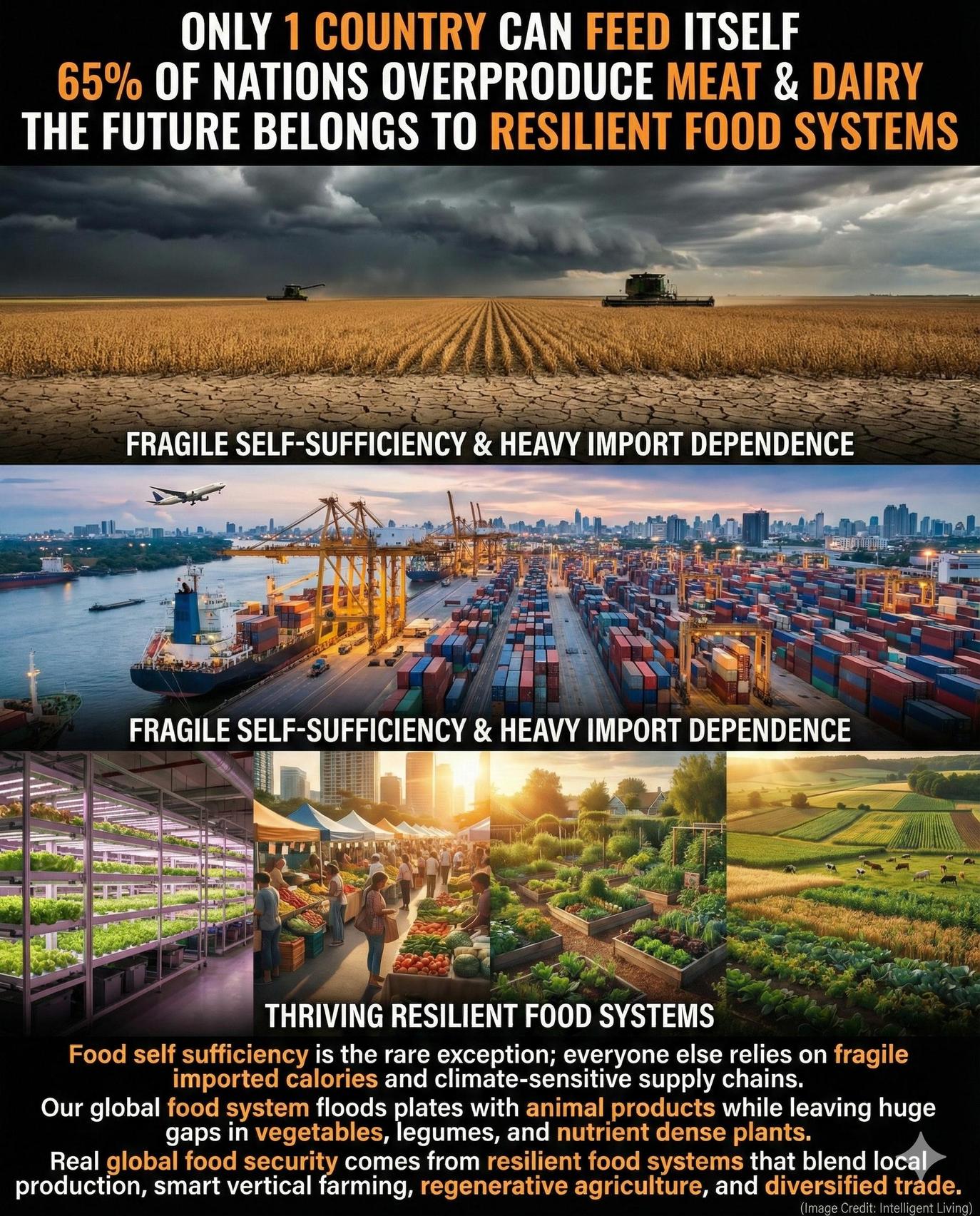
Core Realities of National Food Self-Sufficiency
- Only one nation, Guyana, produces enough food domestically to meet its population’s full nutritional requirements across all seven key food groups: fruits, vegetables, dairy, meat, fish, legumes, and starchy staples.
- Evidence shows that roughly one-third of nations fulfill dietary requirements in only two or fewer categories, emphasizing the extreme rarity of complete agricultural independence.
- Fish and vegetables are the most significant global bottlenecks, with fewer than 25% of nations achieving self-sufficiency in these groups.
- High-income countries frequently prioritize international trade and imports over domestic production to sustain dietary variety and nutritional balance.
- Singapore, which once targeted producing 30% of its food locally by 2030, has scaled back its ambitions, citing land and resource limitations. It now focuses on resilience strategies that diversify import sources and prioritize automated urban cultivation.
These insights highlight a central reality: complete self-sufficiency is almost impossible for most nations. Instead, the key to long-term food security lies in building adaptable, diversified, and sustainable systems that can withstand shocks from climate change, conflict, or global market disruptions.
Defining Nutritional Adequacy in Global Food Systems
The researchers moved beyond basic metrics comparing calories produced with those consumed. They analyzed whether each nation’s agricultural output could meet the dietary guidance standards established by international health organizations. This wasn’t a simple calculation of calories produced versus consumed. Instead, it examined whether each country could supply its citizens with adequate amounts of each of the seven major food groups recommended for a balanced diet.
Traditional agricultural statistics often use a metric called the Self-Sufficiency Ratio (SSR). The UN Food and Agriculture Organization utilizes standardized dietary supply metrics to define this as the share of domestic production in total food supply. Such a ratio compares the total amount of food produced domestically with the amount consumed while accounting for imports and exports. While useful, this ratio can give a misleading impression of food security. A nation might appear self-sufficient in grains or meat but still depend heavily on imports for fruits, vegetables, or dairy.
In this newer model, the emphasis shifts to nutritional adequacy. The data revealed a stark contrast: the majority of nations fail to meet guidelines, despite producing an abundance of total calories. The researchers cross-referenced national agricultural data with dietary recommendations to see whether a country’s food production could actually support a balanced, healthy diet.
This approach reveals a critical gap between food quantity and food quality. Producing enough to feed a population is one challenge; producing the right mix of nutrients is another. And in an interconnected world where trade provides diversity and balance, striving for total isolation may not only be unrealistic but also counterproductive.

Guyana: The World Leader in Nutritional Self-Reliance
Guyana stands alone as the only nation capable of supporting its population across all seven essential food categories through domestic means. With a population of fewer than one million, this small country has leveraged a favorable climate and fertile river valleys. These natural advantages allow for the production of a wide range of essential nutrients.
The primary outputs include:
- Staple grains such as rice and various root vegetables.
- Protein sources like meat and fresh-caught fish.
- Domestic dairy products produced along coastal farmlands.
Preserving this equilibrium relies on the strategic management of limited coastal and river basin arable land. Guyana’s success comes from a combination of low population density, diverse ecosystems, and efficient use of arable land. Despite its agricultural achievement, unspoiled tropical rainforests still cover over 85% of its land area.
However, self-sufficiency doesn’t mean isolation. Guyana still engages in trade, importing goods it doesn’t produce efficiently and exporting others. The lesson here isn’t that every country should imitate Guyana’s model but that scale and diversity matter. Smaller, ecologically rich countries can sometimes balance production and consumption more easily than large industrial nations, where urbanization and export-driven economies reshape land use.
Guyana’s example serves as both an inspiration and a caution. While it meets the technical definition of self-sufficiency, maintaining that balance under population growth and climate stress may prove challenging. Its success underscores how fragile such equilibrium can be—and how essential it is to design systems that are resilient, not just self-reliant.
Critical Barriers to Diverse Agricultural Production
Successful vegetable cultivation relies fundamentally on consistent freshwater access, nutrient-rich soil, and stable climatic conditions, which are often limited in drought-prone or urbanized regions. Access to arable land and reliable irrigation is limited. Countries such as Singapore have turned to hydroponic farming and vertical farms to overcome these challenges. These controlled-environment systems allow crops to grow year-round while using up to 90% less water than traditional farming.
Sustainable Solutions for Marine and Aquatic Stocks
Global marine stocks are under severe strain, with overexploited international fisheries now accounting for more than 35% of the total population. Developing sustainable aquaculture systems provides a viable pathway to meet demand, though such operations necessitate significant energy and water resources. Technologies like recirculating aquaculture systems (RAS), where water is filtered and reused, are promising. These innovations, including closed-loop nutrient cycles that minimize waste, illustrate how circular design can turn constraints into opportunities.
Meanwhile, wealthy nations often prioritize economic efficiency over local diversity. They import out-of-season produce or protein-rich foods rather than expanding domestic production. This trade-driven approach can reduce costs but increases exposure to global disruptions. When climate events or geopolitical tensions hit supply chains, even resource-rich countries can experience shortages of key items like fruits, legumes, or dairy.
Ultimately, the main takeaway from the study isn’t about national pride or isolationism. It’s a call to rethink how societies build resilience into their food systems. Countries that can’t grow everything can still secure their food futures by investing in sustainable technologies, diversified imports, and local innovation. The future of food security depends not on producing everything everywhere, but on producing enough of the right things, in the right places, and for the right reasons.
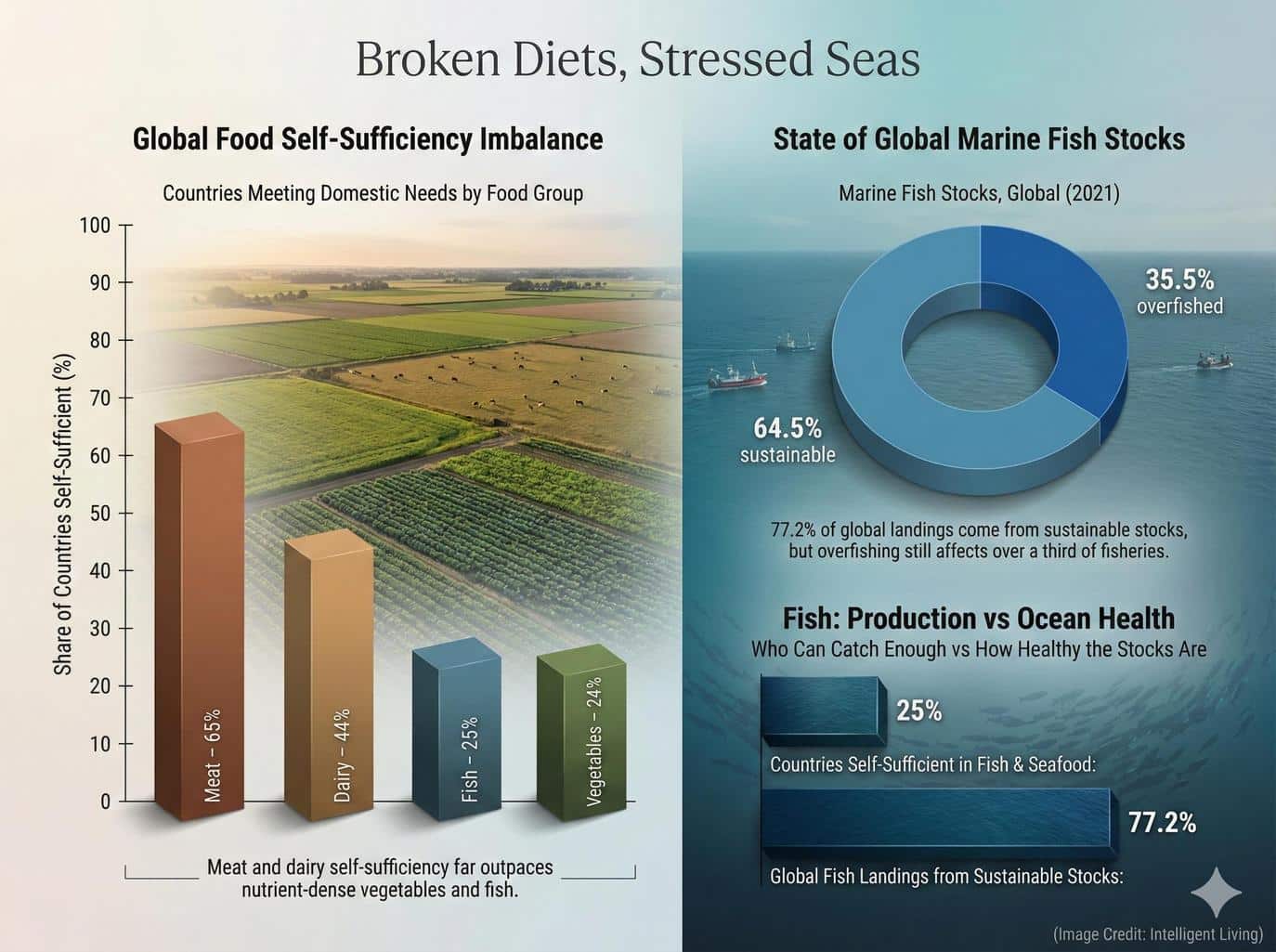
The Real Lesson: Food Resilience Beats Purity
The global conversation about food production often frames self-sufficiency as the ultimate benchmark of success. Yet, the findings from Nature Food suggest a more realistic objective: resilience. True resilience means ensuring a nation’s population can continue to access nutritious food despite external shocks. These challenges often take the form of supply chain disruptions, crop failures, or climate disasters.
Resilience requires redundancy and diversity, not isolation. A diversified import portfolio can act as a safety valve during local shortages, while targeted domestic production strengthens local economies and reduces dependency on a single supply channel. Countries that focus on adaptive systems—blending local production, regional trade, and technological innovation—are better equipped to sustain long-term food stability.
Investing in smart agriculture, renewable energy for food production, and water-efficient systems such as soil-free cultivation methods are practical steps toward resilience. So is improving local distribution and reducing waste—an area where food waste management can yield major climate and food security benefits. The goal is not to close borders but to close gaps—between what nations can produce sustainably and what their people truly need.
Singapore’s Strategic Shift Toward Food Resilience
Singapore imports more than 90% of its food supply. When the city-state announced a goal to produce 30% of its nutritional needs domestically by 2030, the plan sparked international interest as a potential blueprint for urban independence. However, official environmental and sustainability reviews later acknowledged that the target was ambitious but unsustainable given the island nation’s severe land and energy constraints.
Implementing the Resilient Dependency Model
In 2025, the government formally abandoned the 30-by-30 goal as land limits and high labor costs pushed policymakers toward a more targeted strategy. Singapore has since focused on specific food categories—particularly proteins and leafy greens—that can be produced efficiently in urban settings. Moving away from the pursuit of absolute self-sufficiency, Singapore adopted a strategy of resilient dependency centered on diversified imports and technology integration.
This revised model demonstrates that resilience isn’t about producing everything locally. It’s about building multiple pathways to maintain access to essential foods. Singapore’s commitment to smart agriculture and vertical farming proves that strategic focus can be more effective than blanket goals. Other nations, especially those with limited land or water, can adopt similar models by prioritizing resource-smart food systems over symbolic independence.

A Practical Food Resilience Playbook (Home → City → Nation)
Building food resilience starts at every scale—from individual households to entire nations. The principles remain the same: diversify, innovate, and reduce waste.
Household and Neighborhood Level
Cultivating food at the neighborhood level strengthens local resilience while enhancing biodiversity and personal well-being. Localized production efforts frequently offer vital protection against the volatility of global food prices.
Focusing on these items can reduce dependence on imported produce:
- Fresh kitchen herbs.
- Nutrient-dense leafy greens.
- Quick-growing microgreens.
For people in apartments or yardless homes, modular integrated gardening units and compact gardening techniques make it easier to turn balconies and windowsills into productive space. Conscious consumption and active waste reduction serve as equally vital steps in building sustainable habits.
City and Regional Level
Cities hold immense potential for transformation. Urban centers can invest in controlled-environment agriculture such as efficient vertical farms, recirculating aquaculture systems, and even modular floating greenhouse designs. Such innovations operate continuously, leverage renewable energy, and significantly minimize water consumption while effectively shortening supply chains. Cities can also build “food belts”—green zones surrounding urban cores that support local produce markets and smallholder farms.
National Level
At the national scale, resilience depends on a mix of smart policy, technology, and strategic trade. Governments can focus on strengthening supply diversity by building relationships with multiple exporting partners, maintaining buffer reserves, and investing in sustainable and regenerative farming models. Instead of striving for unrealistic total self-sufficiency, nations can set targeted production goals that align with their ecological strengths, as Singapore has demonstrated.

Cultivating Stability in an Era of Agricultural Uncertainty
The pursuit of complete agricultural isolation is a dream that rarely aligns with the physical limits of our planet. As the data shows, the vast majority of societies must rely on a blend of local ingenuity and international cooperation to keep their populations healthy. We are moving toward a future where the strength of a nation’s food supply is measured not by how many walls it builds around its farms, but by how many diverse pathways it creates to secure essential nutrients.
True stability comes from accepting that no single country is an island in the global ecosystem. Emerging circular economy trends that restore biodiversity highlight how redesigning food and material systems can relieve pressure on ecosystems while strengthening food resilience. The lesson from recent shifts in strategy is clear: focus on building systems that bend without breaking, ensuring that nutrition remains a right rather than a luxury dictated by geography.
Insights on National Food Independence
1. Which country is most self-sufficient in food production?
Guyana is currently the only nation that produces enough domestic supply to meet all seven essential nutritional categories.
2. Why do most wealthy nations import so much food?
High-income countries often prioritize economic efficiency and seasonal variety over the resource-heavy costs of total domestic production.
3. Is food self-sufficiency better than food resilience?
Resilience is often superior because it utilizes multiple supply sources to protect against local crop failures or global market shocks.
4. How does land availability affect a nation’s ability to feed itself?
While land matters, soil quality, freshwater access, and climate stability are often more significant barriers to growing a diverse diet.
5. What can cities do to improve their own food security?
Urban centers can adopt vertical farming and hydroponic technologies to grow fresh produce locally while reducing their dependence on long-distance transport.


