
When someone suffers from a spinal cord injury, a small portion of nerves remain intact but the signals they carry are too feeble to move limbs or support the person’s body weight. Until recently, there has been no way to solve this situation, thus leaving the person paralyzed, unable to ever walk again.
But now, through the use of electrical stimulation, a couple of patients are able to walk short distances on crutches. This is unbelievable since both of them haven’t been able to take even one step for several years, ever since their accident put them in a wheelchair.
The doctors say they timed the pulses to coincide with natural movement signals that were still being sent from the patients’ brains, which they believe is a crucial factor in the success of the experiment. It seems to have encouraged the nerves that survived the injuries to form new connections and improve the men’s muscle control.
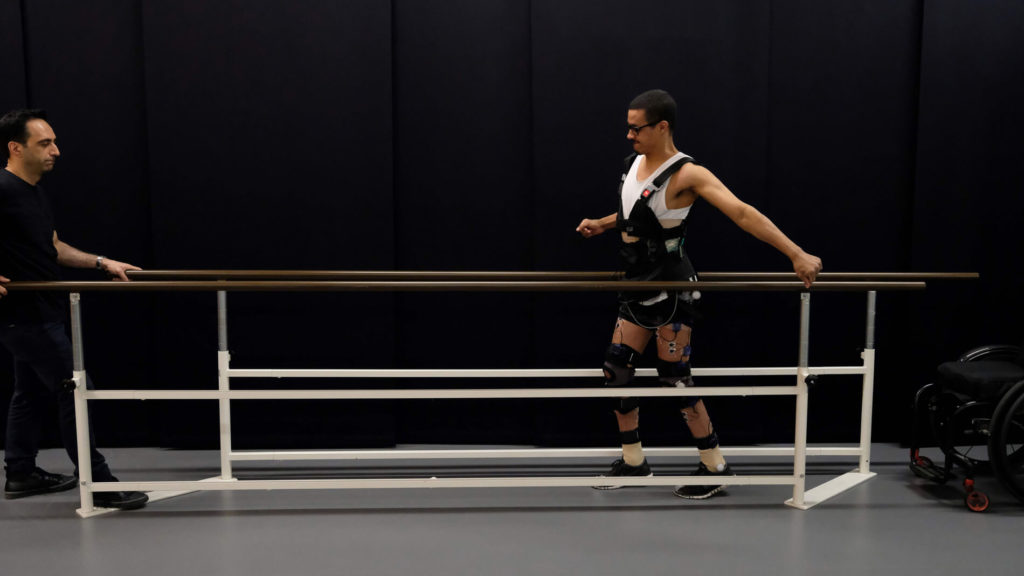
The two lucky patients were David Mzee, 28, and Gert-Jan Oskam, 35. They were both paralyzed in separate accidents more than six years ago and now can stand and walk short distances on crutches after their spinal cords were treated with electrical stimulation. They had electrical pulses beamed into their spines to stimulate their leg muscles as they practiced walking in a supportive harness on a treadmill.
Grégoire Courtine, a neuroscientist at the Swiss Federal Institute of Technology in Lausanne, said:
“They have both recovered control of their paralyzed muscles and I don’t think anyone with a chronic injury, one they’ve had for six or seven years, has been able to do that before… When you stimulate the nerves like this it triggers plasticity in the cells. The brain is trying to stimulate, and we stimulate at same time, and we think that triggers the growth of new nerve connections.”
Mzee’s Story
The cause of paralysis for him was a gymnastics accident. After intensive rehabilitation at a paraplegic center in Zurich, he did recover the use of his upper body and some control of his right leg. However, doctors there told him further improvement was unlikely. They were right until he participated in this study of using electrical stimulation that is. After just 5 months of training with electrical stimulation, he regained control of the muscles in his right leg and can now take a few steps without assistance.
Oskam’s Story
The cause of paralysis for him was a traffic accident while cycling home from work. Up until this study he could not walk at all. Now, after electrical simulation, he can take a few steps outside with crutches. He believes that as he carries on with the treatment, he will quickly improve even more. “I should be able to have a BBQ standing on my own in the near future,” he said.
Conclusion
While both patients continue to improve, they are far from cured of paralysis; they still use wheelchairs in their daily lives. Nevertheless, the work is an important proof of principle. It shows that precisely timed electrical stimulation can help recover some of the movement patients lose when they suffer such devastating injuries, the doctors say.
Courtine said:
“The big challenge is whether it can really change their life. This is an important first step, but the key now is to apply this very early after an injury when the potential for recovery is much larger.”
Next, they want to do a trial which includes patients whose injuries are no more than a month old. Details of the work from this trial are reported in Nature and Nature Neuroscience.
Chet Moritz at the University of Washington in Seattle said in the Nature Neuroscience article:
“It now appears that many people can regain the ability to control their paralyzed limbs and even walk again through the innovative combination of spinal stimulation and rehabilitation … This stimulation combined with rehabilitation is actually helping to direct plasticity and healing of the nervous system around the injury.”
Combining all of the recent studies together, he added:
“We should consider these results across three independent research groups as a breakthrough in the treatment of paralysis. The field of spinal cord injury is poised to take a giant leap forward in the treatment of what was until very recently considered incurable: paralysis.”
A similar electrical stimulation therapy resulted in 5 paralyzed people regaining some movement of their legs, read more by clicking here.


