
While the lens of the world’s most giant digital camera made its debut last year, its sensors have taken until now to develop. But finally, the Stanford researchers involved with assembling the sensors array took the first photographs, proving that hard work pays off.

The camera isn’t complete yet, but the focal plane is. The crews at SLAC National Accelerator Laboratory used it to take 3,200-megapixel images – the most extensive photos ever taken in a single shot – of cauliflower and other things.
The images are so massive it would require 378 4K ultra-high-definition TV screens to display one in its original size. If the camera took a photo of a golf ball that was fifteen miles away, you’d be able to see it clearly – that’s how height the resolution is. Also, the sensors are so sensitive that they can spot objects 100 million times dimmer than visible with the naked eye. Meaning, the camera could capture a lit candle from thousands of miles away!


This unbelievable level of performance is thanks to the 2-foot-wide focal plane of the future LSST Camera, which is made up of 189 individual sensors. Each one brings 16 megapixels to the table, which is about the same output of most modern digital cameras. To compare, a full-frame consumer camera’s focal plane is 1.4 inches.
JoAnne Hewett, SLAC’s chief research officer, said:
Nearing completion of the camera is very exciting, and we’re proud of playing such a central role in building this key component of Rubin Observatory. It’s a milestone that brings us a big step closer to exploring fundamental questions about the universe in ways we haven’t been able to before.
Once the sensor array is integrated into the camera, and the final device installed at Rubin Observatory in Chile, astronomers will use it to take panoramic images of the entire Southern sky for ten years. The data will be cataloged along with all the rest of the Rubin Observatory LSST research. The database already contains more galaxies than there are people on the planet!
These new panoramas captured using the LSST Camera, however, will be used to create a time-lapse; it will be the most massive astronomical movie of all time. The researchers expect it will shed light on some of the biggest mysteries of the universe, including dark energy and dark matter.
Steven Ritz, a project scientist for the LSST Camera at the University of California, Santa Cruz, said:
These data will improve our knowledge of how galaxies have evolved over time and will let us test our models of dark matter and dark energy more deeply and precisely than ever. The observatory will be a wonderful facility for a broad range of science – from detailed studies of our solar system to studies of faraway objects toward the edge of the visible universe.

The finished camera will be giant, weighing in at three tons and as big as an SUV. In addition to the sensors array, there will be imaging technology, state-of-the-art optics, and data management tools – all of which will enable the tracking of motion and changes of about 20 billion galaxies, as well as stars, and other objects. Next decade, we’ll have the opportunity to watch the stop-motion movie of the universe!
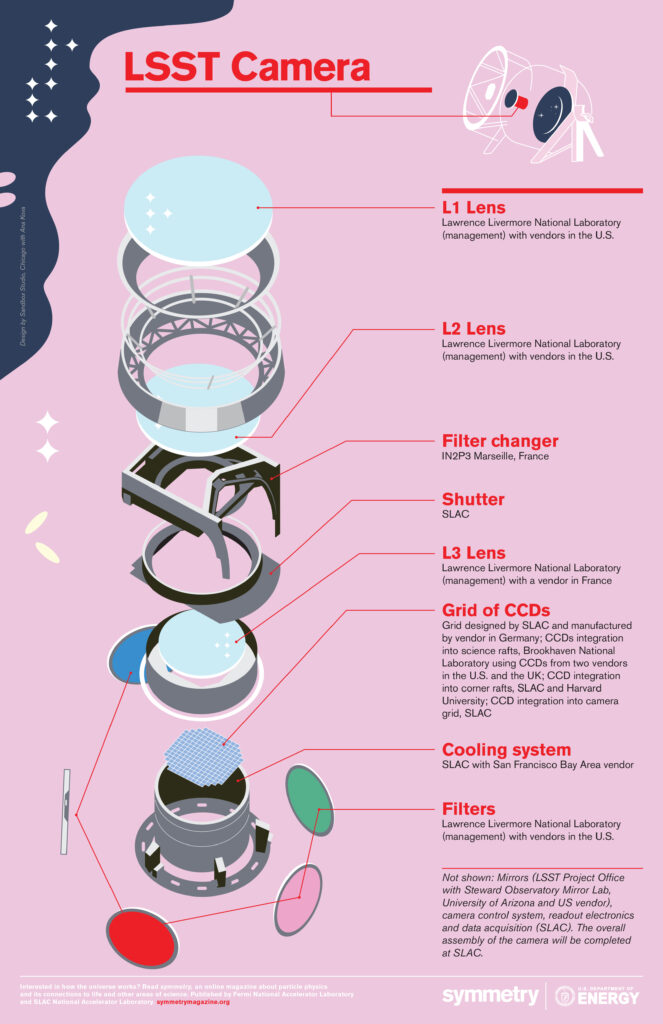
By mid-2021, the LSST Camera will be ready for final testing before being shipped off to Chile. The 3,200-megapixel images of vegetables were just the results of the sensors passing a crucial first test. They’re the tip of the iceberg of what’s to come.


