
Humanity has become almost as dependent on batteries as they have on electricity. We need them for our laptops, phones, cars, and even to store solar-generated power for electricity in our homes. The list goes on. And, as we transition to a decarbonized society, we will only rely on them more and more.
Lithium-ion batteries have been the dominant technology in this realm, but they are environmentally questionable, expensive, and hazardous as they can catch on fire sometimes. Therefore, the demand for better batteries to meet the future’s rising reliance on energy storage is only growing.
The challenge is bringing many new ideas to light, such as living batteries made from bacteria, renewable cells made from wood cellulose, solid-state batteries made with silver-carbon metal, seawater batteries, aqueous batteries, and even batteries made from oil, water, and starch. Now, there’s another kind to add to the list – potassium metal batteries. They are made by replacing the lithium cobalt oxide cathode and the graphite anode with potassium cobalt oxide. In other words, both electrodes are made of potassium metal.
Potassium is cheaper because it’s an abundant element, and it’s easier to work with, so manufacturing costs are also lower. As for safety, the researchers who developed this battery found a way to deal with the issue of flammability, so the risk of fire is negligible.
All batteries contain two electrodes that pass ions back and forth as they charge and discharge. In lithium and potassium batteries alike, there is the problem of dendrite formation – which are metal deposits (the lithium or the potassium) that accumulate on the anode. The metal doesn’t attach evenly but rather in the form of spiky branches. These protrusions eventually get long enough to pierce the insulating membrane that separates the anode from the cathode. When that happens, it causes the battery to short-circuit and heat up, which can cause fires. It also reduces the lifespan of the cell.
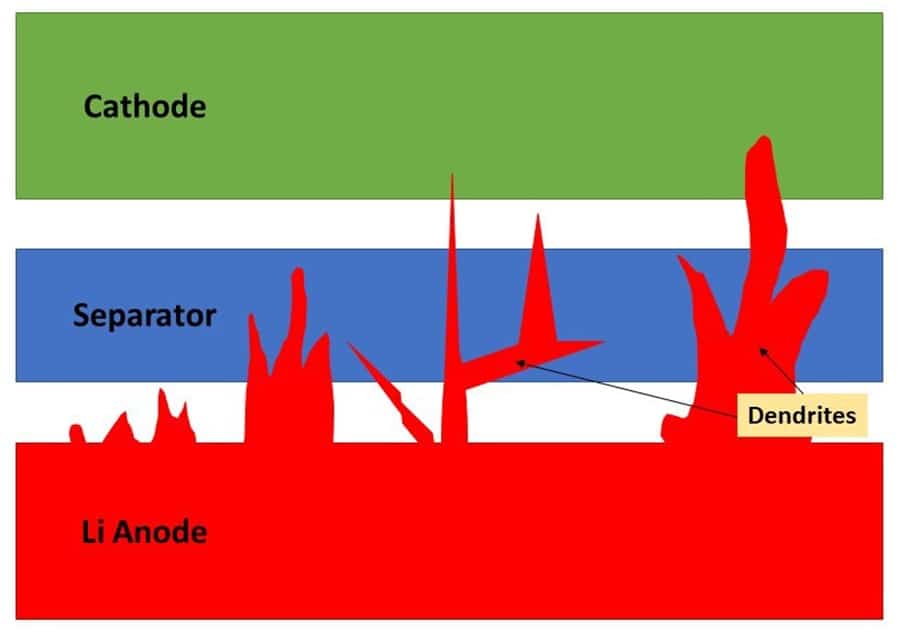
However, a team of Rensselaer Polytechnic Institute scientists has developed a self-healing technique that disperses the dendrites so they never get long enough to cause any damage. The cleaning process happens while you charge your battery. It essentially blast-charges and discharges at a high rate – producing just enough heat in the battery to activate surface diffusion but not melt the potassium.
Lead author of the study, Nikhil Koratkar, who is an endowed professor of mechanical, aerospace, and nuclear engineering at Rensselaer, said:
“With this approach, the idea is that at night or whenever you’re not using the battery, you would have a battery management system that would apply this local heat that would cause the dendrites to self-heal. [The process is comparable to] what happens to a pile of snow after a storm has ended. The wind and the sun help move the flakes off the mound of snow, shrinking its size and eventually flattening it out.”
The study’s findings are promising. Koratkar said:
“I want to see a paradigm shift to metal batteries. Metal batteries are the most efficient way to construct a battery; however, because of this dendrite problem they have not been feasible. With potassium, I’m more hopeful. In terms of performance, this could rival a traditional lithium-ion battery.”
In 2018, the same team of scientists demonstrated a similar self-healing capability for dendrites, but it required much higher temperatures. This new technique is much better, and using potassium metal instead of lithium could be more eco-friendly, efficient, and safer.


