
According to estimations from the International Agency for Research on Cancer, in 2018, there were approximately 9.5 million cancer deaths and 17 million new cancer cases worldwide.
In Germany, scientists have recently developed a new drug that acts like a “shredder” for proteins linked with causing cancer. In laboratory tests, the drug worked to kill the tumors on lab-grown cancer cells, suggesting a new method of treating the disease.
Aurora (Aurora-A kinase) is one of several proteins that, in higher-than-usual amounts, have been associated with an increased risk of cancer. Aurora is overexpressed in some prostate cancers, breast cancers, neuroblastomas, and leukemias, among others.
Worldwide, researchers have explored cancer treatment methods that involve restraining these “tumorigenic” proteins. However, drugs usually shut down the proteins without abolishing them, which may help fight the tumor but to a specific limit because it doesn’t stop the proteins’ functions entirely. These kinds of drugs haven’t yet proven effective enough to be considered a complete success in tests.
Scientists at the universities of Frankfurt and Würzburg, Stefan Knapp and Dr. Elmar Wolf, both primary authors of the recent study, played a lead role in developing this new promising drug. They published their findings on September 28 in the journal Nature Chemical Biology.
Stefan Knapp, a Pharmaceutical Chemistry Professor at Goethe University Frankfurt, said:
“Aurora-A kinase is present in much higher concentrations in many cancer tissues than in healthy tissue, and it also plays a key role in prostate cancer. Blocking the activity of Aurora-A kinase alone seems not a promising approach as none of the many clinically tested drug candidates has achieved clinical approval.”
In the study, the German team developed a class of experimental drugs, scientifically called PROTACs. They demonstrated how PROTACs completely degrade select proteins, with one of the substances proving very effective against Aurora-A kinase specifically.
Elmar Wolf, biochemist at the University of Würzburg, explained:
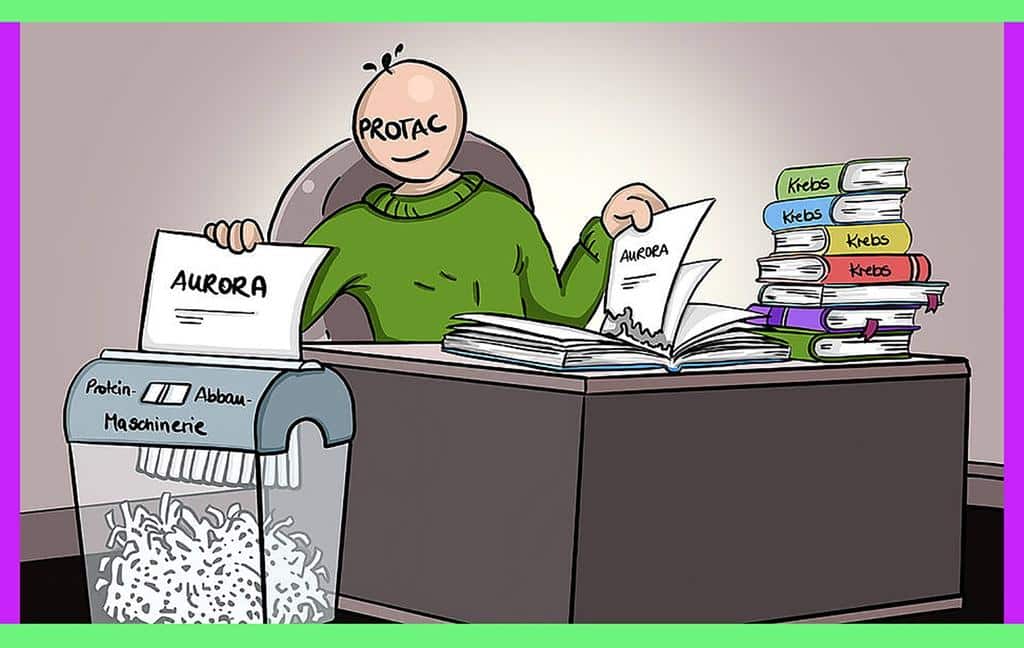
“The tumor needs certain tumor-promoting proteins, which we can imagine as the pages of a book. Our PROTAC substance tears out the ‘Aurora’ pages and destroys them with the help of the machinery that every cell has to degrade old and broken proteins.”
In experiments, the PROTAC worked to degrade the Aurora proteins of the tumors in lab-grown cancer cell lines, which resulted in cell death. While these results are hopeful, there is still a lot of work that needs to be done before considering human trials. For now, the team will test how effective the treatment might be on animals.


