
When you hear the word “recycling,” you may think instantly of a couple of things: paper, cardboard, or those artsy Facebook videos promising to teach you “15 Ways to Turn a Milk Jug into Home Décor!” On the other hand, what you may not instantly think of is cars. Yes, cars!
What happens to cars at the end of their lifetime? For most personal vehicles owned by Americans, they get recycled. According to this paper, produced by Argonne National Laboratory in 2010, between 10 and 15 million vehicles are recycled by Americans each year. And a good thing, too, because the automotive industry is one of the largest consumers of materials in the entire United States.
While the US Environmental Protection Agency states that four major components of vehicles—plastic, metal, rubber, and glass—accounted for only 30.2% of our national Municipal Solid Waste (MSW) in 2017, it is estimated by the Steel Recycling Institute that “nearly 100 percent of the out-of-service automobiles are collected for recycling.” That means that Americans are recycling their cars at higher and more consistent levels than almost any other consumer product. Even with these statistics so high, however, it’s still essential for car owners to understand why car recycling is so important for our economy, climate, and pocketbooks.
The Industry
Wikipedia defines Vehicle Recycling as:
The dismantling of vehicles for spare parts. At the end of their useful life, vehicles have value as a source of spare parts and this has created a vehicle dismantling industry.
This industry is “a vibrant and thriving part of the automotive supply chain” the Automotive Recyclers Association (ARA) reports. In the US alone, the car recycling industry represents more than $32 billion in sales annually. It also employs over 140,000 people at 9,000 locations nationally, making it the 16th largest industry in the country.
Organizations such as the ARA train employees to professionally dismantle and recycle End-of-Life Vehicle (ELV) byproducts. The crazy thing is that 80% of these ELV byproducts can be turned into something new, repurposed into the economy. The ARA, Institute of Scrap Recycling Industries, and Alliance of Automobile Manufacturers (AAM) partnered to create a report which highlights the ways which ELVs are recycled.
- “ELVs are recycled into new vehicles” – So many bits and pieces of ELVs become parts of new vehicles that consumers purchase! It’s estimated in that same report by members of the AAM, including Ford, General Motors, and Toyota, that “vehicles in North America are composed of approximately 20% post-consumer recycled material by weight.”
Recycled Auto parts also are essential in creating cost-effective resources for Collision Repairs. The ARA ensures that their acquired recycled parts offer value, quality, and environmental benefits. Recycled parts cost 20-80% less than new parts for broken vehicles, meet industry standards, and help preserve our natural resources and the environment by reducing air & water pollution.
- “ELVs are recycled into new consumer products” – Metal from recycled cars can be melted down and reused in everyday household items such as consumer batteries! Your flashlights, cameras, & remotes all could be powered by a repurposed pre-loved vehicle.
How are Cars Recycled?
I spoke with the SellMax in Los Angeles and they were able to give me the following information regarding the specifics of Car Recycling. The vast majority of car parts can be recycled, including:
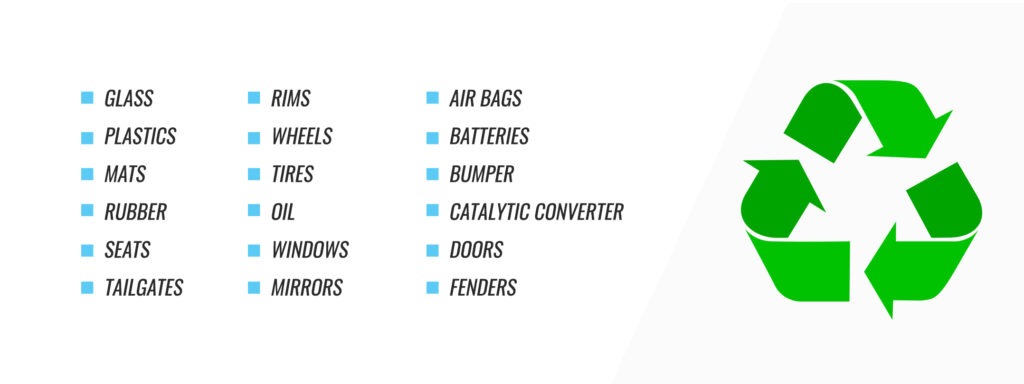
That is an insane amount of potentially reusable materials! Let’s go into a bit more detail.
“Auto recyclers remove parts such as engines, transmissions, doors and bumpers for reuse in other vehicles.” – Automotive Recycling Industry Report (ARI Report)
These parts often are evaluated for quality and then refurbished to be used in collision repair at lower prices.
“Batteries, catalytic converters, tires and some plastics are removed and their materials are recycled into new products.” – ARI Report
A whopping 99% of battery lead is recycled, making vehicle batteries the most recycled consumer product in the world. Old Lead-Acid batteries are broken apart into their various components to make new batteries, battery cases, and sodium sulfate.
Other ELV components like tires can be turned into new tires or garden beds, insulation blocks, playgrounds, shoes, and more.
“Fluids such as engine oil, coolant, and gasoline are carefully managed to prevent releases…prior to being reused…” – ARI Report
Recycling professionals have to be especially careful with fluids, as they have high contamination potential. SellMax informed me, however, that the ARA estimates that the industry responsibly collects and repurposes 100.8 million gallons of fuel, 24 million gallons of motor oil, 8 million gallons of coolant, and 45 million gallons of windshield washer fluid annually!
Finally, ELVs head to the shredding and separation facilities where the metal becomes new products, including new vehicles. And there you have it—a quick guide to car recycling! Now let’s dive into the benefits.
The Benefits
The Economy
As previously stated, the auto-recycling industry is an essential part of the economic supply chain. Responsible auto recyclers are constantly innovating their techniques to keep up with the changes made in the auto industry, providing hundreds of thousands of jobs while they’re at it.
The Climate
This one’s a doozy—according to the EPA and the National Institute of Health, recycling materials often uses far less water & energy. Let’s look at some stats:
- Used oil from a single oil change can contaminate up to 1 million gallons of fresh water
- One gallon of used motor oil produces the same 2.5 quarts of lubricating oil as 42 gallons of crude oil.
- Using scrap steel instead of virgin steel to make new steel uses 40% less water, 60% less energy, and creates 97% less mining waste.
Each of these facts means fewer pollutants & greenhouse gases in the environment.
The Cost
At the end of the day, recycling your vehicle at the end of its life means a little extra cash in your pocket and the pockets of your fellow vehicle owners. All while helping the environment. It’s a win-win all around.


