
A new bridge is being planned in Amsterdam, which will be constructed by robots that utilize 3D printing technology.
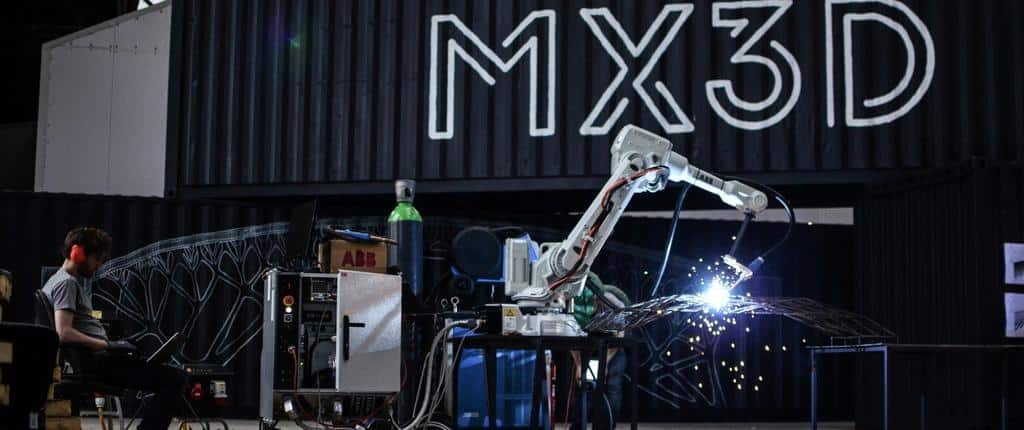
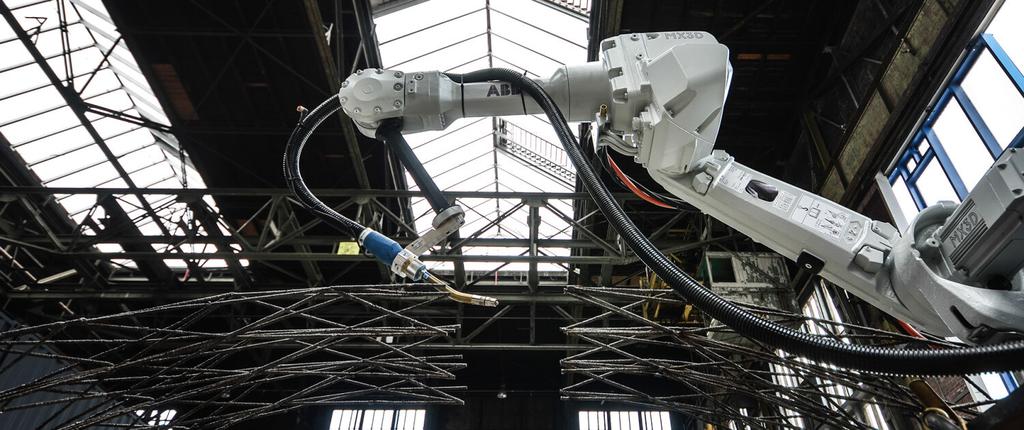
Dutch 3D printing R&D startup MX3D has invented a 3D printing technique whereby multi-axis industrial robots are able to print strong, complex structures anywhere without needing a print bed.
The 3D printing technique uses metal that melts and then solidifies within a second.
The steel bridge will be built in mid-air over a canal in Amsterdam, and surprisingly, it will not require support structures.
While printing, the robot will be supported by the bridge itself thanks to the geometry of the overall bridge design, the strength of the metal, and support from the edge of the canal. This allows the robot to print horizontally without falling into the water.
 “We start with a piece of metal attached to the canal bank. The robots start from one side of the canal; they print their own support structure, so essentially it prints its own bridge. It stands on the floor of the bridge, 3D prints out more and keeps moving,” MX3D’s CTO Tim Geurtjens told IBTimes UK.
“We have the same physics as everyone else, but it looks like it’s gravity-defying. We put a drop of metal, drop by drop at a time, and it solidifies. But you could also print tubes and then print layer over layer of tubes.”
 The 3D printed bridge project is a collaboration between MX3D, designer Joris Laarman, Autodesk, construction firm Heijmans, French welding specialists Air Liquide, and several other partners. The robotic arms used are provided by the robotics firm ABB.
There could be concerns about how strong the bridge will be, especially when compared with traditionally welded metal, but stress tests conducted by Delft University of Technology (TU Delft) proved MX3D’s 3D printed steel retains 90% of the strength of normal stainless steel.
Designer Joris Laarman said that the project was a “fantastic metaphor for connecting the technology of the future with the city’s historic past, in a way which would reveal the best aspects of both worlds.”
The design of the bridge is being developed using software MX3D developed, together with additional software by 3D modeling software firm Autodesk. The overall design of the bridge can be made to be much more efficient and feature a complex, ornate design that is as strong as a bridge built from stainless steel.
“Autodesk is working on a new topology optimisation software which goes further than most traditional optimisation software. It will take into account more parameters and constraints. If you incorporate those parameters into the design software, the whole process will be more efficient, and it makes the bridge stronger,” said Geurtjens.
 A visitor center will be opened in September so that people can learn about the project. The bridge will likely take two to three months to be printed. However, MX3D is still developing its software and working with its partners to ensure the final bridge design is as strong, safe, and efficient as possible. It’s estimated that the project will be completed by the end of 2017.
MX3D says the location of the bridge will be announced soon; however, discussions about where the bridge will be located are still ongoing with the City of Amsterdam. MX3D is aiming to place the bridge over an old canal near the city center.
 MX3D hopes to be able to print other materials in the future, such as concrete and ceramics, and perhaps even with multiple materials.
Geurtjens says MX3D’s software could change the future of robotics. He said:
“Our software translates CAD model software into welding strategies, and then translates that into the Rapid software used by ABB to tell the robot how to move.
In almost all cases, robots are used in industry, programmed to do repetitive tasks like paint the car or weld specific parts. You execute it for years and years in a row after programming it once.
Up until now with our project, no two pieces of information being related to the robots are ever the same, so everything we print is generative. This could change the future of robotics.”
How much it will change the future of robotics is unclear, but it’s certainly exciting. The idea of using fewer materials to build a stable bridge is a good one and is only one of many projects training machines to more efficiently handle construction and other tasks. Will robots be building our houses in the near future?

