
Entering a high-throughput medical laboratory today reveals a distinct, rhythmic pulse—the clinical heartbeat of modern science. This sound is the symphony of clinical lab automation, where sophisticated robotic systems now perform the intricate tasks once confined to manual labor. While the scenery has shifted from rows of technicians with manual pipettes to sleek, high-speed arrays, the core objective remains the same: the pursuit of clinical excellence and life-saving discovery.
Advancements in medical laboratory technology have redefined what is possible in patient care and scientific inquiry. These systems do not merely replicate human effort; they amplify it by removing the physical constraints of repetitive motion and fatigue. The integration of automated science research empowers institutions to process samples with unprecedented precision, ensuring every result serves as a reliable foundation for critical medical decision-making.
Modern labs are navigating a profound transformation as they balance the speed of machine output with the necessity of human oversight. This synergy allows for a more agile response to global health challenges, from rapid viral screening to the development of personalized therapies. The era of the ‘smart lab’ is not a distant vision but a current reality, fundamentally changing how we approach the mysteries of biology and the needs of patients worldwide.
Optimizing Liquid Handling: The End of the Pipetting Marathon
Repetitive manual tasks once dominated lab work. In the past, scientists spent entire days transferring tiny liquid samples, a tedious process that remained highly susceptible to human error. A shaky hand or a brief moment of distraction was often enough to ruin an entire experiment, compromising months of research.
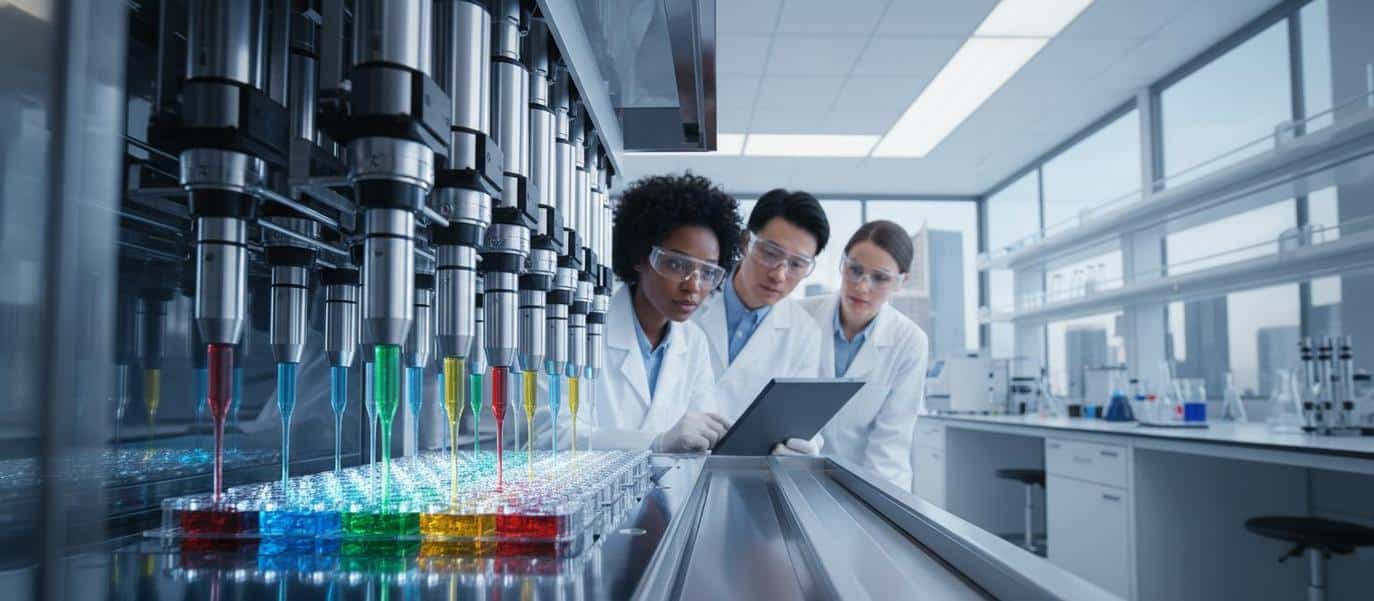
Now, we have the liquid handling system. Performing precise liquid transfers around the clock, these robots operate without fatigue to handle volumes smaller than a teardrop with unwavering consistency. By automating repetitive motions, these systems liberate researchers from the bench, allowing them to dedicate their expertise to high-level experimental design and data analysis.
Accelerating Drug Discovery Through Automated Screening
Drug discovery remains a massive search mission where scientists historically tested thousands of compounds in a painfully slow search for medicinal utility. Automation has revolutionized it. Robotic arms orchestrate complex, multi-stage workflows, seamlessly managing cell culture preparation and the introduction of drug compounds within a continuous analytical loop.
A system can screen tens of thousands of compounds in a single day. This rapid pace identifies promising leads faster than ever before. It accelerates the journey from idea to medicine.
Precision Clinical Lab Automation for Faster Diagnostics
When you are sick, waiting for results is stressful. In the clinical lab, automation delivers answers. From the moment a blood sample arrives, robots take over. The automated process begins by labeling the vial before centrifuging the sample and carefully aliquoting the serum for analysis. Sophisticated analyzers rapidly evaluate these samples to quantify vital health indicators, spanning from lipid profiles to acute infection markers. Transitioning to this automated model provides several critical advantages:
- Error Reduction: Minimized human handling significantly lowers the risk of processing mistakes.
- Standardized Workflows: Every sample follows an identical, rigorous path for total consistency.
- Enhanced Throughput: Seamless transitions between stages accelerate the delivery of results.
These improvements ensure that clinical laboratories maintain the highest standards of accuracy and speed. This means your doctor gets consistent, reliable results quickly. Faster diagnoses lead to faster treatment decisions.

Leveraging Bioinformatics Pipelines for Large-Scale Data Management
Modern experiments generate enormous amounts of data. A single run on a genetic sequencer generates data on such a massive scale that traditional manual analysis becomes functionally impossible, necessitating automated intervention. Automated bioinformatics pipelines are the answer. By processing raw data and aligning sequences, these software robots identify genetic variations and compare findings against global databases with superhuman speed. This automation finds patterns invisible to the human eye. It turns raw data into actionable knowledge. Scientists can then ask deeper questions about health and disease.
Navigating Automation Challenges
The transition toward comprehensive automation introduces a unique set of technical and economic complexities. High upfront costs for robotic systems often create a significant disparity between well-funded institutions and smaller laboratories. Furthermore, the necessity for specialized technical expertise requires staff to master the operation and maintenance of these complex machines. While a software error or a robotic jam can halt an entire facility’s operations, a more profound concern involves the potential loss of foundational skills among new scientists who may bypass the manual techniques that underpin automated workflows. Understanding the core principles remains vital.
The Human Touch Remains Central
It is vital to recognize that the laboratory is not evolving into a sterile robotic factory; rather, automation is assuming control over defined, repetitive tasks to augment human capability. Automation handles defined, repetitive tasks. It cannot replicate human curiosity and insight. While robots handle the repetitive mechanics of pipetting, human scientists remain responsible for designing experiments, interpreting complex datasets, and making the creative leaps that drive innovation. Automation is a powerful tool. It extends human capability. It does not replace the critical thinking that is the true engine of science.
The Future Lab is Integrated
The next step is total integration. We are moving toward the “smart lab.” Imagine different automated systems talking to each other. In this environment, a liquid handling system prepares a sample while a robotic arm transfers it to an incubator, followed by automated imaging systems capturing cellular changes. As data flows into a centralized digital platform, artificial intelligence software reviews the findings and may even autonomously suggest the parameters for the next experiment. This interconnected ecosystem catalyzes the discovery process, fostering an environment where scientific breakthroughs occur with unprecedented velocity. The automated lab is here. It is making science more powerful every day.

Future Horizons of Automated Science Research
The integration of advanced robotics into the laboratory environment marks a permanent shift toward high-velocity discovery and unwavering diagnostic accuracy. Delegating the most grueling and repetitive tasks to precision machinery allows the human mind to reclaim its rightful place at the center of innovation—focusing on analysis, strategy, and creative problem-solving.
This evolution ensures that the next generation of researchers will spend less time at the bench and more time at the forefront of breakthroughs that will shape the future of medicine. Advancing toward deeper integration will see the boundaries between physical hardware, analytical software, and biological inquiry dissolve into a unified research paradigm.
The automated lab provides a robust infrastructure where data flows seamlessly and insights are generated at an unprecedented scale. Far from sidelining the scientist, these tools empower professionals to reach further and think deeper, securing a future where medical challenges are met with the full force of human and mechanical intelligence combined.
Frequently Asked Questions About Lab Automation
What are the primary benefits of clinical lab automation?
Automated systems drastically reduce the risk of human error while increasing throughput and consistency in sample processing, leading to faster results.
How does a liquid handling system improve experimental accuracy?
Precision sensors and robotics dispense volumes smaller than a teardrop with perfect repeatability, eliminating the variations often caused by manual pipetting.
Will drug discovery automation replace human researchers?
No, automation handles massive search missions of compound screening, allowing human scientists to focus on experimental design and data interpretation.
What role does AI play in automated diagnostics?
AI identifies subtle patterns in complex datasets from analyzers, aiding in early disease detection and the optimization of personalized treatment plans.
How do bioinformatics pipelines manage large datasets?
Automated software processes and aligns massive digital files, such as genetic sequences, turning raw data into actionable medical knowledge within minutes.


