
Imagine having a security system of flying grasshoppers. That’s becoming a reality, thanks to Barani Raman and his Washington University in Missouri team. The team tapped into the olfactory senses of the American grasshopper to make biological bomb-sniffing grasshoppers, which could eventually be used for homeland security purposes.
Insects detect chemical odors in the air through olfactory receptor neurons in their antennae. These neurons send electrical signals to the antennal lobe found in the insect’s brain. Each grasshopper’s antenna has roughly 50,000 of these receptor neurons.
To test the grasshoppers’ bomb-sniffing abilities, the researchers implanted electrodes into the antennal lobes of grasshoppers. Then, they puffed vapors of explosive materials, including DNT and TNT, onto their antennas. As controls, they used non-explosives such as benzaldehyde (the main element in the oil of bitter almonds) and hot air.
The team found that the grasshoppers exposed to the explosives activated different groups of neurons in their antennas. They examined the electrical signals and could identify the non-explosive vapors apart from the explosives.
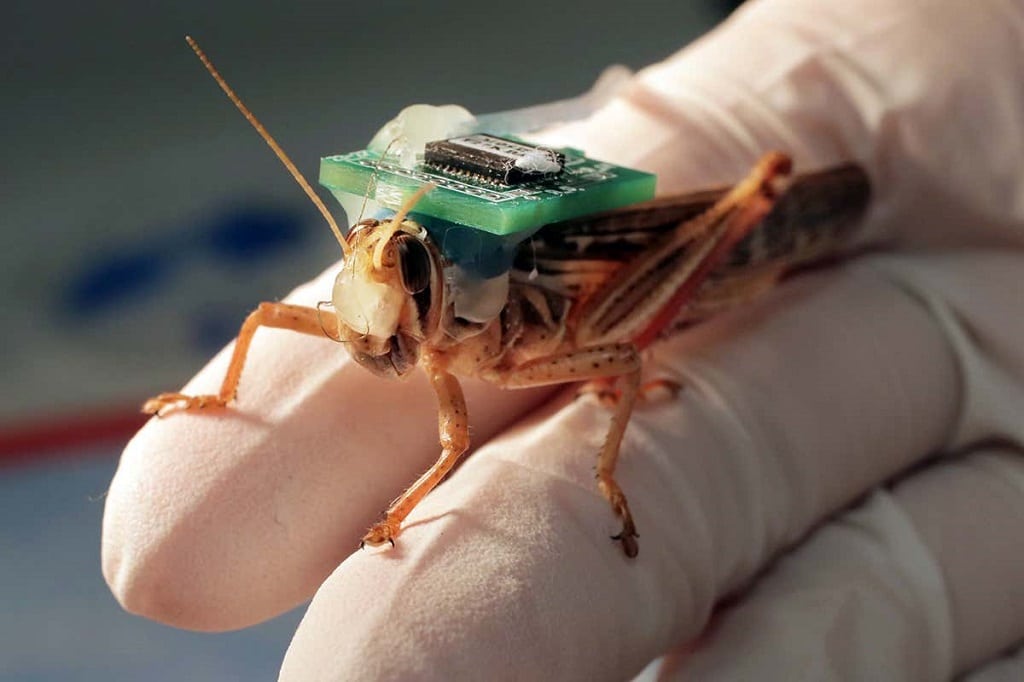
The grasshoppers were fitted with tiny, lightweight sensor backpacks that could instantly record and wirelessly transmit their antennal lobe’s electrical activity to a computer. From the moment the researchers implanted the electrodes, the grasshoppers successfully detected explosives for up to seven hours until they finally died.
The experiment immobilized the little grasshoppers, it was too much for them to handle. So, the team placed them on a wheeled, remote-controlled platform to examine their ability to sniff out explosives from different locations. When the researchers moved the platform to different areas, the grasshoppers were able to detect where the highest concentration of bombs was.
In the real world, chemicals may be dispersed by environmental factors such as wind. Therefore, the team also tested the effect of combining sensory information among multiple grasshopper bomb sniffers. They found that the neural activity from seven grasshoppers resulted in an 80% detection accuracy, compared with 60% for a single grasshopper.
The research, funded by the US Office of Naval Research, was limited because it didn’t test the grasshoppers’ bomb-sniffing abilities while various odors were present simultaneously.
More recently, scientists in Japan have created remote-controlled cyborg cockroaches that might one day be used for environmental monitoring or in search and rescue missions.


