
Chinese scientists defy the laws of physics with their newly developed thin strands of ice that can bend and curl, which they believe can be used to transmit light and detect air pollution.
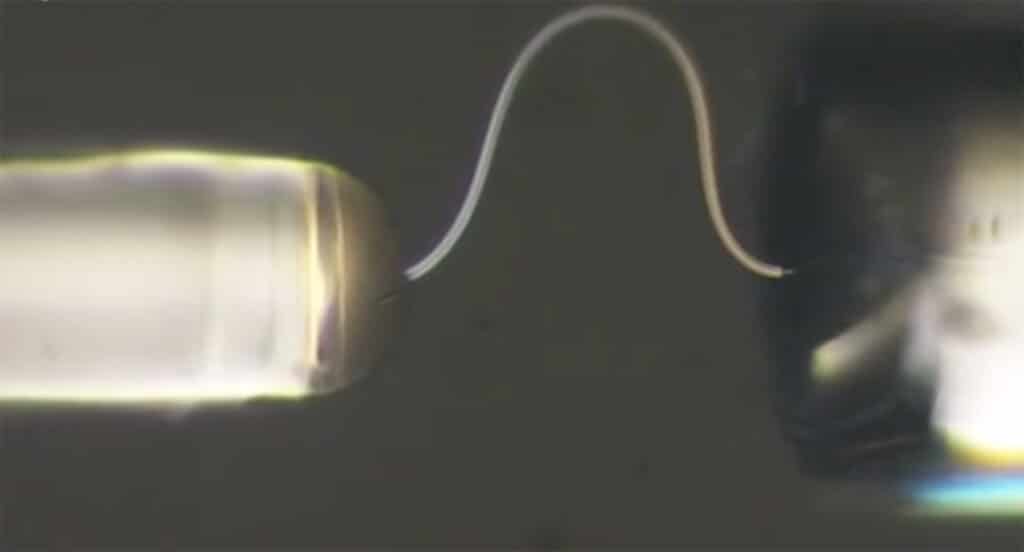
Ice is well known to be a rigid and brittle crystal that fractures when deformed. However, instead of being fragile and breaking under pressure, this novel ice – described as “elastic ice microfibers” – bends like a noddle! See for yourself in the video below:
How Did The Scientists Create Bendable Ice?
The team began by transferring water vapor into a small circular chamber in a 3-D printer. Then, they cooled the space within the chamber to -58°F, using liquid nitrogen. Next, they placed a tungsten needle inside of the chamber and electrified it to 2,000 volts.
That voltage produced an electrical field, which attracted the water molecules present in the air to the needle. After settling on the pin, rodlike ice microfibers slowly grew from the tip of the needle at a rate of around a hundredth of an inch per second.
While the microfibers didn’t grow very long (they could hardly be seen with the naked eye), high-resolution imaging unveiled that they were single crystals, meaning the atoms within them are arranged in repeating patterns. “The atoms are ordered like honeycombs,” Dr. Tong noted.
The team altered the chamber’s temperature between -70 to -238°F, causing the microfibers to become incredibly flexible at the coldest temperatures. They published the study in the journal Science.
To demonstrate the microfibers’ flexibility, Dr. Tong and his colleagues used microscopic tools to push on the microfibers. They proved that the ice could bend like a cooked noodle into almost complete circles before returning, undamaged, unchanged, to its original rodlike shape. “There was no permanent deformation,” confirmed Dr. Schulson, who wrote a perspective article that accompanied the study.
Possible Applications
The scientists found that the microfibers can effectively transmit light, similar to fiber optic cables that enable fast internet communications. When the team sent visible light into one end of the microfibers, more than 99% emerged at the other end! “They can guide light from one side to the other,” physicist Limin Tong, from China’s Zhejiang University, who was a part of the team that created the ice, told the New York Times.
A mix of fiber-optic cables and laser pulses was demonstrated earlier this year by researchers from the University of Cambridge. They used fiber optics to map ice sheet temperatures in unprecedented detail, from the very top of the Greenland Ice Sheet to the very bottom. These exact temperature readings offered a clearer image of the changes occurring throughout Earth’s second-largest ice sheet.
Since particles associated with pollution – such as soot and metals – often stick to pieces of ice, Tong and his colleagues believe that the microfibers could also be used to create sensors that detect air pollution. When such particles cling to ice in the atmosphere, they change how it absorbs and reflects light. These sensors would allow the scientists to study how light spreads through the microfiber to gather insights on the quantity and type of pollution in a particular area.
The study concluded:
The discovery of these flexible ice fibers opens opportunities for exploring ice physics and ice-related technology on micro-and nanometer scales.
If this device could detect the amount and type of air pollution in a region, people could be warned of high-risk zones and avoid them. A wave of studies has previously been published, revealing that air pollution is much worse for us than we had previously imagined.
Among many health problems, air pollution is linked to an increased risk of painful menstruation cycles, adverse pregnancy outcomes, blindness, adolescent psychotic experiences, anxiety, depression, Dementia, schizophrenia, higher COVID-19 death rates, a shorter life expectancy, reduced productivity, and so much more.
In addition, the University of California, Davis, found that traffic-related air pollution is connected to a risk for alterations in brain development that might cause neurodevelopmental disorders, such as mental retardation, dyslexia, and attention deficit hyperactivity disorder.
Regardless, even if there ends up being no direct application for this fantastic discovery, it’s still exciting to see what scientists can do with frozen water. Overall, it’s a fascinating development that proves that the world of physical science can continue to push limits and surprise us in unique ways.


