
It is well known that insects like bees assist plant reproduction by transporting pollen from one plant to another. However, recent research has revealed that red algae and tiny crustaceans form a similar arrangement in the sea.
As a crucial food source for humans and marine life, crustaceans play a significant role in the ecosystem. More giant crustaceans can serve as a food supply for large aquatic mammals, while smaller crustaceans can recycle nutrients as filter feeders. A new study found that the crustaceans improve red algae’s reproduction rate by moving the sperm from the male to the female algae.
The Study
The study was led by population geneticist Myriam Valero of the Centre National de la Recherche Scientifique (CNRS) and PhD student Emma Lavaut of the Sorbonne University in France. They worked partially from Sorbonne’s Roscoff Marine Station, alongside their institutions and Chile’s Austral University associates.

The researchers examined a type of red algae called Gracilaria gracilis and marine isopods (tiny crustaceans) known as idoteas (specifically Idotea balthica).
Until recently, researchers thought that the algae, neither plants nor animals, benefited from underwater currents that transported gametes (reproductive cells) from one type of algae to another. However, male algal gametes are incapable of swimming on their own because they lack flagella that are similar to those in sperm.
Crustaceans Foraging Algae
The scientists learned through tests and field observations that the idoteas play a supportive role. For example, it was discovered that as crustaceans scavenge on male G. gracilis algae, the spermatia, or male gametes, which are produced by structures that dot the alga’s surface, attach to the animals’ cuticles in a sticky, mucilage-coated state.
Some spermatia are transported to the female alga’s reproductive organ when the same idoteas settle on it, completing the fertilization process. The algae also benefit the idoteas since it protects them from the environment and has microscopic critters on its surface that they may consume.
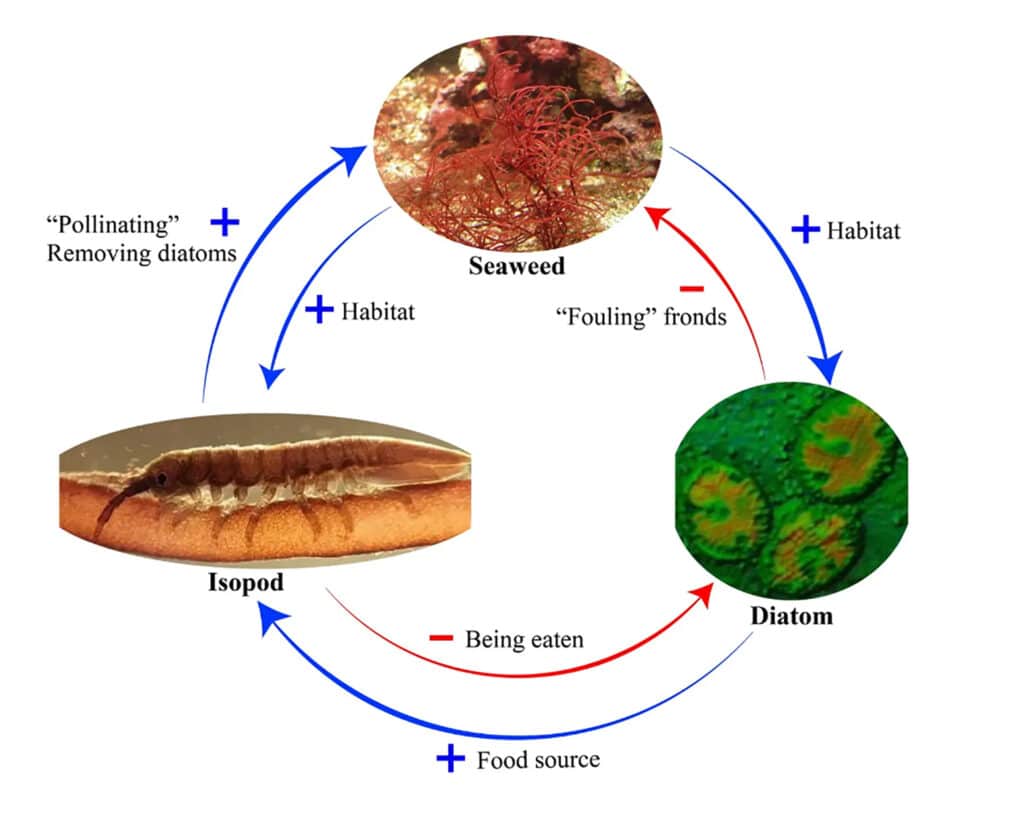
Since underwater currents undoubtedly play a significant role, it is still unclear what percentage of gamete distribution is carried out by crustaceans. Nevertheless, the research does provide evidence that plant pollination by insects may have developed from a process that started in the water. A paper on the study was published on July 28, 2022, in Science.
Crustaceans At Risk
Unfortunately, crustaceans may be threatened by accumulated pollutants made by humans. A previous study, published in Nature Ecology and Evolution, discovered pollution-poisoned crustaceans in the Mariana Trench.
The team examined various species of tiny foraging crustaceans called amphipods that were collected between 7,000 and 10,500 meters below the surface of the Mariana and the Kermadec trenches in the western Pacific. The researchers found that these animals were rich in two types of persistent organic pollutants (POPs), regardless of depth, species, or trench.
POP exposure can decrease reproductive success and consequently population expansion in organisms found in shallower waters. Although it is challenging to investigate deeper animals alive in a controlled environment, we can presume that contaminants have a similar impact. Although there were notable differences between the trenches and the types of pollutants, the critical finding is that some of Earth’s most extreme and remote locations have a significant human footprint.
These pollutants in the deep sea are particularly problematic because they are naturally hydrophobic or attracted to things other than water. This includes tiny flakes of larger corpses known as “marine snow” that descend through the ocean and provide most of the energy for the deep sea. As a result, the primary mechanism for supplying food to vast depths also serves as a very effective means of delivering pollution.
Thankfully, POPs were banned by the 2001 Stockholm Convention once people realized these chemicals were an awful contribution to the world. But apparently, it may still be lingering in the deep sea.


