
In 2014, a landslide carved out a significant gap in the forest of China’s Hainan Island, damaging an arboreal highway, a favored route through the trees that Hainan gibbons use to cross the rainforest. Researchers noticed that as the apes leaped from tree to tree, this gap prevented them from jumping to the other side; so, they decided to build a safe route.
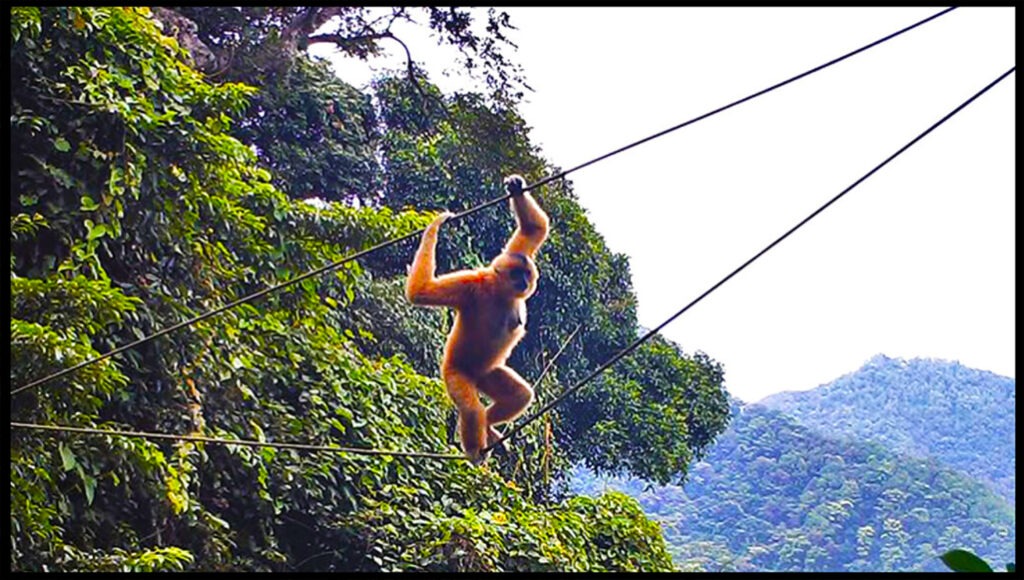
The team installed a bridge made of two thick ropes across the 15-meter gap. At first, the gibbons were slow to adopt this new route, but they began to explore the bridge and use it for traveling after time. These findings suggest that such roped bridges could help re-connect fragmented forests and aid conservation efforts of tree-dwellers.

According to conservation biologist Bosco Pui Lok Chan, from Hong Kong’s Kadoorie Farm & Botanic Garden, Hainan gibbons are almost exclusively tree-living, and forest fragmentation can divide the already critically endangered primates into reduced breeding populations. This can ultimately lead to local groups dying out or inbreeding.
In 1970, the species had a population of less than ten. Conservationists have worked hard to save the Hainan gibbons (Nomascus hainanus), and now the population is around thirty, all of which live in a nature reserve on Hainan Island.
In a study published on October 15 in Scientific Reports, a team monitored a group of nine gibbons after installing the bridge, as they didn’t want the animals to get hurt crossing the gap. After around 176 days, the gibbons finally caught on; cameras captured the gibbon’s first steps onto the ropes. “I was very excited when the gibbons first started using it,” Chan recalled.


Over time, the gibbons crossed the bridge almost as frequently as the primates had traveled that section of the forest before the landslide. Females and juveniles favorably used the bridge, while nearly grown juveniles rarely used it, and adult males never did.
The gibbons preferred to walk on the bridge as though on a tightrope, using one rope as a handrail, instead of swinging along under it using both arms. Occasionally, they climbed along the ropes using all their limbs, while some daredevils would dash across without holding on with their upper limbs.
This bridge offers a temporary safe solution until transplants of native trees grow, and other trees are restored. Primates are not the only animals that can benefit from such a bridge. Other animals have already started crossing the bridge, including two squirrels and a rodent.


